My article on the story of Aru Sultan, the young Kazakh woman brought back to England from Central Asia by the Elizabethan merchant adventurer Anthony Jenkinson in 1560 has now been published by Qalam magazine. You can find a copy here.
Qalam is a multi-media project founded by Timur Turlov, a successful Kazakh entrepreneur and financial expert and founder and owner of the publicly traded company Freedom Holding Corp. Timur Turlov invests in IT startups in Kazakhstan, actively supports a number of charitable and social projects in the humanitarian, public and sports spheres. Since January 2023, he has been head of the Kazakhstan Chess Federation.
Literature about the southern Siberian territory of Tuva, just to the north of Mongolia, is not easy to come by. The Austrian Otto Mänchen-Helfen, an expert on the Huns, is one of the very few authors who have written with authority on the culture of the Tuvans. He was the first non-Russian to visit the region – whilst he was teaching at the Marx-Engels Institute in Moscow in the late 1920s. His book Journey to Tuva,[i] first translated in 1992, remains a classic.
A horseman carrying a sheep in the Western Sayan mountains of Tuva (author’s photo).
The English traveller and author Douglas Carruthers, who travelled through north-western Mongolia, Djungaria and Tuva in the years before the First World War, and who wrote the impressive two-volume Unknown Mongolia,[ii] was another of this rare breed. Otherwise, there is little. Ralph Leighton’s Tuva or Bust! Richard Feynman’s last Journey, for example, is about the famous mathematician’s desire to visit Tuva (never accomplished), rather than the country itself.
Thus it was a pleasure to come across a 2023 essay in English about the Khakassian scholar and Turkologist Nikolaj Fedorovich Katanov (1862-1922), who was the first person to study the language and culture of the Tuvans.[iii] The Russian researchers who have uncovered his story have had to search through archives in Kazan, Moscow, St Petersburg and various non-Russian institutions to gather material.[iv]
Katanov was a professor at Kazan University where his research into the languages of southern Siberia was ground-breaking. His expedition to the region in 1889-1892 to study languages and ethnography was financed by the Russian Geographical Society, the St Petersburg Academy of Sciences and the Ministry of Public Education. It resulted in his A Study of the Uriankhai Language. Sadly, a comprehensive report on the expedition was never published, although a selection of the hundreds of folk tales he collected was published in 1907.
Without a detailed final report, the best source of the author’s work is his diaries. The first of these, which covers the first stage of the journey to Tuva, was only published in (in Russian) 2011. Another diary that describes Katanov’s stay in Khakassia and his first trip to Semirechiye and Tarbagatai (now both in Kazakhstan) and Xinjiang in 1890 was only published in 2017. Other diaries, so far unresearched, lie in the state archives of the Republic of Tatarstan. The diaries for his winter expedition to Hami and Turfan in Xinjiang have not survived. There is also a question about the location of the photo archive taken by the photographers Vasiliev and Tolshin during the expeditions, which does not seem to have been found to date.
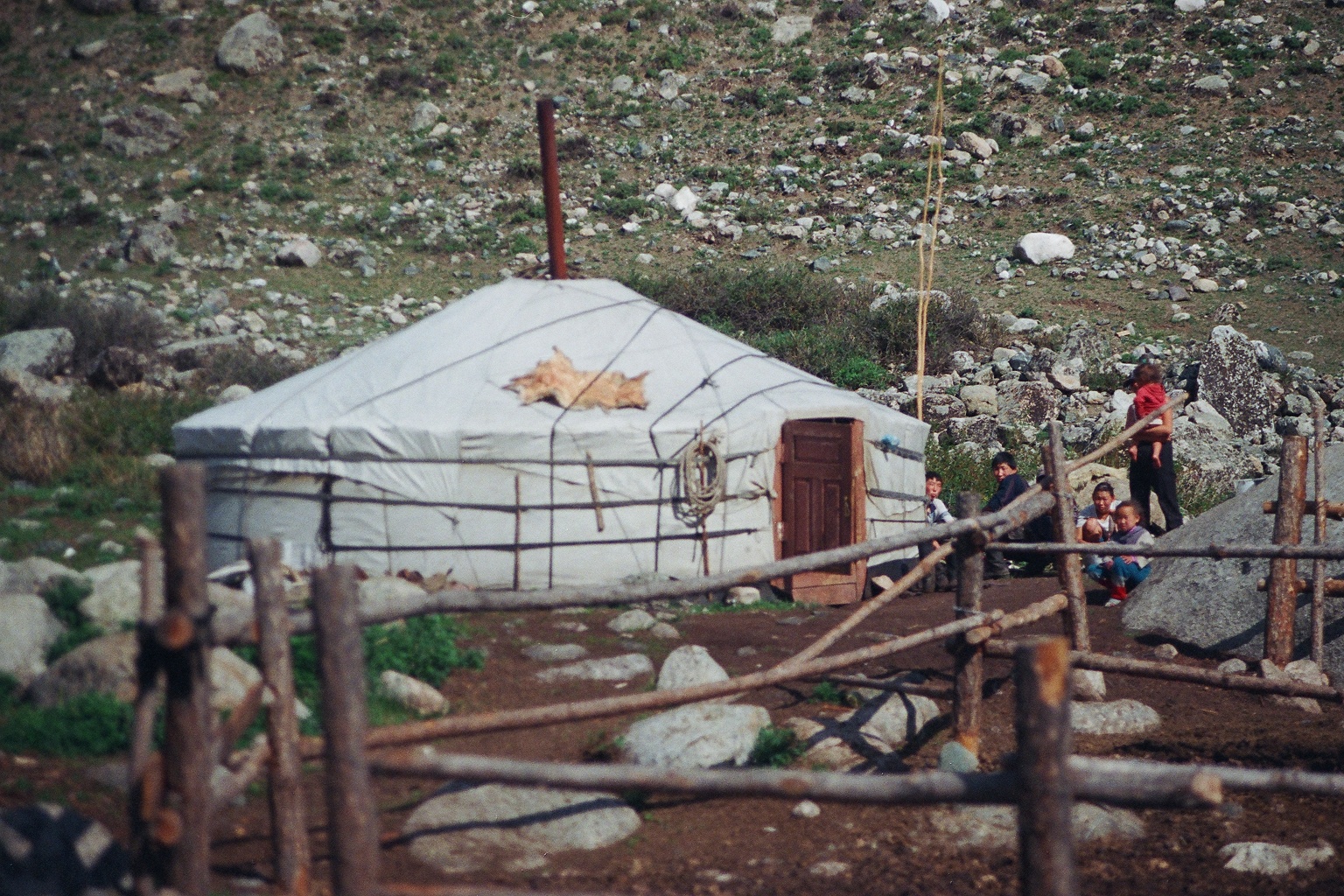
Typical yurt in the Western Sayan Mountains of Tuva (author’s photo)
In the St Petersburg archives of the Russian Geographic Society there is a “A Letter with a Brief Overview of the Trip to the Semirechensk Region in 1891-1893’ and several other documents.[v] Other documents were published later in Germany and America, including Folk Texts of East Turkestan from the Legacy of N F Katanov, published in East Germany in 1973.
Many of Katanov’s letters did survive and these now provide more details of his life and work, although they have not yet been collected and published, with a few exceptions, including those to the Russian Academician V V Radlov, who was deeply impressed by their content. The authors of this paper say that in the coming years all Katanov’s letters to St Petersburg Orientalists will be published as part of a project to publish the lifetime work of this pioneering author, who has been largely forgotten because of the policies brought in by the Soviets that resulted in the widespread destruction of Turkic culture during the Stalin years.
[i] Mänchen-Helfen, Otto, Journey to Tuva, Ethnographics Press, Los Angeles, 1992.
[ii] Carruthers, Douglas, Unknown Mongolia: A Record of Travel and Exploration in North-West Mongolia and Dzungaria (2 vols), Hutchinson & Co, London, 1913.
[iii] Valeev, Ramil M et al, ‘The Heritage of NF Katanov and the Prospects of its Study: Diaries and materials of his Travel to Siberia and Xinjiang (1889-1892),’ Written Monuments of the Orient, Vol 9, No 1 (17), 2023, pp36-49. DOI: 10.55512/wmo465708
[iv] The only work in English that touches on some of the same areas is Gold Khan, (trans. By Norman Cohn, Secker and Warburg, London, 1946). This is a series of heroic legends from the Koibal, Katchin and Sagai tribes of Khakassia (to the north of Tuva) collected in the mid-19th century by a group of philologists travelling in the Minusinsk District.
[v]Archive of the Russian Geographical Society, Category 87, Op 1, No 15, 2l.


 Siberian Steppes