For the last 14 months of his life Thomas Atkinson was seriously ill and almost unable to work. He continued as best he could to complete his final book, Travels in the Regions of the Upper and Lower Amoor, but to all intents and purposes he was housebound, unable to travel much. A final visit to his birthplace at Cawthorne in Yorkshire in the autumn of 1860 was one of the last journeys he made. He spoke about his travels at a meeting in the village on the 1st November, where no doubt he took the time to visit his mother’s grave in the churchyard, the headstone of which he had carved himself many years before.

He also met up again with the Spencer Stanhope family and stayed for a few days at Cannon Hall from where he visited Sprotborough, the home of Sir Joseph Copley and also Wentworth House, where he was guest of Earl Fitzwilliam, and says Lucy in a letter, “the lion of the evening”. The Reverend Charles Spencer Stanhope, who was a particular friend and had encouraged and supported Thomas in the early days when he was starting out on the road to becoming an architect, was also present.
But what happened after Thomas died in August 1861 at Walmer in Kent? What became of Lucy and their son Alatau? The full story is not yet clear, but there are a few clues. This article will explain Lucy’s predicament and how she survived the various storms that broke over her during those first few years following her husband’s death.
The first – and most profound – shock for Lucy following Thomas’ death came when she was informed that her husband already had a wife who was alive and well in Chelsea, London and seeking his estate. So shocked was Lucy that at first she could not believe it was true. In fact, Thomas had married Rebecca Mercer, from Halifax, in April 1819 whilst he worked at the quarries in the town. They had three children – Martha, John and Emma – and lived together until the late 1830s.
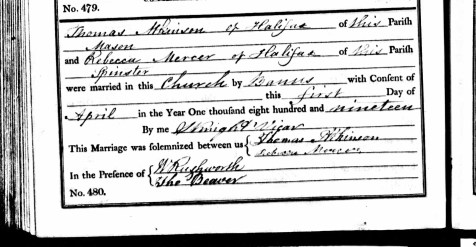
Details of the circumstances leading to their separation are unknown, but it is possible that she and Thomas parted following Thomas’s bankruptcy in the late 1830s. According to an entry in the 1901 Dictionary of National Biography: “He remained at Manchester until 1840, after experiencing some reverses, owing probably to a too liberal expenditure on works of art.”
Evidence for their separation is limited, but the 1841 Census shows Thomas living in Chorlton cum Hardy, Manchester with his daughter Emma, but provides no clear evidence of his wife Rebecca or their son John. Their other daughter, Martha, had married the previous year and was living locally with her new husband James Wheeler. There is a ‘Mrs Atkinson’ living nearby in Chorlton on Medlock. Her occupation is given as washerwoman, but although she is the right age, we cannot be sure it is Thomas’ wife. If it is, she had clearly fallen on hard times. For some of his bankruptcy hearings and as correspondence addresses for his watercolour exhibition entries to the Royal Academy and elsewhere in the period 1839-40, Thomas gives locations in London.
At some point in the 1840s Rebecca moved to Chelsea, possibly after Thomas had set out for India in the early 1840s. She is recorded there in the 1851 Census, living as an annuitant, along with several other women, in a boarding house in Beaufort Street run by a Mrs Palmer and her two spinster daughters. In fact, she stayed there until she died in 1872. She may have been following her daughter, Martha, who had married solicitor James Wheeler in July 1840 and moved to London from Chorlton sometime before 1847, when her third child had been born in Pimlico, London. Wheeler’s business – he became a leading lawyer specialising in railway company law – took off and he was soon a very rich man.
On his return from his Indian trip, in 1842 or 1843, Thomas moved to Hamburg to work as a jobbing architect, taking with him their son, John, who was probably suffering from TB. They stayed in Hamburg until John died on 3rd April 1846 at the young age of 22. His death was noted by the Manchester press, which stated he had died after a four-year illness and that he has shown promise as an artist: “His talents were various: as a marine painter they would have been great, as shewn by his sketches, one of which, the Phantom Ships, is of a very high order.” Sadly, the sketches are lost.
Soon after, having decided to give up his work as an architect and become an artist, Thomas left Hamburg for good, first for Berlin and then for Russia, where he stayed for the following 12 years. It seems reasonable to assume that his marriage to Rebecca had effectively ended some years before. Rebecca’s annuity may be evidence that he set up a fund for her, although evidence is scant. In his diary for 1847 there is a note that states “Ordered Mr Wheeler to pay £24 into Coutts Bank for Mr Drury”. The diary also lists the business address for James Wheeler. Of course, such payments could have been a leftover from his bankruptcy, but there is just a chance that they were connected to Rebecca’s annuity. Either way it shows that he was in touch with Wheeler, even when he was in Russia.
We don’t know if there was any direct contact between Rebecca and Thomas in the intervening years. They never divorced and so when in 1848 Thomas married Lucy, in strictly legal terms it was a bigamous marriage. However, he had been living abroad by this point for at least six or seven years and bearing in mind the extraordinary difficulties of obtaining a divorce in Victorian England, it does not, in my consideration at least, appear to be such a serious crime. That, of course, is not the way it would have seemed at the time, when bigamy was punishable by up to five years in prison.
Thomas’ failure to tell Lucy about the marriage was more serious. It certainly affected the way he wrote his books, as he could hardly mention the fact that he was accompanied by a new wife – and child – for most of his travels. Only when Lucy published her own account of their travels, in 1863, do we hear anything about her part in their remarkable six-year journey. Nor could Thomas travel with Lucy without marrying her, even in Russia. In the circumstances, he chose to marry Lucy and tell her nothing, a secret he kept until he died. Hence Lucy’s disbelief when confronted by Rebecca’s claims for Thomas’ estate after he died.
Although there was not much in Thomas’ estate – it was listed at “under £300” in October 1861 shortly after his death and then resworn as “under £20” in March 1863 – Rebecca successfully claimed it all, relying on the legal skills of her solicitor son-in-law James Wheeler, one of the most prominent lawyers in London and himself a very wealthy man by this time.
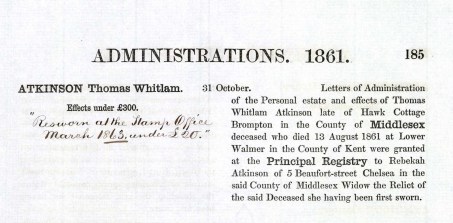
Wheeler was very diligent in seeking to obtain anything he thought was Thomas’ and appears to have launched a relentless campaign against Lucy, suggesting that she and Thomas had never married. In doing so, of course, he was also defending the reputation of his mother-in-law, who would have been scandalised by the fact that her husband was a bigamist.
We know about James Wheeler’s actions because in May 1862 Lucy replied to a letter written by Lord Ashburton – now lost – to explain what had been happening. Ashburton was president of the Royal Geographical Society from 1860-64 and had known Thomas and bought some of his paintings. She wrote:
“I am well aware and have also made acquainted those who had interested themselves in me, that the son-in-law of my husband had made statements to the effect that there is another wife, besides myself living, and further, he has taken out letters of administration – all my solicitor demands is proof that there is such a person existing, in the absence of which I am his legal wife and act as such. We are doing our utmost to bring this unfortunate affair to an issue. My friends, the gentlemen to whom we are indebted, are now going to sue Mr Wheeler. They are doing this not so much for their own benefit as to obtain justice for me.”
So even nine months after Thomas’ death Lucy still found it hard to believe that Thomas had a previous wife who was still alive. Her ‘friends’, by whom she meant the great geographer Sir Roderick Murchison, the publisher John Murray, Lord Ripon, the scientist Francis Galton and the scientist and publisher William Spottiswoode, were even considering suing Wheeler for libel.
As Lucy explained: “Mr Wheeler has written to all the principal persons at the Geographical and though not in direct terms still has worded his communications in many instances so as to lead them to conclude I had been living in an improper way with Mr Atkinson. Having done so, it is just possible he may have written to your Lordship. The way Mr Wheeler has attacked my character is the more despicable and cowardly as I told him whence he (my husband) had married me. The manly way would have been to attack the culprit if such there was, and not the poor victim.”
The reason that Lucy had written to Lord Ashburton was in reply to a query she had received from him in connection with the paintings he had bought from Thomas and which were hanging in his residence at Bath House, Piccadilly. Having no doubt heard from James Wheeler, he was unsure if he had title, as he had bought them from Lucy. She reassured him that the paintings had been given to her by Thomas “some years hence” and that therefore she had been entitled to sell them. It was not the only challenge concerning the ownership of Thomas’ paintings; a few weeks after Lucy wrote to Lord Ashburton a posthumous sale of Thomas’ paintings at Christie’s, due to be held on 16th June 1862, was cancelled on the morning of the sale, presumably because there was a dispute over ownership.
Lucy explained to Lord Ashburton that she had not benefited in any way from Thomas’ estate:
“All my husband’s property I have delivered over to the principal creditors, but as I fear those will not arise sufficient funds to liquidate the debts, I am endeavouring with my feeble efforts to make the wherewithal to do so, and if I am successful it will be the proudest day of my existence.”
Still sceptical about whether or not Rebecca was alive, Lucy was clearly loyal to her deceased husband’s memory, as this extract from the letter makes clear:
“Should this man (Wheeler-ed) be able to prove (which I doubt) that the first wife is living, still I look upon myself as the one entitled to pay my husband’s debts and clear his memory. In the sight of God I am his wife and I have to the best of my ability acted the part of one to him. I never deserted him for an instant either in sickness or in poverty, and I have followed him through danger which many a man would have shuddered to encounter, and he has ever been to me a good husband, during a period of 14 years that I have been married to him.”
Considering the circumstances, it is a remarkable letter. Hounded by creditors and a powerful solicitor acting for a former wife, she is strong and determined and still faithful to Thomas.
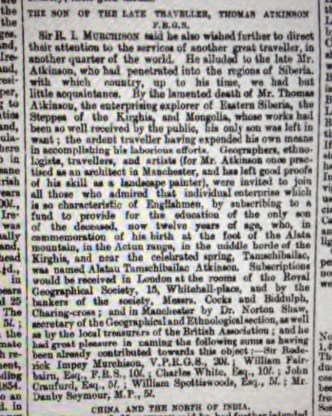
But the fact remains that Lucy was by this point almost destitute. The £500 she had inherited from her uncle, Joseph Sherrard, in 1837 (see previous blog below), appears to have gone by this point, and she had no other source of income. An appeal to members of the Royal Geographical Society, launched by Sir Roderick Murchison in September 1861, had raised several hundred pounds to pay for Thomas and Lucy’s son, Alatau Tamchiboulac Atkinson, to be educated at Rugby School, although he did not actually attend the school until August 1864.
Lucy had also started work on her book, Recollections of Tartar Steppes. Although not published until 1863, a letter she wrote to her publisher John Murray and dated 23rd January 1862 survives in the Scottish National Archives. We don’t know when a contract was agreed, but the letter makes clear that she had already sent him some draft chapters, written in the form of letters to a friend. She had waited anxiously for a reply: “To speak frankly, your letter lay some short time on my table ere I dared to open it, to know my fate. In the style I have sent you I can write more letters, equally, if not more interesting. I so feared you would say they were trash.”
Murray had asked her specifically to write more about the Siberian exiles, those men who had been banished to Siberia following the unsuccessful Decembrist Uprising against Tsar Nicholas I in 1825: “As regards the Exiles I presume you would like me just to tell how I found them. You must know I was received by them all as a sister, I having lived in the Mouravioff family during eight years. When I entered the houses of Mouravioff and Iakooshkin (Mattvei Muravyev and Ivan Yakushkin, two of the exiles-ed) and mentioned my maiden name, I was immediately recognised. I was always considered part of the family. Others of the exiles with whom I had no acquaintance received me with open arms so soon as I said where I had been living. The name acted as a talisman.”

But a small book advance, whenever it arrived, was not going to be enough to keep her and Alatau. Lucy therefore decided to seek funding from various other institutions. In March 1862 she approached the Royal Literary Fund for help. Founded in 1790 and supported entirely by donations, over the years the Fund has helped thousands of writers and their dependants who have fallen on hard times, including such prominent names as Samuel Taylor Coleridge, Thomas Love Peacock, James Hogg, Leigh Hunt, Thomas Hood, Richard Jefferies, Joseph Conrad, D. H. Lawrence, James Joyce, Ivy Compton-Burnett, Mervyn Peake and Dylan Thomas.
Lucy’s application letter, preserved in the archives of the Fund at the British Library, is both fascinating and very moving. Fascinating because it settles once and for all the birth date for Thomas – in her own hand she writes 6th March 1799 – and moving because it also reveals the extent of Thomas’ illness in the last year or so of his life. “My Lords and Gentlemen”, she began:
“I should not have applied for relief from this fund but for the death of my husband, the late Thomas Witlam Atkinson, owing to which circumstances I am left with an only son, totally unprovided for, he having expended the whole of his own means during his researches in Siberia, Mongolia and Chinese Tartary, whither, after our marriage in Moscow in 1848, I accompanied him over a period of six years. It was during our wanderings in Chinese Tartary that our only son was born under peculiarly difficult and trying circumstances.
This journey was performed without the aid of any society whatever and entirely at his own cost.
For fourteen months before his death my husband was quite incapable of undertaking any kind of occupation owing to illness brought on from over-working himself and taxing his strength beyond its endurance.
I am now reduced to the necessity of disposing of any wardrobe and a few little valuables I possessed for our maintenance. And moreover I may add even before my husband’s death we have commenced doing so – always hoping he might recover and be able to resume his labours.”

Her application included supporting letters from Murchison, Murray, Lord Ripon, Spottiswoode and Francis Galton. Galton’s letter revealed that Thomas was planning further journeys until his illness stopped him in his tracks: “She was her husband’s devoted companion and helpmate in all his Asiatic wanderings (which I need not dwell upon here, as they are well known to the public). She was, as I can testify from direct personal knowledge, the supporter and encourager of his artistic and literary labour and she is now by his premature death – I say premature for he was planning new journeys as an artist-traveller when his illness commenced – reduced to the greatest financial embarrassment.”
The result was an award of £80, no mean sum in 1862, which was enough at least to tide her over. The following year she also made an application to the Civil List for a pension. These pensions were given to people who had made a contribution to science and literature. Lucy was awarded £100 a year and her citation says: “In consideration of her husband’s contributions to geographical science, the fruit of six years’ exploration in Eastern Siberia and Mongolia, during which she accompanied him, and aided him in preserving a record of his researches; and of his having expended all his means in these efforts, leaving his widow totally unprovided for.”
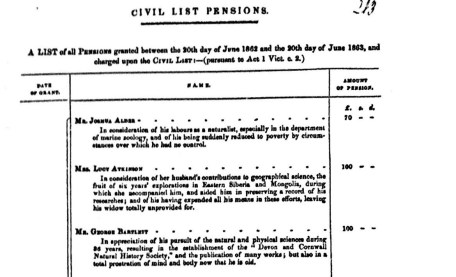
What is interesting about this citation, which must have given Lucy great pleasure, was the fact that it named her as Mrs Lucy Atkinson and made clear that she was Thomas’ widow, despite the fact that Rebecca Atkinson was still alive at this time. (In 1870 Lucy, listed as Mrs Lucy Finley, was to receive another pension from the Civil List, this time for £50 “in consideration for her services to literature”.)
So by 1863 Lucy had at least kept the wolf from the door. She had enough to pay her rent at 9 Lilly Terrace – now part of Goldhawk Road – in Hammersmith, which allowed her to finish her book. And whatever the legal situation, in some quarters at least she had been officially acknowledged as the widow of her husband, despite the fact that his first wife – and two of his children from that marriage – were still alive. Her son Alatau was soon to be sent to Rugby School, where he would stay for two years. And then what? That will be the subject of further postings.


















 Siberian Steppes