Before she went to Russia – Lucy’s early life

The life of Lucy Atkinson (née Finley) prior to her marriage to Thomas Atkinson in Moscow in February 1848 is little known and only documented in part. Marianne Simpson, who is a direct descendant of Lucys brother, William York Finley, has spent several years tracking Lucys life. Here she provides a remarkably detailed picture of the young governessbackground, up until the point she left London for St Petersburg in Russia in 1839 or 1840.
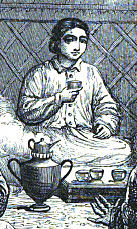
Lucy Atkinson
The only known likeness of Lucy Atkinson

Lucy Sherrard Finley was born on 15 April 1817 at her parents’ home in Vine Street, Sunderland, Durham. She was the fourth child of her 24-year-old mother, Mary Ann (née York), who had already given birth to three sons. Her father was Matthew Smith Finley, who at 39 was 15 years older than his wife, having been born in 1778.

Mary Ann was actually a Londoner. Her parents were William York and Elizabeth Sherrard, who were married in St George’s, Hanover Square, in May 1792. William York was a perfumer. After his marriage, the couple lived on the south side of the Thames in King Street, Southwark.  Their daughter Mary Ann was baptised at St Saviour’s, Southwark in May 1793.

How Mary Ann and Matthew met is not certain but we may surmise. Matthew Finley was born in Monkwearmouth in County Durham in the north of England. His father, Robert Finley (1747-1806), was a master mariner who, following in the footsteps of his own father, another Robert Finley (1707-1778)[i], regularly plied the waters between Monkwearmouth and London to feed the rapidly growing metropolis’ seemingly inexhaustible need for coal. But Robert Finley did not confine himself to the coal trade. There is also evidence that he crossed the English Channel several times conveying French wines to the British market[ii] and made at least one trip to St. Petersburg (with a cargo of hemp) which is interesting in view of the subsequent career of his granddaughter Lucy.

Matthew Finley, the oldest in a family of five children, may himself have served time at sea and possibly have also been a master mariner. This would explain how he came to be in London and perhaps also his relatively late marriage. In terms of how Matthew and Mary Ann actually met, press advertisements reveal a ‘Mr Finley’ advertising not only his perfumery business in Piccadilly but also for a cook for the East-Indies![iii] It is very likely that he was a relation of Matthew.

Matthew and Mary Ann were married on 25 April 1810 at St Dunstan’s in the East (most probably Mary Ann’s parish church) near London Bridge.  It is possible that they may first have lived at Wapping because a Matthew Finley is recorded as living there in Sir William Warren’s Square in 1812.  In the seventeenth century, Sir William Warren was the leading timber merchant of his day who imported timber from the Baltic and supplied the navy with masts. Matthew Finley may have been employed by William Warren’s company both before and immediately after his marriage.[iv]
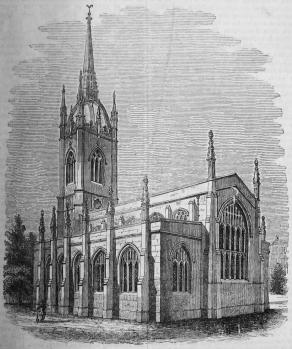
St Dunstans
St Dunstan’s in the East – now a ruin

The birth of his children at regular intervals suggests that Matthew Finley may have changed occupation not long after his marriage as in all the surviving documents concerning the births and marriages of his children he is described as a schoolmaster. This is further supported by the fact that Matthew and Mary Ann’s second son was born in 1813 at Somerstown, north of King’s Cross, which was not an area frequented by seafarers.

At some point between 1813 and 1815 Matthew, Mary Ann and their first two children moved from London, first to Monkwearmouth and thereafter to Sunderland, 250 miles north of London. The reason for the move is not clear, although it cannot have been to take over his father’s business, as Robert Finley had died in 1806. Once in the north the family was welcomed by Matthew’s remaining family. We know this because Matthew’s sister, Mrs. Barbara Benson, is recorded as having been present at the birth of Lucy’s brother, William York Finley, in Monkwearmouth in 1815.

Lucy was born two years later, in 1817. When she was either seven or eight years of age, the family, now expanded to include seven children, returned to London where they took up residence in Sidney Street, off the Commercial Road in an area known as Ratcliffe. Once known as “Sailor Town”, the area had since Elizabethan times drawn shipbuilders and owners, sailors and merchants and Matthew would have known it well, as this was where the coal vessels from Newcastle and Sunderland unloaded their cargoes.

Sometime after 29 June 1831, when the tenth and last child, Mary Ann, was born, the family relocated again. The move may have been prompted by financial distress because, just a few months before, on 9 February 1831, Matthew appears in a schedule of prisoners making petition before the Court for Relief of Insolvent Debtors. The date of Mary Ann’s birth indicates that he must have been apprehended after September 1830 but, whether his imprisonment was terminated after five months or not, it must have been a very difficult period for the family and, in particular, for Matthew’s wife.

She may, however, have been able to call on family help because the will of her childless uncle, Joseph Sherrard, shows that he was well established and also had a close relationship with his only niece. Joseph Sherrard, who was brother to Mary Ann’s mother, was a ship’s purser in the Royal Navy. Mary Ann was clearly very close to him as she called her second son – Joseph Sherrard Finley – after him and it was from Joseph’s wife that Lucy derived her first name – as well as receiving Sherrard as her second name.

In so naming her son and daughter, Mary Ann gave her uncle and aunt precedence over her own parents. In fact, it was only when she came to her third son, William York Finley, and third daughter, Elizabeth Harriet Finley, that she used her parents’ names and, even then, the Elizabeth could have been a reference to her mother-in-law, Elizabeth Smith. This clearly suggests a very close relationship with the Sherrard branch of her family.

This is despite the fact that Mary Ann would have been in her fifteenth year when Joseph Sherrard returned for good after spending several years in His Majesty’s Service in Australia.  Joseph Sherrard was one of the earliest British Naval officers to sail to Australia and he was also the beneficiary of significant “prize money” for ships captured at sea.  He first arrived at Sydney Cove in New South Wales on HMS Reliance in 1795.  Returning to England in 1800, he travelled out to Sydney again in 1802.  In 1804 he is recorded as leasing 58 rods of land in the township of Sydney and in 1807 he was granted 100 acres in the district of Cabramatta.[v]  He died in Kent, England in 1835, making Mary Ann – along with her first son, Matthew Smith Finley Jnr. and her first daughter, Lucy – a principal beneficiary of the will.  It is therefore also possible he may have helped the Finley family in 1831 when Lucy’s father was imprisoned for debt [vi].

In April 1832 when Matthew Smith Finley Jnr. was baptised as an adult at Deptford, he gave his place of abode as Rotherhithe.  Provided he was still living under his father’s roof – and there is no reason to suggest he was not – this would suggest that, after the financial collapse, the family moved to the south side of the Thames to cut down on expenses. But, before the end of the decade, they were back again on the north side of the Thames, now at 4 Waterloo Terrace, Commercial Road East, Ratcliffe.  We know that they were there by 1 March 1837 because that is when Matthew Finley took out fire insurance on the property.[viii]  It is indeed possible, however, that they were there as early as 1835, this being when Joseph Sherrard died, leaving his generous bequests (see below).

Waterloo01
All that remains of Waterloo Terrace in Stepney, along the Commercial Road

The Commercial Road, which shaped the family’s life, both before and after their residence in Rotherhithe, had been constructed between 1802 and 1806 to take dock traffic from the West India Docks and East India Docks into the City of London. It conveyed so much traffic that in 1828-1830 the company that built the road constructed a stone tramway of Aberdeen granite along its entire length to reduce wear from heavy road wagons. During Lucy’s residence there, and until the 1860s, those using the road had to pay a toll. Industries and railways followed and Stepney railway station was opened, close by Waterloo Terrace, at around the time Lucy left London for Russia.

In contrast to some of the less salubrious areas between the Commercial Road and the Thames, Booth’s “Poverty Maps” describe the residents of the Commercial Road as “hardworking sober men of good character and intelligence.” This would appear to be borne out by a description of the residents/businesses in Waterloo Terrace as set out in the 1841 Post Office London Directory. Living at No. 4 Waterloo Terrace, the Finleys’ neighbours comprised linen drapers, a stationer and Post Office receiving house, a watch and clockmaker, a bookseller, a baker, a tailor, a pawnbroker and, significantly, the Seamen’s Registry and Pay Office.

Waterloo06
Waterloo Terrace is just below the ‘RCIA’ of Commercial Road

Waterloo Terrace was located directly north of Ratcliffe Dock and Stanford’s 1864 map of London also shows a Sailors’ Institute and a Wesleyan Seamen’s Chapel in the area. Lucy did not just hear about the sea and what lay beyond the shores of England from her father, great-uncle and possibly oldest brother, but she was daily surrounded by the evidence of maritime trade and the impact of the sea on the social fabric of her community.

No information has come down as to where Matthew Finley may have been employed as a schoolmaster. Stanford’s map, compiled 17 years after his death, shows a number of schools in the area, in particular several “National Schools”, so called because they were set up by the National Society for Promoting the Education of the Poor in the Principles of the Established Church throughout England and Wales.  It is, however, known that the Finleys were “dissenters” and, as such, not members of the Established Church. Ratcliffe, in fact, was well known as a non-conformist area and there is tentative evidence to suggest that the Finleys may have come from a Presbyterian background. It is possible, however, that they did not attend any house of worship because there is no evidence that the children were presented for infant baptism.

Stanford’s map also shows a “Ragged School” (for destitute children of poor families) directly behind Waterloo Terrace which may have been in operation during Matthew’s time. However the Ragged School movement did not take off in a big way until after 1844, three years before Matthew’s death. While we can speculate, it is important to keep in mind that Londoners of the Victorian period were accustomed to trudge many miles to reach their place of work and it is entirely possible that Matthew worked out of his area of residence; this is perhaps even more likely when it is remembered that he continued to be recorded as a schoolmaster, while living at Rotherhithe.

It is equally not known where the children of the family received their education – quite possibly their father played a large part – but we do know that Lucy spoke French. Writing in 1916 towards the end of his life, Lucy’s nephew Francis George Finley wrote the following about his father, Matthew Smith Finley Jnr, who was Lucy’s oldest brother, born in 1811: “He was certainly one of the most highly cultured men that ever came to Australia. He could speak several languages and he must have been well educated. He was a polished gentleman.”[ix] It is perhaps significant that Matthew was a convert to Catholicism and between 1843 and 1846 was in partnership in Sydney with the French wine merchant Didier Joubert.

The 1841 census entry for the Finley family in Stepney is illuminating because it lists the children still living with their parents – namely Maria (21), Elizabeth (19), Mary (9) and Thomas (12). Besides Lucy, who was already in St Petersburg, two of the younger boys were missing – Horatio who would have been 17 and George who would have been 15. Does their absence mean that they were being educated away from home? The two boys are not found elsewhere in the census which raises the question whether they may have been at sea or were being educated on the Continent.

We know that both their parents had naval connections, that Lucy and Thomas Atkinson originally destined their son Alatau for the navy and that, when Matthew Smith Finley Jnr. arrived in Australia in 1833, it was as a seaman[x]. As for the possibility that the boys were educated abroad, we know from his will that Matthew Jnr. owned books written in French, German, Spanish and Italian which he left to his sister Maria on his death in 1861. Was he taught these languages on the Continent or just as a result of his travels as a seaman? Also, when he bequeathed the books to Maria, was it because, while still in London, she had been a book dealer or was it because she, herself, had knowledge of these languages? Maria’s nephew, Francis George Finley, knew his aunt Maria and wrote that she “was a particularly well educated woman.” For whatever we read about Maria, we can extrapolate to Lucy, her elder sister by two years.

As stated above, in 1813, when Matthew and Mary Ann’s second son was born, they were living at Somerstown near Kings Cross. The Gentlemans Magazine of 1813 published a letter about Somerstown which mentioned, inter alia, that a considerable number of French emigrés had settled there and a certain Abbé Carron from France was running four schools – two for boys and two for girls. Could Matthew have been teaching at one of Abbé Carron’s schools in 1813 and, given that Matthew Jnr. and Lucy certainly knew French, could Matthew have used these links to later provide his children with a French, or even European, oriented education?

Irrespective of her education, we know that, before she went to Russia and probably from her late teens, Lucy was running a business as a dealer in toys and jewellery from her family’s address at 4 Waterloo Terrace. We know this from the insurance records of the Sun Fire Office which reveal that Lucy Sherrard Finley took out a policy for the above named business on 14 June 1839.[xi]

Waterloo02

Intriguingly, she is again listed at Waterloo Terrace as a toy dealer in the Commercial Directory of 1846. With Lucy, of course, in Russia by that time, the seeming anomaly is perhaps explained by the Post Office Directory of 1848 which also records a dealer in toys at the same address, but now the business is in the name of Mrs. Mary A. Finley. This would suggest that Mary Ann kept the business going in Lucy’s name in the hope that Lucy might return but when Lucy married at the beginning of 1848, Mary Ann realised that this would now not happen and transferred the business to her own name.

Another explanation may also have been the death of Matthew in February 1847, possibly requiring Mary Ann, now a widow, to invest more of her time and energy into the business as a means of maintaining a livelihood.

As pointed out by Nick Fielding, the word “toy” as used at this time does not necessarily have the same connotations as it has today. In the first half of the nineteenth century, a “toy” would generally mean what today we would call a knick-knack or ornament. In speaking of her son, Alatau, Lucy indeed said he had no toys. However, it is also clear from her book that she was an efficient needlewoman.

In 1835, shortly before his death, Mary Ann’s uncle, Joseph Sherrard, made his will. He had not forgotten the only close family he had. The three principal beneficiaries were:

  • His niece, Mary Ann, to whom he bequeathed £500 sterling.
  • His grandnephew, Matthew Smith Finley, Jnr. to whom he bequeathed £300 sterling, together with the whole of his herd of horned cattle in the charge of his agents in New South Wales, also the whole of any sums of money that might be owing to him in the colony.
  • His grandniece, Lucy Sherrard Finley, to whom he bequeathed £500 sterling to be paid on her attaining the age of twenty-one years – she was only 17 – with the interest of the said sum to be paid to her annually until she came of age.
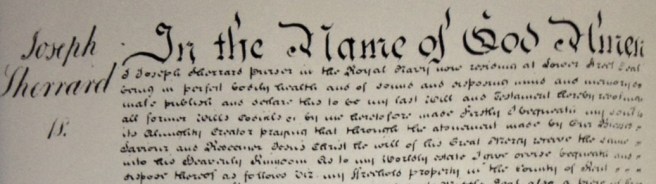
Waterloo07
The beginning of the will of Joseph Sherrard

One can imagine what a relief this very substantial legacy must have been to Mary Ann who had worked so hard caring for her large family, especially during the tough times when Matthew was unable to discharge his debts. Mary Ann’s death certificate in Australia states that she gave birth to ten children all of whom she raised to adulthood. In a time of high infant mortality, this stands as testimony to her wisdom, vigilance and care. Mary Ann lived a life dedicated to her children and, with her own raised, she was called upon yet again, as a grandmother, to care for another young family. In the words of her daughter, Maria, writing in 1867 to a niece:

I am sorry to say your grandmother is far from well…Every time she puts her head on the pillow such a ringing noise [comes] in her ears that she is ready to go mad. Tom [the second youngest of Mary Ann’s ten children] ought to think a great deal of his mother. I really don’t know what he would have done but for her. She is always on the look-out for all she can do for him and, when his first wife was sent away, she staid [sic] with him three years and did everything herself for them all – washing, cooking and cleaning and think only, she was then 70 years of age and little Maria was a baby in arms and fearfully ill…I stayed with them for five weeks and during that time I took charge. Poor Mother was sorry when I left.[xii]

Having received the £500 legacy from her uncle, Mary Ann Finley emigrated to New South Wales in 1850 with her three youngest children. Several of her older children were already there. However, in making the decision to leave England, she would have been painfully aware – as indeed proved to be the case -that she would never again see Lucy, who was in Russia with Thomas Atkinson, or either of the two other children who remained in England. She died in 1877 and is buried in Dubbo cemetery in New South Wales in a grave for which there is no surviving headstone. Her grandson Francis George Finley stated that she retained her faculties to the end. The influence of a mother is far-reaching and in some of Lucy’s best qualities we can surely see Mary Ann: sacrifice (there is no evidence that Lucy ever saw her son Alatau again after he left England), resolve, adaptability, resourcefulness, endurance and sound sense. Mary Ann was indeed an exemplary mother.

Before leaving the will, comment should be made about the generous legacies left by Joseph Sherrard to Matthew Finley Jnr. and to Lucy. In 1835 Matthew Jnr. is known to have been one of three masters supporting the Headmaster at The King’s School, Parramatta in New South Wales.  The legacy gave him the opportunity to leave this position and, having been issued with licence no. 133, he became part of the first cohort to be officially recognised to pasture the unsurveyed lands west of the Blue Mountains.  Matthew was to go on to have a successful career as a farmer and auctioneer in the Bathurst district, before qualifying as a surveyor and becoming one of the first to survey the Grafton area in northern New South Wales.

And it seems likely that the legacy from her great uncle Joseph allowed Lucy to set up the toy business that was registered in her name at Waterloo Terrace.

The other eight children are not mentioned in the will by name, which makes the identification of Matthew Jnr. and Lucy the more remarkable.[xiii] Again with respect to Matthew, given that he received an education which appears to be almost that of a gentleman, the question must be asked whether his great uncle financed some or all of it. While any such claim for Lucy must be more tenuous (given the excellent education that her next youngest sister is believed to have received), it is nevertheless pretty clear that Lucy, a bright and engaging little girl, named for his deceased wife, occupied a very warm spot in Joseph Sherrard’s heart.

In the preface to her book, Lucy stated that, before her marriage in February 1848, she had been eight years in the employ of General Mouraviev. This suggests that she went to St. Petersburg in 1839 or 1840. The date of the insurance policy indicates that she was still in London in June 1839, so it was presumably the late summer of 1839 or (perhaps more likely) the spring or summer of 1840. She also stated that, growing up in a large family, she was keenly aware of the need to make her own way in the world. The legacy that she received would surely have confirmed to her that this was her opportunity.
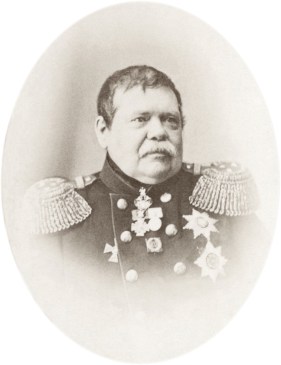
m-n-muravyev-vilensky
Lucy’s employer in Russia, Gen. Mikhail Nikolayevich Mouravyev-Vilensky

In choosing to become a governess, Lucy showed ambition but also she reflected her times. If (unlike those around her) she did not wish to stay in trade, the only other option available to her was to become a governess, which was the single respectable occupation open to a gentlewoman at that time.[xiv] The downside, however, was that the profession, at least from the 1830s, was greatly overcrowded, as well as being traditionally undervalued and poorly paid.

But Lucy had probably heard about Russia from her family connections and knew that the situation there was quite different, offering social and financial opportunities otherwise closed to her in England. In that country the English governess, to quote Harvey Pitcher, “enjoyed a much higher standard of living than she was likely to have experienced before… As soon as the children were old enough to sit at table, they had most of their meals with their parents, and their governess always accompanied them. Even on festive occasions, or when visitors were present, governess and children were never excluded from the sumptuous meals…At its best her position was that of an equal and member [sic] of the family, something that had not happened in England since the eighteenth century; and … English governesses [attended] important social functions on terms of complete equality with the other guests.”[xv]

In confirmation of this, we will remember Lucy writing that she was twice in the same room as the Tsar. The governess was also more liberally rewarded in Russia and in St. Petersburg and Moscow she could even enhance her income by giving private English lessons in her free time. Also, Russian families that employed a governess could be generous with gifts and legacies.

These were very real inducements to a young lady who had already proved herself to be enterprising and self-reliant. The only ties to hold her back were those of family affection and was not duty – honed over many years by her position as eldest daughter of the family – part of what she owed their love? Moreover, she had her uncle’s legacy which would give her some discretion in negotiating terms of employment, so where could the venture fail?  Whether she secured the appointment with General Mouraviev before she left England, or after her arrival in St Petersburg, is not known. One possibility is that she contacted a well-known “clearing-house” for governesses in Moscow run by a Mrs. Scott.

There is an interesting account of the experiences of prospective governesses arriving in Russia in the 1830s, which has been left to us by the German observer, J. G. Kohl, and quoted by Harvey Pitcher:

“…from the same ships that have brought out the new fashions and new books from London, Paris and Lubeck, many young ladies may be seen landing with torn veils and ruffled head-gear…These are the lovely and unlovely Swiss, German, French, and English women destined to officiate in Russia as priestesses of Minerva, in fanning the flame of mental cultivation. Exhausted by sea-sickness, saddened by homesickness, frightened by the bearded Russians who greet their eyes in Cronstadt, and pierced through and through by the chill breath of a St Petersburg May, they issue from their cabins, pale, timid, and slow, anxiety and white fear upon their lips, and despair in their eyes. …Their entrance into a rich and distinguished house is a new stage of suffering: and if the rude voices, long beards, and filthy clothing of the barbarous population of the harbour terrified them, here the glitter of unwonted luxury alarms their bashfulness. The loud tumultuous life of a great house in Russia, where no one comprehends their feelings in the slightest degree, is enough to overwhelm them; and, quartered in an apartment with the tribe of children entrusted to their care, they have scarcely a corner to themselves…”[xvi]

It is hard to imagine Lucy as “pale, timid, and slow” and “with despair in her eyes” but there is no doubt that, while her father’s house would have accustomed her to lack of privacy and the unending flow of traffic along the Commercial Road would likewise have exposed her to an unrelentingly noisy environment, she would nevertheless have had to make a considerable adjustment to her new life in a Russian noble household. When we next meet Lucy in 1848, we see how admirably she had risen to this challenge!

Footnotes

[i] Robert Finley is mentioned in the Shipping News of the Public Advertiser of 26 November 1767 and the Shipping News of the London Evening Post of September 17-19, 1778, which latter notice reveals that he died that year on a voyage to Jamaica.

[ii] Star, January 6, 1789; Newcastle Courant, 20 August 1803.

[iii] For example, from The Morning Post and Daily Advertiser, August 5, 1786: “WANTED, for the East-Indies, a COOK.  If he has been at the sea the more agreeable…Enquire at Mr. Finley’s, perfumer, to His Royal Highness, the Duke of Gloucester, opposite Melbourne House, Piccadilly.”

[iv] I am indebted to Nick Fielding for this research.

[v]Land Grants 1788-1809 NSW, NI & VDL; Colonial Secretary’s In-letters Index 1788-1825 (cited in Biographical Database of Australia).

[vi] I am indebted to Sally Hayles for this information.

[viii] Record held by London Metropolitan Archives, reference MS 11936/556/1245759.

[ix] Recollections of Francis George Finley (from “Surveying New South Wales – the Pathfinders”, 2005.

[x] Crew list; SRNSW ref: Vol. 4/2178 No. 33/4872; Entry No. 25283 (cited by Biographical Database of Australia).

[xi] Record held by the London Metropolitan Archives, reference MS 11936/568/1304850.

[xii] Original, unpublished letter, held by her gt gt gt niece, Marianne Simpson.

[xiii] The others are covered by the provision, “whatever sums of money which may be remaining…to be equally divided among my grand nephews and nieces not named or otherwise provided for”.

[xiv]Interestingly, the career of Lucy’s sister Maria very much reflected her Waterloo Terrace background being, at various times, a tobacconist, stationer and bookseller, and (in Australia) Postmistress at Rouse Hill.

[xv] Pitcher, Harvey, “When Miss Emmie was in Russia: English governesses before, during and after the October Revolution”, (John Murray, 1977).

[xvi] Pitcher, Harvey, op. cit., p5.


Losing out to his competitors

I am constantly amazed by the amount of material that still lies undiscovered in archives throughout Britain and beyond that relates to Thomas and Lucy Atkinson. A few days ago I came across a reference to a document in the Manchester Central archives and having applied to see a copy, this morning it arrived.

It is a note, dated 8 August 1836 and addressed to the Secretary of the Royal Institution in Manchester.

Manchester letter content

The note is brief and to the point:

Sir,

I have forwarded three drawings for your exhibition which I hope the committee will approve and give a place accepting the pictures.

I am Sir,

Your Obedient Servant

T W Atkinson

Beneath the note he lists the three drawings he has submitted:

No 1 A design for the Athenaeum in George Street

No 2: A design for the Unitarian Chapel, Upper Brook St

No 3: A view of Sudely Castle, Gloucestershire.

Clearly Thomas was submitting his three drawings for an exhibition, to be held at the Royal Institution. At this time he was an architect, practising in Store Street in central Manchester. He had already won a commission to design a headquarters building for the Manchester and Liverpool District Bank and had also designed several churches in the City.

Of the three drawings mentioned in Thomas’ letter, I am familiar with one – that of the Unitarian Chapel. Here is his drawing of the building:
Unitarian chapel

The chapel was not built to this design, as a very different neo-Gothic design was eventually accepted by the church committee and it was built between 1836-38. The winner of the competition? It was Sir Charles Barry, who also happened to win the competition to design a building for the Manchester Athenaeum, the subject of Thomas’ first drawing. Barry subsequently went on to help AW Pugin with the design and construction of the Houses of Parliament, following its destruction by fire in 1834. Thomas Atkinson was also involved in some of the detail work on that building.

So here we have two drawings by Thomas showing buildings he was not able to build, having been beaten in a competition by the same man – Sir Charles Barry. I wonder what hs thoughts were?

As for Sudely Castle, it still exists and is now flourishing. But in the 1830s it was in a mess. The wealthy Worcester glove-makers, John and William Dent, bought the estate from Lord Rivers in 1830 and then the castle itself from the Duke of Buckingham and Chandos in 1837. The Dents restored the castle using their architect, Harvey Egington of Worcester and later George Gilbert Scott. Is it possible that Thomas Atkinson’s drawing was part of a bid for that bit of work too?

Thus it appears that all three buildings mentioned in this brief note represented potential work that did not materialise. Not surprisingly, Thomas’ business was soon to be in difficulties. His partnership with the architect Alfred Bower Clayton was dissolved in October the same year “by mutual consent”. And barely 16 months later, in February 1838, Thomas was declared bankrupt. It was to lead to a major reassessment and to decisions that would transform his life.

(If anyone knows the whereabout of copies of the Athenaeum picture and the picture of Sudely Castle, please let me know. A copy of the Unitarian chapel drawing is held by the RIBA library.)


Atkinson descendants to visit Kazakhstan

In a few weeks time I will be taking a group of ten descendants of Thomas and Lucy Atkinson to eastern Kazakhstan. Our intention is to visit the exact spot where, in 1848, Lucy Atkinson gave birth to a son from whom all ten relatives are descended. She and Thomas decided to name the child Alatau Tamchiboulac Atkinson after the place he was born. Alatau was the name of the mountain range that stands behind the small town of Kapal and Tamchiboulac was the sacred spring next to the exact spot where he was born.

Alatau_T._Atkinson2
Alatau Tamchiboulac Atkinson – born on the Kazakh steppe, he eventually settled in Hawaii.

A total of ten relatives will be making the journey – three from Hawaii, one from Florida, one from New Zealand and five from England – where they will all be guests of the Kazakh government. None of them have ever visited Kazakhstan before and it promises to be a momentous occasion. We will be flying – courtesy of Air Astana – to the capital city of Astana where we are scheduled to meet the prime minister, ambassadors and other dignatories. A few days later we will fly on to Almaty in the south of the country before heading east to the Semirechiye/Zhetysu region where the town of Kapal is located. After unveiling a memorial to Alatau’s birth, we will head into the mountains to see some of the places that Thomas and Lucy wrote about in their books.

Already the trip is making headlines. You can read about it here, in the Hawaiian press, and also here in The Diplomat, a prestigious international publication. I will try to post regularly during the trip, depending on internet access.

More on Gothic Ornaments

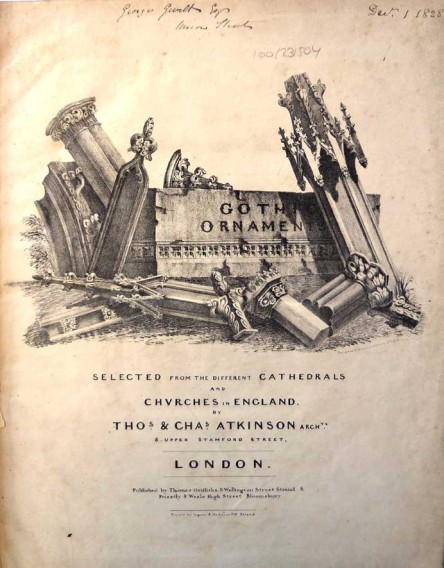
A month ago I wrote about Thomas Atkinson’s first book, Gothic Ornaments, commenting on the fact that that other great exponent of the neo-Gothic style, AW Pugin, had published a book that looked very similar, although it appeared several years after Thomas’ book.

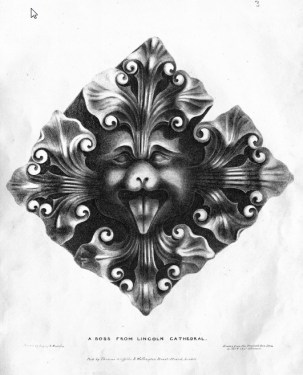
I have now been able to obtain a very rare physical copy of Thomas’ book, which I found – of all places – in Madrid, Spain! It is very large, with each plate 330mm x 425mm. There is no text other than that on the title page and the captions beneath the beautifully executed drawings of carved stone details from churches and cathedrals across Britain.

Gothic04
A plate from Thomas Atkinson’s Gothic Ornaments

Nor is Pugin the only author to produce a book that looked very similar to Thomas’ work. Joseph Halfpenny, for example, published Gothic Ornaments in the Cathedral Church of York in 1831; and James Kellaway Colling published Gothic Ornaments, Being a Series of Examples of Enriched Details and Accessories of the Architecture of Great Britain in 1848So Thomas was certainly at the forefront of thinking and writing about the neo-Gothic, as his book was published in 1828.

One other thing about the copy of Gothic Ornaments I found in Madrid; the bookplate shows that it once belonged to Laurence A Turner (1864-1957). Turner was an extremely

Gothic bookplate
Laurence A Turner’s bookplate

important figure in the history of British architecture. Not only did he design the tombs of William Morris and Norman Shaw, but he worked on many important buildings. These include (and I quote): “Scottish Provident Institution building (1905); the Scottish Widows’ Fund in Lombard Street (1915); University College, Bangor, North Wales (for Henry T Hare); the Bodley Memorial, Holy Trinity, Prince Consort Road (for Edward Warren); the stone carving and decorative plasterwork in Rhodes House, Oxford and Church House, Westminster; internal plaster and wood carving at Africa House, Trafalgar Square; stone and wood carvings at Downing College, Cambridge, Woldingham Church, and Bishop Jacob Church, Ilford; coloured heraldry and symbols, lettering and stone carving for Winchester Memorial Cloisters; and the carved oak pulpit, altar table and the fibrous plaster chancel ceiling at St. Thomas’s Church, Upshire, Essex.”

He was also Master of the Art Workers Guild in 1922, a member of the Society of Antiquaries, and an honorary Associate of the Royal Institute of British Architects. In 1927 he published Decorative plasterwork in Great Britain (Country Life, London and New York, 1927). He was a lifelong Freemason and held office in the Grand Lodge as well as being a past Master of the Arts Lodge.

He retired from practice in the early 1950s and died in a London hospital. Charles Wheeler paid tribute to his craftsmanship and design skills in an obituary for The Times: “According to the fashion of these days such artists are rare and at a discount, but never does skill of his quality disappear form the world without a warmth and richness going too.” (Tuesday, 15 October 1957, p. 14). (You can find out more about him here).

Gothic

It is, indeed, a great pleasure to see his name alongside that of Thomas Atkinson and his business partner, Charles Atkinson (no rel.), in a copy of this very rare book.

A visit to Cannon Hall

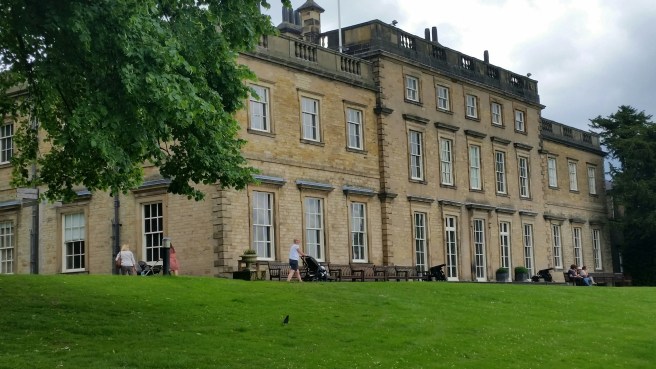
Cannon Hall-NBF

This week I paid my first visit to Cannon Hall near Barnsley in South Yorkshire. This large mansion, once known as ‘Roast Beef Hall’ due to its owners’ generosity at dinner, was the ancestral home of the Spencer-Stanhope family, who made their fortune in the local iron industry. Those of you familiar with the background of Thomas Atkinson will know that his father was head mason on the estate and that Thomas had a close relationship with the Spencer-Stanhopes, in particular with John and his brother, the Reverend Charles Spencer-Stanhope.

Like many similar estates, the upkeep proved too much for the family and the house and grounds were sold to Barnsley Corporation in 1951. Today Cannon Hall, along with 70 acres of beautiful parkland, is a museum with fine collections of Moorcroft pottery, paintings – including works by Constable and Canaletto – and glassware. Although some of the rooms still contain artworks associated with the Spencer-Stanhope family, most of that has now gone and it is not easy to imagine what life would have been like in the house’s heyday in the mid-eighteenth century when the likes of William Pitt, the anti-slavery campaigner William Wilberforce and other grand figures were regular guests.

However, an insight into life at Cannon Hall can be gleaned from a wonderful book: Annals of a Yorkshire House from the papers of a Macaroni and his kindred, written by A M W Stirling and published in 1911. And before you ask, a macaroni was a kind of eighteenth century dandy, noted for their accentuated fashion, over-the-top hairstyles and exaggerated manner of speech. A quote from the book gives an idea of the extravagant entertaining that lay behind the nickname Roast Beef Hall during the days of Walter Spencer-Stanhope:
Stanhope, after his marriage, kept open house, where the guests who came uninvited were as welcome as the invited guest and it was a recognised fact that despite the ever-widening home-circle which the years brought, his family party never dined without the addition of several friends present. As his sons grew older they used to be expected to bring men in to dinner, and John used to relate that he often wandered about not liking to go back till he had captured his own contribution to the merry evening party. Once when Mary Winifred complained to her chef of the extravagance of the house-books, the man replied “Do you know Ma’am, although you had no party, how many people dined here last week? – A hundred!”. The neighbours in Grosvenor Square (where the Spencer-Stanhope’s had their London town house-ed), however, maintained that Mrs Stanhope must have a rout every night, so continuous was the stream of company which invaded her, while several of the old letters describe her house as ‘the gayest in town’.

From his humble beginnings as the son of a stone mason on the estate, Thomas Atkinson returned to Cannon Hall in 1860 as a guest of the family. It was, indeed, a remarkable turnaround for an uneducated Yorkshire lad. There are some small indications that the Spencer-Stanhopes saw the potential of the young mason and set him on his way to becoming an architect, even allowing him as a youth to take drawing lessons with the Spencer-Stanhope girls. That, like so many other aspects of this story, will be the subject of further research.

Volcano Atkinson and the Kara Noor

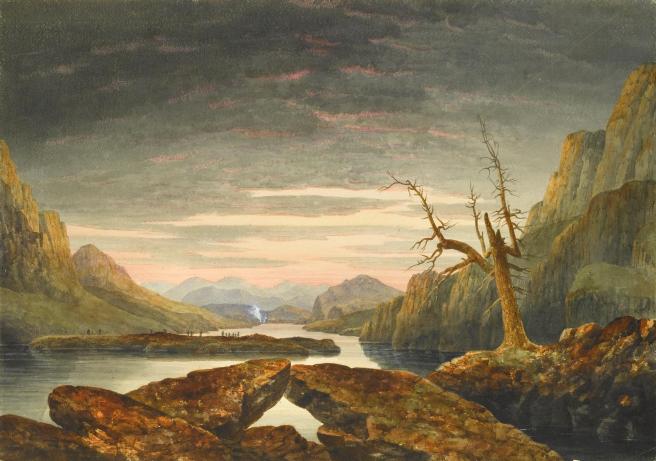
Kara Noor, formed by lava of the Djem-a-louk, Saian Mountains, MongoliaIn the winter of 1852, while staying in Irkutsk on the shores of Lake Baikal in Eastern Siberia with his wife Lucy and young son Alatau, Thomas Atkinson painted The Kara Noor, formed by lava of the Djem-a-louk, Saian Mountains, Mongolia, one of several watercolours he painted of this remote area. Having recently acquired this painting, I have tried to find out as much about it as I can.
The subject of this painting was particularly important for Thomas and relates to a posting I made on this blog about the connection between him and the great German explorer and geographer, Alexander von Humboldt (see below). The important word in the title of this painting is ‘lava’, as it clearly implies the presence of volcanic activity. Humboldt believed that volcanoes were likely to be discovered in Central Asia and Siberia and yet, despite looking for them himself, he had failed to find any. It was only when Thomas came across an ancient, but massive lava flow in Eastern Siberia, that the evidence Humboldt was looking for was discovered.

Thomas describes what happened in his book Oriental and Western Siberia: “The lava rose like a wall, in some places forty feet high; in others, it was heaped into enormous masses, and great chasms crossed the bed, looking as if formed by the mass cooling. This volcanic matter interested me greatly and I determined to seek its source: for during my ride I had ascertained that it had flowed down the valley of the Djem-a-louk. At dusk in the evening we reached a Cossack piquet, when I made known my wishes to the officer, who told me that the Bouriats had great dread of that valley and never ascended it, except by compulsion. He ordered that seven good men should be collected and be ready to accompany me in the morning.”

Thomas describes how the next day the party – excluding Lucy – followed the lava flow up the valley in what became an increasingly dangerous ride. On the third day he reached the Kara Noor (Black lake), the subject of this painting, and on the following day proceeded on foot to find the source of the lava: “In doing this we had to descend into chasms sixty and eighty feet deep, where the volcanic matter had cracked in cooling. After a day of extraordinary toil, we slept on blocks of it at night. On the afternoon of the second day, we beheld the top of a huge cone, and, as the sun was setting, stood on its summit looking upon the terrific scene around. I at once began sketching a view of this wonderful region and gave orders to a Cossack to have a fire and preparations made for our night’s encampment.”

Thomas goes on to say how the Bouriats who were guiding them begged him not to sleep on the cone of the volcano, as Shaitan was sure to pay them a visit. He told them to make camp where they pleased. Meanwhile he continued to sketch. It was clearly a very moving place: “No scene with which I am acquainted conveys such an impression of the terrible and sublime, as the prospect from some parts of this wonderful region, in which I spent many days.”

The painting above certainly conveys an impression of the power of nature, particularly the dark reddish hues of the massive rock, the wreck of a tree and the red tint to the charcoal clouds. It was a piece of lava from this volcano that Thomas sent back to Humboldt in Berlin – the significance of which the German did not realise for a further three years.  Thomas made several other paintings of scenes in the immediate vicinity of the Lake, two of which appear in his book.

In more recent years, this particular volcano field has been the subject of much study by Russian geologists. Now known as the Jom-Bolok volcanic field, it is actually located in Russia in the Eastern Sayan Mountains. In 2011 it was the subject of a major Russian study which you can read here. That article by Alexei V Ivanov et al notes: “Despite the fact that the Jom-Bolok volcanic field has been known for almost one and a half centuries , it is little studied and no geological information has yet been published in English.

In an appendix to the article there is a historical note which states: “Initial information about the volcanoes in the East Sayan Mts. was published in a local Siberian newspaper in 1858 by an English architect, Thomas Witlam Atkinson. Later, he devoted a number of pages in his extensive travel book to the same volcanoes (Atkinson 1859). In 1852, Atkinson travelled from the inhabited Oka river area, along Jom-Bolok river (referred by him as Djem-a-look river) up to Haranur lake and the Hee-Gol valley. Apparently, he was among the first visitors to the volcanoes, because the local Bouriat people had great dread of that valley, and never ascended it except by compulsion. His report was used later by the Russian royal Peter Alekseevich Kropotkin, who was famous for both his anarchist philosophy and contributions to glaciology (see Ivanova and Markin 2008). He visited the volcanoes in 1865 and provided a geological description (Kropotkin 1867).”

So Thomas Atkinson, according to Russian geologists, was the first outsider to visit this remarkable volcano field. The second person was the great Russian anarchist Kropotkin! The Russian geologists who studied the volcano field decided that they should right a great historical wrong: “Volcano Medvedev was named in this paper for the first time after Marat Medvedev, whose field-book notes were used by us to find the location of this practically unknown volcano. The name Atkinson is given to a previously unnamed volcano to restore the historical fairness.”

Thus one of the cones in the Jom-Bolok volcano field is now called Volcano Atkinson. Not a bad result after more than 150 years. And here is a photo showing the volcano, which can be seen on the right of the picture.

EUCC01


Save

Save

Thomas Atkinson’s first book…

Gothic Ornament title page

When I began researching Thomas Atkinson, I soon found out that he had written a book in the late 1820s, not on his travels, but on architecture. The book was hard to find but I eventually found a copy in the architectural library of the Victoria and Albert Museum in London. Entitled Gothic Ornaments selected from the different Cathedrals and Churches in England, and published in 1829, the book contains 44 engraved plates, made from drawings executed by Thomas and his business associate, Charles Atkinson (no rel.). They show details of carved stonework from places such as Lichfield Cathedral, Lincoln Cathedral, Boston Church in Lincolnshire, St Alban’s Abbey, Westminster Abbey, St Catherine’s Church in Tower Hill and so on.

Thomas and Charles had recently set up in business as architects in Upper Stamford Street in Southwark, but the book clearly reflects Thomas’ background as a stonemason. That was also his father’s profession and it is clear that Thomas was expert in – and attached to – the carving of stone. His love of the Gothic extended to his design work as an architect and he quickly developed a taste for designing buildings – particularly churches – in the neo-Gothic style, which was undergoing a revival at that time.

It was, therefore, a great surprise to come across this frontispiece for the book, which is missing from the copy in the V&A and which carries another drawing by Thomas. There is, however, no text that I am aware of. The book was originally published ‘in folio‘, which means that the plates were issued at a rate of two or three a week, to be bound later at their purchaser’s expense. This book contains a total of 42 plates.

What is also remarkable is the similarity between this book and a very similar book, published by that great exponent of the neo-Gothic style, A W Pugin. Here is the frontispiece of Pugin’s book:

Pugin-Gothic Ornaments

As you can see, Pugin’s book is called Gothic Ornaments selected from various ancient buildings seen in England and France during the years 1828, 1829 and 1830. Perhaps like me, you will be struck by the similarity between the two works,which have almost exactly the same title as each other. As Thomas’ book was published first, would it be in order to suggest that Pugin had seen a copy of his book and then decided to produce his own version? Perhaps this kind of book was popular at the time? Either way, it shows that Thomas was at the heart of what was to become an important trend within British architecture at this time. Leaving aside the whole issue of Thomas’ travels and explorations, it is also probably time that his contribution to architecture was reassessed.

Pics from Geological Society meeting

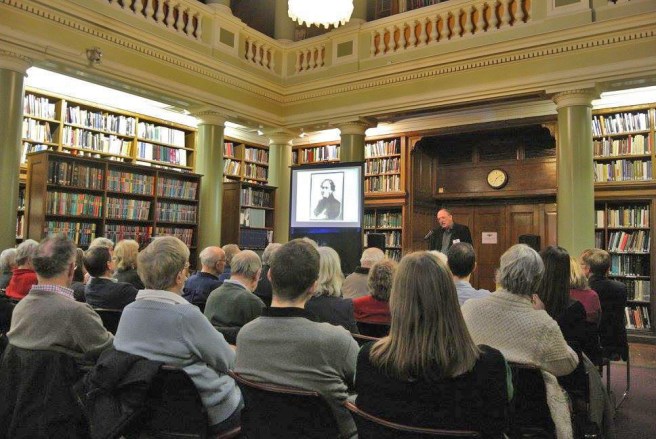
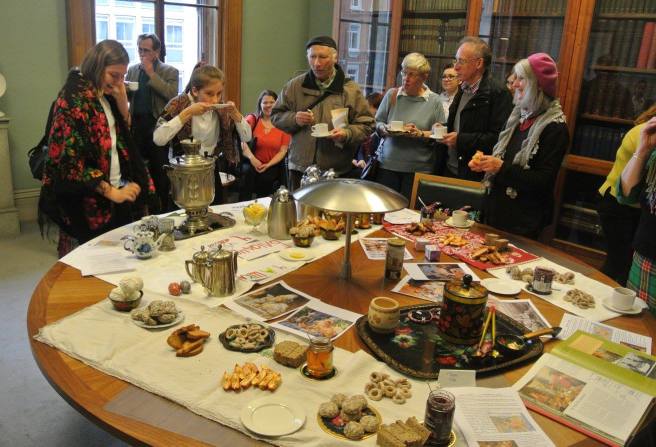
Here are a few pictures taken by Caroline Lam, archivist at the Geological Society of London , at the talk I gave on Thursday evening at Burlington House about Thomas Atkinson and his geological adventures in Siberia.

GSL-28042016-1a

Pupils from London’s  first Russian-English Bilingual School, AZBUKA, attended the meeting and demonstrated the Russian art of tea-drinking, bringing along with them many typical Russian dishes.

GSL-28042016-3

Also on display were some wonderful documents, books, prints and artworks from the Geological Society archive. Thanks to everyone who made this such a successful (and sell-out) event.

GSL-28042016-2


Thomas Atkinson and the great geologists – Humboldt and Murchison

In the first year of his seven-year journey through Siberia and Central Asia, Thomas Atkinson travelled with another Englishman called Charles Edward Austin. I decided to look into the background of Austin and soon began to uncover extensive links between Atkinson and two of the greatest geologists of the nineteenth century.

When Thomas Atkinson received his passport from Tsar Nicholas I in 1846 it also noted the fact that he was accompanied by an English engineer. Nowhere in either of Thomas’ two books about his travels in Siberia and Central Asia does he mention the name of the man who spent most of 1847 travelling with him. And so I set about trying to find out more. Bit by bit I pieced together the story and found out that his companion was an English engineer called Charles Edward Austin.

Once I had his name, more facts came to light. The Engineer magazine, published by the Institute of Civil Engineers, ran his obituary soon after his death in April 1893 and from that I found out that he was born in 1819 in Wootten-under-Edge in Gloucestershire in June 1819. He became a pupil of George E Frere, who was chief assistant to the great railway engineer Isambard Kingdom Brunel. Thus Austin learned much of his trade as an engineer working on the Great Western Railway at the time it was being built. He developed automatic switching equipment for which he took out patents in 1841 and soon after this moved to St Petersburg in Russia.

From there he travelled across Russia, improving navigation on the Volga River and developing schemes for improving the management of traffic on this great waterway. At some point in 1846 he must have met Thomas Atkinson, who had arrived in St Petersburg from Hamburg where he had lived for several years helping to reconstruct the city after the great fire of 1842.

From Thomas’ standpoint, it made sense to team up with Austin. Thomas was about to embark on a long journey to the East where, as he says in the introduction to his book Oriental and Western Siberia, “My sole object was to sketch the scenery of Siberia – scarcely at all known to Europeans”. He knew nothing about Russia and did not speak the language, whereas Austin was an old hand who knew the ropes. Precisely why Austin decided to accompany Atkinson is not known, although there may be clues which we will discuss later.

The two men left St Petersburg by sleigh in January 1847, heading east towards the Urals, their first objective. As I traced their route, using the text of Atkinson’s book – and later his diaries, where Austin is mentioned on many occasions – I was struck by the similarity of their itinerary to those of both Alexander von Humboldt, the great German geologist and also that of Roderick Impey Murchison, the Scottish geologist and geographer. I decided to look into this in more detail.

Humboldt’s travels in Russia

Daguerreotype of Humboldt,_Alexander_von_1847

Alexander von Humboldt (1769-1859) was one of the greatest German scientists of the eighteenth-nineteenth centuries. A polymath, friend of Goethe and Schiller, he travelled extensively in Latin America between 1799-1804, describing it for the first time from a modern scientific standpoint. His great multi-volume work, Kosmos, sought to unify different branches of scientific and cultural knowledge.

In 1829 he was contacted by Count Georg von Cancrin, the Russian Foreign Minister, who wanted to know if Humboldt could help the new Tsar Nicholas I determine if it was possible to create a platinum-based currency in the country. Having long dreamed of visiting the Urals and Asia, Humboldt seized the chance. In April 1829, together with mineralogist Gustav Rose and naturalist Dr Christian Gottfried Ehrenberg, he set off for St Petesburg, where he was jouned by Count Adolphe Polier and Johann Seifert, a collector of animal specimens.

Although his expedition was tightly controlled by the Tsarist officials, Humboldt was able to travel extensively in the Urals, visiting the enormous mines and workshops scattered throughout the area. They were soon amongst the topaz, beryl, amethyst, rock crystal, jasper, malachite, porphyry and other mines. “There is scarcely another place in the world whose immediate surrounding provide such a wealth of ores as Nizhne Tagilsk,” he wrote later. “Only two versts away lies the famed Magnetberg (Mount Blagodat) whose excellent ores satisfy the blast furnaces of the entire region. Copper ores were discovered close by in 1812 and in respect to yield are not inferior to those of Gumechewsk. In still more recent times, gold and platinum placers have been discovered in the vicinity and are so richly productive that all other workings in the Urals are virtually as nothing.” Remarkably – and sadly – his three-volume Asie Centrale (1843), which set out the main findings of his Russian travels, has never been published in English.

blagodat_hill_summit
Mount Blagodat in a 19th century photo

This trip allowed Humboldt to develop further his theory about the proximity of diamonds to alluvial gold and platinum, an observation he had first made in Brazil 30 years previously. No-one thought that diamonds could be found at the high latitude of Ekaterinburg. Thus at every point where they found placer workings, Humboldt and his companions examined the gold sands microscopically to look for diamonds. They only found zircons. But then, four days after Count Polier had left Humboldt’s party to look in another direction, the Frenchman turned up three stones. In fact they were found by a 14 year-old boy. They turned out to be diamonds. The second stone, weighing over half a carat, was later presented to Humboldt by Polier as a gift. It was the beginning of diamond mining in the Urals.

Humboldt’s journey was not without incident. The police and officials remained suspicious, as the following letter from the chief of police at Ischim to the Governor-General of Western Siberia makes clear:
A few days ago there arrived here a German of shortish stature, insignificant appearance, fussy and bearing a letter of introduction from your Excellency to me. I accordingly received him politely but must say I find him suspicious and even dangerous. I disliked him from the first. He talks took much and despises my hospitality. He pays no attention to the leading officials of the town and associates with Poles and other political criminals. I take the liberty of informing your Excellency that his intercourse with political criminals does not escape by vigilance. On one occasion he proceeded with them to a hill overlooking the town. They took a box with them and got out of it an instrument shaped like a long tube, which we all took for a gun. After fastening it to three feet they pointed it down on the town and one after the other examined whether it was properly sighted. This was evidently a great danger to the town, which is built entirely of wood, so I sent a detachment of troops with loaded rifles to watch the German on the hill. If the treacherous machinations of this man justify my suspicions, we shall be ready to give our lives for the Czar and Holy Russia. I send the despatch to your Excellency by special messenger.”

Presumably the police chief was referring to an inclinometer.

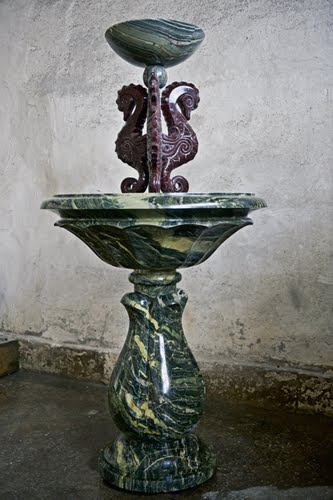
From Tobolsk the party headed for Barnaul in the Altai mountains, 1500 versts to the south. Here there was a massive silver mining industry that produced 36,000lbs of silver a year and much greater quantities of copper and lead. They visited the famous Kolyvan Lapidary works, where huge ornaments were cut from jasper to decorate the palaces of the Tsar.

Kolyvan jasperware

From there the party travelled south to Ust Kamenogorsk (now Oskemen in Kazakhstan) and then back westwards towards Omsk, along the banks of the Irtysch river. It was a substantial journey, totalling more than 15,000 kms.

Despite being warned not to talk about social issues, Humboldt’s report to Cancrin decried the use of slave labour in the mines. His publications showed that he had learned much about the mountain chains and climatology of central Asia and exhibited further his understanding of climatology. He gave technical advice to the Russian government on how to improve the technical processes of the mining and extractive industries and wrote to Cancrin in September 1829: “This year has become the most important of my restless life“.

However, despite his desire to travel further in Siberia and Central Asia, Humboldt resisted an invitation to return due to his disapproval of the restrictions on his freedom of movement. He wanted to find out much more about the role of volcanic activity in the creation of the mountain chains in these regions and this remained an enduring interest.

Murchison in Russia, 1840,1841.

roderick_murchison
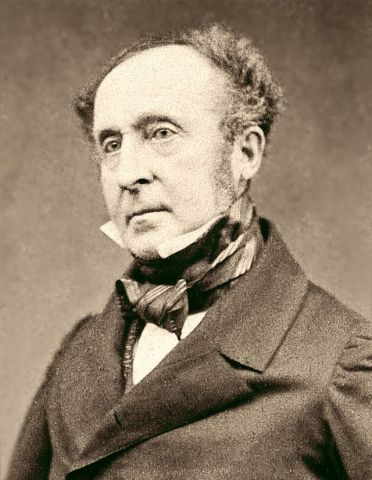
Sir Roderick Murchison

The second great geologist to visit the Urals was Roderick Impey Murchison (1792-1871). A decade after the great German had been there, the Russians approached him – perhaps because Humboldt had refused to return – and persuaded him to look into the minerals and how they could best be exploited. Murchison had his own reasons for making the journeys. He wanted to extend his classification of the older rocks of Western Europe to that part of the Continent. Already he had developed the ideas that led to the establishment of the Silurian System and the Devonian and had worked out that the age of rock strata could be determined by their fossil content. His Russian trips would result in adding the category of the Permian to his system of geology. He also effectively extended the known range of the Palaeozoic strata from the Urals eastwards.

Murchison, who was supportive of the Russian autocracy, was given full diplomatic, financial and logistical support by Tsar Nicholas, who became sponsor of his expeditions. The Tsar wanted to know more precisely what existed and whether or not there was sufficient coal to allow minerals to be brought across the Urals to European Russia. Murchison both corresponded with and met with Humboldt in Berlin before he began his travels in Siberia. When he left for Russia in 1840 he was president of the Geological Society of London. Some have argued that it was these contacts that directed Murchison more towards geography than would otherwise have been the case. For much of his later life he was seen in Britain as the great imperial geographer.

Murchison’s route in the Urals and beyond followed closely that of Humboldt a decade earlier, travelling extensively along the Chusowaya River, for example and visiting the same mines and lapidary works. He too wanted to travel more extensively in Central Asia, but he ran out of time.

Atkinson and Austin’s travels in 1847

Although there is only limited evidence, it seems that Atkinson, was at least familiar with some of the debate and discussion taking place over the stratification of rocks in Siberia and Central Asia, not least because of his discussions with Humboldt. Atkinson had met Humboldt in Berlin on his way to St Petersburg in 1846 and decided to follow the great scientist’s recommendation to travel east in search of untouched places to sketch and paint. It was not the last time they were to be in contact with each other. In her book, Recollections of Tartar Steppes and their Inhabitants (1863), Thomas’ wife Lucy records that Humboldt had told Thomas that he believed islands in the middle of Lake Alakol in what is now Eastern Kazakhstan were volcanic, which he saw as evidence that the Tien Shan Mountains were volcanic in origin. Lucy writes: “It had been told Mr. Atkinson, by Baron Humboldt, that there had been volcanoes in this lake, and, as if in confirmation of his theory, we found near its shores what appeared to be lava. We brought a piece of it with us to Barnaoul, where they have analysed it, but declare it is not lava. Now I do not pretend to tell you what the composition is, nor anything about it. All I can say is, that the spot itself was a lovely one.” Thomas never stopped looking for volcanoes in Central Asia and Siberia, clearly hoping one day to find something that would interest Humboldt.

He had also clearly read Murchison’s book, The Geology of Russia (1845) as he certainly traced the Palaeozoic formations noted by Murchison right across the Kazakh steppes, through Mongolia and into Chinese Tartary. Was it thus a coincidence that Murchison sponsored Atkinson for fellowships of both the RGS and the GSL when the explorer eventually returned to England in 1858? Murchison also played a prominent role in raising funds for Atkinson’s son – born in the steppes – to be educated at Rugby following the explorer’s death in 1861. And also in ensuring that his widow, Lucy Atkinson, received a government pension in 1863. Atkinson’s son later took a job teaching at Durham School, which had been Murchison’s alma mater.

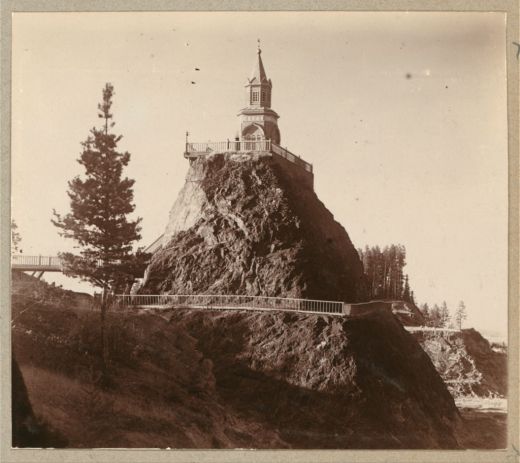
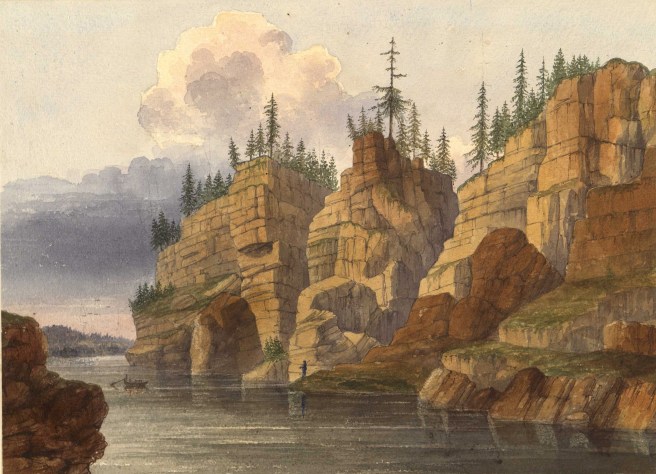
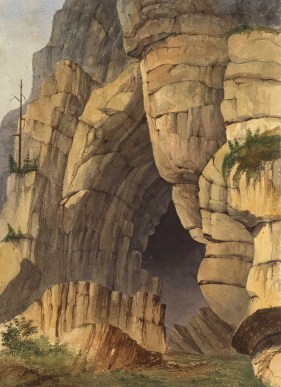
Like both Humboldt and Murchison, Atkinson and Austin spent the first month or so of their travels in 1847 exploring the incredible mineral deposits of the Urals. They too floated on rafts down the Chusowaya River, visited the solid iron ore Mount Blagodat – where Thomas had some kind of epiphany when he was trapped in the tiny chapel on top of the mountain by an electrical storm, surrounded by lightning bolts – and the Lapidary works at Kolyvan. In fact, Thomas’ first serious artistic endeavour was a series of paintings, now in the Hermitage Museum in St Petersburg, of the Chusowaya River.

Chusovaya2a

chusovaya12a

chusovaya3ajpg
Some of Atkinson’s paintings of the Chusowaya River

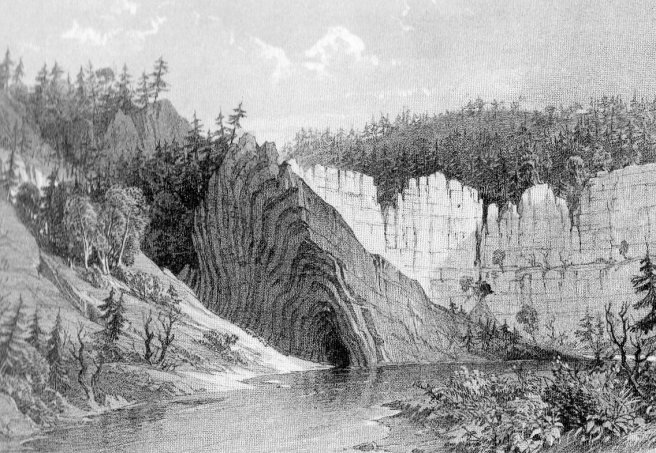
The third of these watercolours bears a remarkable similarity to one of those drawn by  Murchison and published in his book, as can be seen below:

murch003

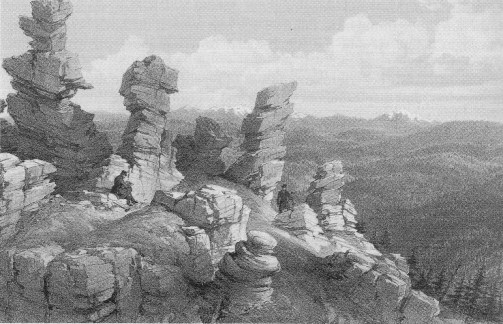
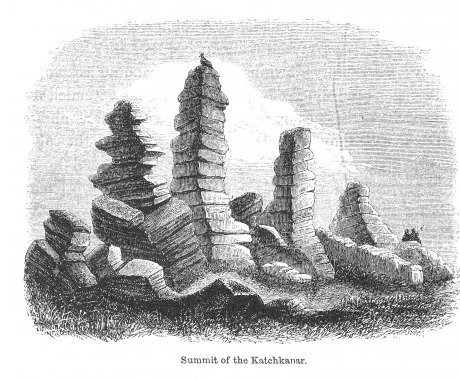
Nor is this the only example of a close correlation between the artworks of Murchison – who had been trained to draw whilst serving as a soldier in the Peninsula Wars – and Atkinson. Their views of the summit of the Katchkanar Mountain in the Urals also bearing striking similarities. Here’s Murchison’s drawing:

murch004

And  here is the same view by Atkinson:

summit-of-the-katchkanarAfter spending a month or so in the Urals, the two men set out for Barnaul, the main town in the Altai Mountains, about 1600kms east of Ekaterinburg. From here they made their way through the mountains south to Zirianovsk, Riddersk and other mining towns in the Altai. In both the Urals and the Altai, so far as I can tell, Atkinson and Austin followed almost exactly the same routes taken by both Humboldt and Murchison. The only slight difference is that Atkinson made a larger detour into the Kazakh steppes, an experience which enthralled him and made him want to come back to sketch and paint the dramatic scenes of nomad life. One major incident must have stuck in his mind – an occasion one night when the encampment he was staying in was attacked by a marauding band of nomads. This baranta (raid) resulted in his hosts losing several hundred horses and cattle, even though Atkinson had opened fire with his rifle in an attempt to drive off the intruders. Atkinson later painted the scene. He can be clearly seen in the middle of the picture firing his weapon.
Night attack on the Aoul of Mohammed

By the end of 1847 Atkinson and Austin were once again back in Barnaul where they settled in for the winter. Except that they didn’t! Both men, independently, returned west. Thomas, we know, got into a sledge on 13th January 1848 and headed 3,500kms due West, travelling non-stop – na perecladnikh – towards Moscow. It would take him the best part of a month. “Pack of wolves 10 versts before Tomsk” he writes in his diary.

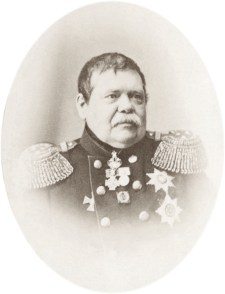
And why has he decided to do this? Because throughout the year he has been away he had not been able to stop thinking about the young lady he had met in St Petersburg. For the previous eight years Lucy Sherrard Finley, 28, the daughter of an East London schoolmaster,  had been working as a governess to the daughter of a Russian aristocrat – General Mikhail Nicolaevitch Muravyev. The Muravyevs were an important Russian family, some of whom had opposed the Tsar in the Decembrist uprising of 1825 and who, for punishment, had been sent into exile in Siberia. One of the Muravyevs had even been hanged as a central planner of the attempted coup. Other members of the family, including Lucy’s employer, had remained loyal to the Tsar. The General was one of the founders of the Russian Geographical Society and this is probably why Atkinson had visited him in the first place.

m-n-muravyev-vilensky

General Mikhail Nikolaevitch Muravyev-Vilensky

Thomas had written 66 letters to Lucy during the time he was away from her in 1847, all carefully noted down in his diary. He arrived in Moscow on the 9th February 1848 and immediately wrote to Lucy in St Petersburg. She, in turn, got into a sleigh for the long journey to Moscow, arriving on 14th February. Two days later in the English chapel of St Andrews, she and Thomas were wed. And two days after that, despite the fact that Lucy had barely sat on a horse before, they set off back for Siberia.

And what about Austin? He too had met a young Swedish lady in St Peterburg, who was apparently giving music lessons in the home of her sister, who lived in the city. Named Adele Hogqvist, she was the illegitimate daughter of a ballet dancer – Johanna Hogqvist – and niece of a well-known actress, Emelie Hogqvist. They married in the British chaplaincy, St Petersburg, on the 10 February 1848, so Charles could not have travelled back with Thomas.

However, that was not the end of the story.

Thomas and Lucy headed straight back to Barnaul and soon after left for the Steppes, taking in the Altai Mountains on their way. That journey is the subject matter of my book: South to the Great Steppe, the travels of Thomas and Lucy Atkinson in Eastern Kazakhstan, 1847-52. Suffice it to say that they got as far as anyone could go at that time – the tiny military outpost of Kapal in the Djungar Alatau Mountains. At that point, in September 1848, it was the most remote outpost of the Imperial Russian Empire. Here, alongside the Tamchiboulac Springs, Lucy gave birth to her son, whom she named Alatau Tamchiboulac Atkinson. He was to accompany the couple for the rest of their long journey throughout Central Asia and Siberia. (Later he migrated to Hawaii, where he became director of education, and director of the first census.)

By October 1849 Thomas and Lucy  were once again back in Barnaul, together with their new son, having spent more than 18 months travelling through some of the most remote parts of Central Asia. They settled in for the winter, taking part in the town’s very active social life during the evenings whilst Thomas turned his sketches into paintings in the day.

And Austin and his new wife Adele? His obituary in The Engineer following his death in April 1893 in London says: “He extended his travels and explorations on two occasions over a wide tract of Siberia. On the first tour he crossed the Altai Mountains to the Chinese frontier and during a subsequent tour, on which he was accompanied by his wife, he visited some of the exile stations of Siberia, the mines of Nerchinsk and the Sayan Mountains to the Chinese frontier, and resided for some time at Irkutsk. In 1862 he presented to the Geological Society, of which he was a Fellow, some notes of these explorations.”

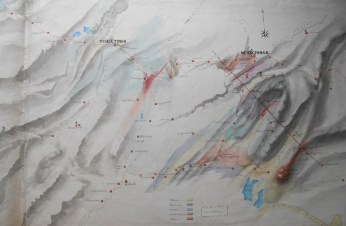
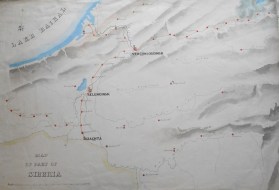
I was curious about this report when I first saw it and even more curious about the map that he had clearly prepared on this trip and which is now in the archives of the Geological Society (GSL). The map is about 2m x 70cm and you can see part of it below. It is entitled Map of Part of Siberia and is hand-drawn. It shows the routes from Irkutsk, close to lake Baikal, south to the Chinese border and east to the great gold mines at Nerchinsk. A red line south-west from Nerchinsk is also the subject of a separate geological section, showing the different rock strata along this line. So why had Austin gone to one of the most remote parts of Eastern Siberia with his new wife? What was he doing?

map-1a map-2a

The papers Austin presented to the GSL in 1862 offer some  clues. We know from the Geological Journal articles he wrote that he presented to the Society some slabs of fossiliferous shale containing specimens of the fossil fish and crustacean shells of Estheria Middendorfii which he had collected from a site about 100 miles south-east of Nerchinsk. Austin himself says he worked out that the beds from which the fish came had been pushed up by volcanic action: “Mr Austin thinks that the shale-beds formed the surface at the time of the last igneous eruption of any magnitude in that part of Siberia and that it was then disturbed and covered by the volcanic products.”

Volcanoes again! But was that really it? One explanation could be that he was looking for signs of more  gold mines like those at Nerchinsk. Another answer could lie in a completely different direction.

A clue can be found in a biography of Count Nikolai Nikolaevitch Muravyev-Amursky (1809-1881), the governor of Eastern Siberia – and cousin of Lucy Atkinson’s former employer in St Petersburg.

473px-konstantin_makovsky_nikolay-muravyov-amursky_1863

Count Nikolai Nikolaevitch Muravyev-Amursky

Muravyev-Amursky had been the architect of Russia’s eastward expansion. His aim: to win back from China the territory along the 3,000-mile Amur River that had been ceded to China in the 17th Century. By the middle of the 19th Century, following the Opium Wars and increasing political and economic domination of the country by Britain and France, China was weak and willing to do a deal with Muravyev-Amursky over the desolate Siberian lands. Eventually, in 1858 China signed the Treaty of Aigun ceding all land north and west of the Amur, including the port of Nikolaevsk. Two years later Russia founded Vladivostok at the mouth of the Ussuri River, giving Russia an ice-free port onto the Pacific. These achievements can be put down to the determination of Muravyev-Amursky.

At the end of 1848 Muravyev-Amursky was on an inspection trip in the gubernias of Yeniseisk and Irkutsk and was gathering data he needed for a proposal to visit the remote Kamchatka Peninsula. Whilst travelling, he was told that an Englishman named Austin, allegedly pursuing geological investigations, had crossed Lake Baikal and via Verkneudinsk and Chita, had reached Nerchinsk.

According to Muravyev-Amursky, Austin had arranged to have a large raft built on which he planned to sail down the Shilka River and the River Amur to its mouth, hoping to find a whaler on which he could cross the Pacific to America, or which could take him straight to Europe.

Being very suspicious of foreigners, particularly Englishmen, and convinced that Austin was a spy, he ordered on of his officers to go to Nerchinsk and catch up with him and bring him back to Irkutsk, ‘dead or alive’.  Austin was back in Irkutsk within 10 days. Muravyev-Amursky immediately reported the incident to St Petersburg and in a personal letter to Interior Minister Lev Perovsky he ranted about how Austin’s uninvited visit had put in jeopardy the Russian project of occupying the Amur. According to one biographer, “Muravyev seems to have been obsessed with the idea that the British might suddenly seize Sakhalin, or the mouth of the Amur, an idea to which he clung for years.” (It should be noted that during the Crimean War only a few years later, Britain and France sent a flotilla of ships to Kamchatka with the intention of seizing it. It was a terrible failure.)

In reply Perovsky wrote: “It is not without foundation that you consider it necessary to warn the English, and that the time has come when this should not be postponed. I fully share your view, but Count Nesselrode (Russian Foreign Minister) is not thinking along these lines.”

He went on to point out that Nesselrode would oppose any decisive measure at the mouth of the Amur, and would be supported by Vronchenko, the Minister of Finance. Nesselrode, he said, feared any possible rupture of friendly relations with England, while Vronchencko would point to the unfavourable consequences for Russian commerce and industry, if there should be a break with China. He warned Muravyev-Amursky that those “upon whom this matter most depends” would accuse him of being hasty, hair-brained, presumptuous and unacquainted with the area he was administering. They would say that he had not considered either the difficulties or the consequences of what he was proposing.

Accordingly, Perovsky advised Muravyev-Amursky to keep the Emperor personally informed on the Amur question, stressing the need for action and the unfortunate consequences of immobility, and to assemble information to demonstrate that if action was carefully taken, Russia’s trade with China would not suffer.

So without further ado Austin was released. He made his way back to St Petersburg with his new wife, got a ship and headed back to England via Sweden (where he called on his in-laws) and soon after returned to Russia, where he worked mostly in the Crimea.

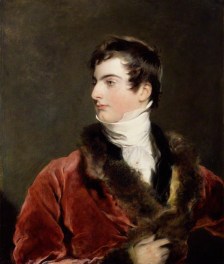
This was, by any account, a remarkable turn of events. So who was Austin working for? The Tsar or the English? One possible clue comes from a most curious fact. John Arthur Douglas Bloomfield (1802-1879), the Second Baron Bloomfield, was from 1844-51, the British envoy in St Petersburg. Bloomfield, in turn, was the lover of Emelie Hogqvist, the aunt of Austin’s wife, who had borne the Baron an illegitimate daughter, Techla Hogqvist.

NPG 1408; John Arthur Douglas Bloomfield, 2nd Baron Bloomfield by Sir Thomas Lawrence
The Second Baron Bloomfield, by Sir Thomas Lawrence, oil on canvas, 1819

Make of that what you will. Either way it is the most intriguing connection.

So now it only remains to look at the Atkinsons. What did they do after their long expedition to central Asia and return to Barnaul in the winter of 1849? Early the following year they headed east and also ended up in Irkutsk in eastern Siberia, where they were to spend much of the next three years. The Atkinsons met with Muravyev-Amursky and his French wife and spent much time in their company. Although he clearly trusted Lucy because of her connections to his cousin in St Peterburg, he never permitted Thomas to visit Nerchinsk or to travel along the Amur River, despite strong efforts by the latter to do so.

Instead, the Atkinsons spent the summer months exploring the regions around Irkutsk and south into Mongolia. One of the papers he presented to the GSL on his return to England in 1858 was entitled “On the Volcanoes of Central Asia, commencing with the Baikal, in Oriental Siberia, and extending into Mongolia and Chinese Tartary, illustrated by a beautiful series of drawings of the principal volcanic scenes described.”  Note the title and its reference to volcanoes. He told the Fellows he was not intending to furnish a strictly geological account, but said that he had been on Lake Baikal and he gave one of the first accurate accounts in English of its physical appearance. “There was no appearance of volcanoes ever having been in action either on the northern shore or on the island (of Olchon, in the middle of the lake).” He also described a conical shaped island in the middle of Lake Kossogol (Hovsgol) in Mongolia which he believed to be volcanic.

Then he described what may have been his most important geological discovery – in what is known today as the Jom-Bolok Valley, where he (Lucy travelled with him on this expedition) found a lava bed more than a mile in width, extending across the valley and reaching in some places to a wall 40 feet high. After a five-day journey following the lava flow he found the crater which was two miles long and three-quarters of a mile in width.

Ride01

He was the first person ever to visit this important valley , which has since been far more extensively studied. Kropotkin visited it in 1865, but the reason why Thomas is likely to have been the first person to visit the valley is that the local Buryats refused to go there, believing it was haunted.

That volcano turned out to be quite important. It is today known as the Jom-Bolok volcanic field and lies in the Eastern Sayan mountains to the west of Irkutsk. As described by Atkinson, the lava flow is around 70kms in length and around 100km2 in area. “The area and volume of this flow file ranks this eruption highly in the global record of fissure-fed effusive eruptions”, according to one academic study by Russian geologists.

Ten years ago, the Russian geologists who published the paper which discusses this group of volcanoes decided, in order to right a historical wrong, to name one of the cones in this volcano field Atkinson Volcano. Today you can trek there, but 160 years ago it was definitely terra incognita. After years of searching he had finally found what Humboldt had told him to look out for – volcanoes.

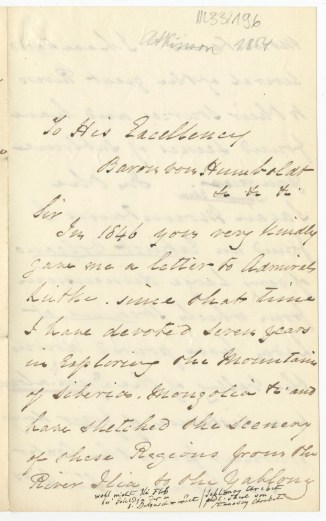
So excited was Thomas by his discovery that when he got back to St Petersburg,  he wrote to Humboldt in Berlin, enclosing a little present for him in a letter dated 26 April 1854:

In 1846 you very kindly gave me a letter to Admiral Lutke. Since that time I have devoted seven years in exploring the mountains of Siberia, Mongolia and have sketched the scenery of these regions from the River Ili to the Yablong Mountains. I have traced several of the great rivers to their sources and have found scenes of subline grandeur. In the Sayan Mountains I found an extinct volcano of very large dimensions from which streams of lava have poured down the valley of the Djem-a-Louk to a distance of four days’ journey from the crater. The bearer of this, Mrs Capley, will hand you a specimen of the lava which I brought along with me. Having made sketches of this most interesting place it will afford me great pleasure to send you copies of them should you deem them of any value. Probably they may possess some interests as this is the only volcanic crater that has been found in these regions. Hoping you will not deem me intrusive.

I remain with most sincere respect, Your obedient servant

TW Atkinson”.

Letter to Humboldt-pic

Thomas Atkinson’s letter to Humboldt

Humboldt, rather surprisingly, did nothing immediately. Eventually, in 1857 he must have reviewed his correspondence and he wrote in great excitement to Carl Ritter (1779-1859), his great collaborator.

I did not answer Herr Atkinson in 1854 because the four days’ journey lava flow put me off and I feared the accompanying (female) painter would only send pictures for the King and be focussed on/encourage monetary transactions.  I have been wrong.

“Keep, dear friend, Herr Atkinson’s letter.  Should this be the point which we are seeking and how should we be travelling to Irkutz and the Baikal Sea even though we have earlier heard nothing of it?”

What is amazing is that Humboldt, at the age of 88 – both he and Ritter died in 1859 – should still be thinking of travelling out to Siberia to investigate a report of a volcano. That is how important a discovery it was.

So there we have it. The mystery of Austin’s map at the Geological Society of London, turned into a wonderful story about volcanoes in Siberia and Central Asia, involving two of the greatest names in the history of geology. We may not have entirely resolved the matter of Austin’s remarkable map, but I hope to have shown that Thomas’s discoveries were not insignificant. They were enough to inspire the greatest geologist of the age, at the ripe old age of 88, to consider making a trip to Eastern Siberia.

(This is an abridged and edited version of the talk I delivered at the Geological Society of London on 28 April 2016.)

Atkinson talk at Cambridge University Nauryz celebration

On 12th March ‘South to the Great Steppe: The Travels of Thomas and Lucy Atkinson in Eastern Kazakhstan, 1847-1852’ by Nick Fielding was presented at the annual Nauryz celebration at Cambridge University, organised by the Cambridge Central Asia Forum (CCAF) and held at Jesus College. Attendees included Professor Ian White, Master of Jesus College and Deputy Vice Chancellor of the University, H.E. Mr. Erzhan Kazykhanov, the Ambassador of Kazakhstan to the UK and Professor Peter Nolan, Director of the Centre of Development  Studies. Dr. Siddharth Saxena, CCAF Chair, moderated the programme.
Others attending included heads of the diplomatic missions accredited in the UK, government officials, together with staff and students from the University of Cambridge.
Dr. Siddharth Saxena, Professor Ian White and Mr. Erzhan Kazykhanov made welcome addresses. Mr. Nick Fielding, the author of the book, gave an insight into the life of Thomas Atkinson and gave a detailed account of the travels the explorer undertook with his wife, Lucy Atkinson, to the Great Steppe in the 19th century.
The presentation was followed by a concert in the honour of the Nauryz celebration organised by Cambridge Central Asia Forum in collaboration with the Cambridge University Kazakh Society in the ancient Chapel of Jesus College. More than four hundred people attended the events.Cambridge 12 March 2016