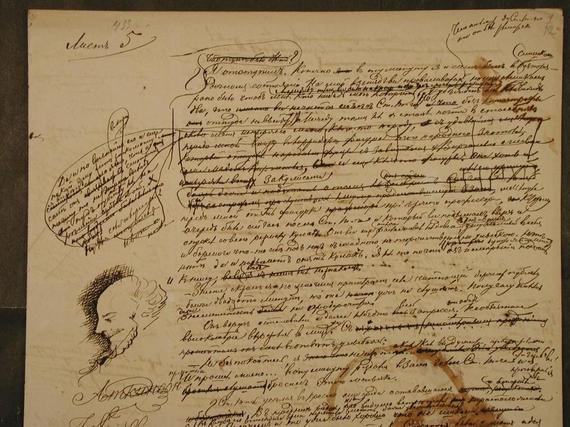
In 2014 a scrappy piece of paper covered with jottings by the great Russian author Fyodor Dostoevsky caused a bit of a stir, due to various doodles in the margin.
The page contained notes that were later used by Dostoevsky in his novel Demons, first published in 1871. One of the doodles was of a man’s head – see the picture below – which most experts took to be a portrait of William Shakespeare. However, beneath the little portrait can just be made out (in Cyrillic) the name ‘Atkinson’. Nothing else connects to the name and there is no further explanation. Who was this Atkinson mentioned by the great writer?
The name Atkinson can be made out just below the portrait.
According to scholars, it could only be one of two men; either Thomas Witlam Atkinson or the British art critic Joseph Beavington Atkinson (1822-86). Which one was it?
First, let’s deal with the question of whether or not the portrait is ‘Atkinson’. All the experts seem to agree that it is too close to the famous ‘Chandos’ portrait of Shakespeare to be anyone else. That being said, there is a very superficial resemblance to Thomas Atkinson, although it is extremely unlikely that Dostoevsky ever met him. Dostoevsky was imprisoned in Omsk in Western Siberia from 1851-54 and subsequently lived in Semipalatinsk – in what is now northern Kazakhstan – for a while after that, but there is no evidence from either man that they met.
Considering the name alone, let’s look at the case for Joseph Beavington Atkinson first. Dostoevsky expert Professor Nikolay Zakharov notes that in his diary Dostoevsky mentions an anonymous article called “Angliyskaya kniga o russkom isskustve i russkikh khudozhnikakh” (“An English Book about the Russian Art and Russian Artists”) which retells and includes excerpts from J. B. Atkinson’s book An Art Tour to Northern Capitals of Europe (London, 1873). Zakharov assumes Dostoevsky would have been provoked by Atkinson’s claims in the book that “up to now, the Russian school of art has not developed new styles or new themes”.
However, the date of the Atkinson book is a little late, considering that Dostoevsky’s novel was published in 1871.
Fyodor Dostoevsky
So what about Thomas? As stated above, Dostoevsky was imprisoned in Siberia for several years and could certainly have heard about the odd English couple and their child roving around the Siberian and Central Asian steppes at that time.
We also know that when he was living in Semipalatinsk, from 1854-56, Dostoevsky became friendly with Baron Alexander Egorovich Wrangel (1833-1915), an admirer of his books. They both rented houses in the Cossack Garden outside Semipalatinsk and the baron later wrote a book of reminiscences about his encounters with Dostoevsky.
Interestingly, in 1848-9 when Thomas and Lucy were living in Kapal in what is now eastern Kazakhstan – and directly south of Semipalatinsk – they also knew a Baron Wrangel, who was the commanding officer of the small outpost. As Thomas notes in Travels in the Regions of the Upper and Lower Amoor: “The society among which I was thrown was of a mixed character. At the head of the civil department was a German baron, who had won glory in the Caucasus, where he had received a wound from a Circassian sabre, that nearly proved fatal. He was the Priestoff, or political agent, whose duties were with the Kirghis. He was a good soldier, had few scruples, and was a most amusing fellow, believing himself equal to Nesselrode in diplomacy. Were fiction and invention essential in the acquirements of a minister, I would back the Baron against the Count.”
Thomas does not name the Baron, but Lucy does – more than 30 times! She writes many amusing anecdotes about Baron Wrangel, who was clearly a good friend of her husband. She even describes the two men playing duets – Thomas on the flute and the baron on the guitar.
Was this the same Baron Wrangel? Without knowing the full name of the Baron known to the Atkinsons it is difficult to be sure. Thomas’ baron had been wounded in the Caucasus, so that might be a clue. The baron known to Dostoevsky was born in 1833, which might make him too young to have been the same person known to the Atkinsons. If not, he was probably a close relative.
However, there are even more possible connections. We know that Dostoevsky went to live in Barnaul after leaving Semipalatinsk. Again, the Atkinsons were well known there, having spent two winters in the town. It seems very unlikely that Dostoevsky did not hear something of them during the time he spent there.
So, although we cannot prove definitively that Dostoevsky was referring to Thomas Atkinson in his marginalia, the likelihood seems very high. Did he ever appear as a character in a Dostoevsky novel? That is up to you, dear readers, to find out.
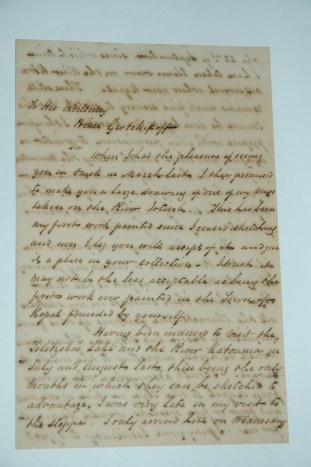
When Thomas and Lucy Atkinson arrived on horseback in Kapal* in Eastern Kazakhstan in the autumn of 1848, they had no intention of staying in this remote Cossack settlement on the borders of China. That much is clear from a letter Thomas wrote to Prince Pyotr Dmietrievich Gorchakov in November 1848 and which is part of the Dahlquist Collection in Hawaii.
Atkinson had met Gorchakov, who was governor-general of Western Siberia, at Omsk in March that year, at the beginning of his and Lucy’s travels into Siberia. At that meeting he promised the governor a large painting of the River Irtisch, which runs along the border between the Kazakh Steppes and the southern border of Western Siberia. Only now was he in a position to send the completed work. On 19th November 1848 he wrote to Gorchakov, his letter presumably enclosing a rolled-up copy of the promised picture. “I trust it may not be the less acceptable as being the first work ever painted in the town of Kapal, founded by yourself”, writes Thomas.
Prince Pyotr Gorchakov
Thomas tells Gorchakov that he arrived in Kapal on 22nd September 1848, “since which time I have taken 11 views on the River Kora and several others near Kopal.” He adds that his intention is to move from Kapal to the more established town of Ayagus, which lies around 300km to the north. From Ayagus he would return south to the Djungar Alatau mountains in the spring in order to continue his sketching. Thomas asks for permission to continue his journey as far south as the River Illi, as “I should then embrace in my sketches all the characteristic features of this great mountain chain and steppe”.
Atkinson’s letter to Prince Gorchakov
One reason for the decision to move north may have been the birth of his son, which had occurred a couple of weeks previously. As he tells the governor: “I must not forget to tell you that on 4th November Mrs Atkinson presented me with a son, the first and perhaps the only Englishman that will ever be born in Kapal. This circumstance detained us here three weeks longer still.”
In fact, continuing snow and a very harsh winter prevented Thomas, Lucy and the newborn Alatau from leaving Kapal until the following May. As far as I can determine Thomas was denied permission to visit the Illi valley, which at that time was barely under Russian control. The danger of capture (or worse) by Kirghiz tribesmen was very real and the Chinese border was very close.
As for the picture Thomas sent to Prince Gorchakov – not to mention the 11 views of the Kora River – to date there is no record of it. It does not appear to be in any of the major Russian museums, so for now its whereabouts remains a mystery.
*Kapal is a small town in the Zhetysu region of Kazakhstan, in the foothills of the Djungar Alatau mountains. In the summer of 2016 I took a group of ten Atkinson descendants to the town, where they unveiled a superb monument commemorating the birth there of Alatau Tamchiboulac Atkinson on 4th November 1848.
I am grateful to Sally Hayles for ferreting out diary entries from 1830 logged by a member of the Spencer Stanhope family that shed further light on the early architectural career of Thomas Witlam Atkinson. The entries, from a diary compiled by the Reverend Charles Spencer Stanhope, relate to the construction of a tomb and show that the young architect was held in high esteem by the family on whose estate he had been raised.
Charles was the tenth child (of 15!) of Walter Spencer Stanhope, the incumbent at the Cannon Hall estate at Cawthorne, near Barnsley in South Yorkshire. He was only four years older than Thomas and had a lifelong friendship with him and corresponded with him almost to his dying day. Throughout much of his life he kept a detailed diary, now held in the Barnsley Archives.
A young Walter Spencer Stanhope
Thomas had been born on the estate, where his father was the Spencer Stanhope’s senior mason and his mother a maid in the hall. There he spent his early years learning his trade alongside his father.
When it became clear that the young man had a talent for drawing, the Spencer Stanhopes encouraged him to refine his skills and to move on from mason to builder’s clerk of works and then to become an architect in his own right. According to Lady Elizabeth Stanhope in her book The Letter Bag of Lady Elizabeth Stanhope: “By and by, owing to the influence of John Stanhope and his brother Charles, who were greatly struck by his talent, Atkinson went first to Manchester and thence to London, where he set up as an architect and where his advance to fame was rapid.”
As early as 1825 John Spencer Stanhope had introduced the aspiring young architect to Richard Westmacott (1775-1856), the great sculptor whose statue of Achilles in Hyde Park and of William Pitt the Younger at Westminster are well known.
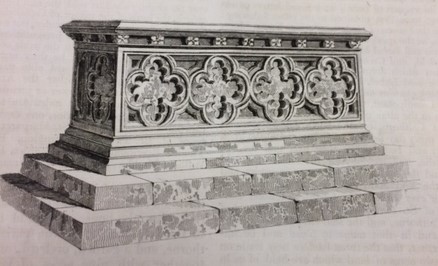
Charles Spencer Stanhope became vicar of Weaverham in Cheshire in 1839 and for 52 years was non-resident vicar of Cawthorne, which he visited regularly. That he was impressed by the up-and-coming young architect is shown by the fact the family commissioned Atkinson to design and construct a tomb for Walter Spencer Stanhope, following his death in 1821. The tomb was to be placed within All Saints Church in Cawthorne and was one of his earliest works.
At around this time Thomas also presented Charles Spencer Stanhope with a picture of the Barnby choir stalls at All Saints, inscribed as follows: “To the Reverend Charles Spencer Stanhope, an admirer of Antiquities. This plate is inscribed with sentiments of esteem by T.W. Atkinson.”
Atkinson’s etching of the Barnby choir stalls at Cawthorne (Private collection). Walter Spencer Stanhope’s tomb can be seen in the background.
Also located in the same churchyard are the ornate gravestone carved by Atkinson for his mother and a tablet dedicated to his father.
Designed in the Gothic style championed by Atkinson at this time in his life, the tomb for Walter Spencer Stanhope was, according to Hunter’s Deanery (vol 11,p237) “designed by Mr. Atkinson after the model of the tombs of the early Tudor reigns.” It was not until 1830 that the family finally gave the go-ahead for the tomb to be built.
Atkinson’s design for Walter Spencer Stanhope’s tomb
We knew very little about this until Sally Hayles recently located Charles Spencer Stanhope’s diaries in the Barnsley Archives – to whom we are grateful for permission to quote, particularly to Paul Stebbing. It contains many references to Thomas Atkinson, particularly to his visit to Cawthorne in February 1830 to supervise the installation of the tomb.
Charles’ diary notes on 16th February 1830: “Atkinson has not arrived.” The following day he went with his older brother John – who had succeeded his father as the new owner of Cannon Hall – to inspect the tomb as designed by Atkinson. He notes that they stopped a local mason, Ibbotson, from proceeding with the work until Atkinson had arrived from London. Two days later Charles notes “Atkinson made his appearance in the evening.”
The following day Charles and Thomas called on the Reverend Small at All Saints in Cawthorne to talk to him about the exact position of the tomb and to unpack the stone tablets from which it was assembled and on one of which a dedication was carved.
Over the next week Charles records several long walks with Atkinson. One visit was to a salt mine in Cheshire. What they discussed is not recorded, but it is clear that the two men were close. By Friday 26th February Thomas was taking measurements in the Church and had also begun a drawing of one of the grand rooms at Cannon Hall.
A page from Charles’ diary
The extent of Charles’ interest in and encouragement of Thomas can be gauged from the fact that the former records that he walked from Cawthorne to Doncaster – a distance of over 20 miles – to try and get subscribers for Thomas’ part-publication Gothic Ornaments Selected from the Different Cathedrals and Churches of England. The book, which was issued in 1829, was published in folio, ie with one or two plates published every week to subscribers.
On 1st March Charles records that Thomas was still busy taking measurements in the church. He was finished a few days later. Much later, the tomb was moved and today is partly obscured by being built into the wall of the church.
Walter Spencer Stanhope’s tomb today
Following his return from Siberia and Central Asia, Thomas Atkinson was to make a final return to Cawthorne in October 1860. There is not enough space here to describe that journey in full, but it is worth including the following anecdote from Lady Elizabeth Spencer Stanhope:
“Walking in Cawthorne shortly after his arrival, Atkinson encountered one of the cronies of his youth. The man, who had passed his life in the same little trivial round in his native village, failed to grasp the gulf which now separated him from the man of European reputation, the great architect, the great author, the world-wide traveller and the acquaintance of an Emperor. Clapping his old comrade heartily on the back, this friend of a dead past hailed Atkinson with the approving, if somewhat tactless comment, “And soa, lad, you’ve cum back to lay your ould bones among ous”. Atkinson, it is said, failed to appreciate the familiarity of this typical Yorkshire welcome and did not again honour Cawthorne with his presence.”
A good story – if a little harsh. After all, within nine months of this visit Atkinson was dead.
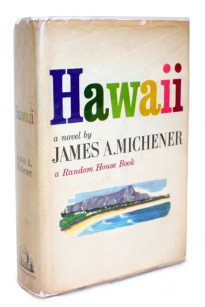
In 1959, to mark Hawaii’s attainment of full US statehood, James A Michener, the novelist and author of the Broadway hit South Pacific, published his blockbuster novel Hawaii, which has since sold tens of thousands of copies. One of the most intriguing characters in the book is called Uliassutai Karakorum Blake, portrayed as a strict schoolmaster whose influence on his pupils was huge. This unusual name is clearly inspired by that of Alatau Tamchiboulac Atkinson, Thomas and Lucy Atkinson’s son[i].
Alatau Atkinson was born in eastern Kazakhstan in 1848, spent his first five years travelling with his parents through Siberia and Central Asia and eventually, at the age of 21, emigrated with his wife and first of seven children from England to Hawaii, where he died in 1906.
In the essay below Marianne Simpson – a direct descendant of Lucy Atkinson’s brother – explores the character of Michener’s creation and the extent to which it was based on that of Alatau.
Marianne Simpson writes: That Alatau Tamchiboulac Atkinson left a lasting impression on Hawaii and popular culture is evident from his inclusion, in the person of Uliassutai Karakoram Blake, in James A Michener’s 1959 novel, Hawaii.
James A Michener and his blockbuster, Hawaii, published in 1959
While we will never know who Michener’s informant was, his/her tales about Alatau obviously caught Michener’s imagination because he says Blake is the only character in this epic 900-page novel based on an historical person. Michener presents a fascinating and compelling portrait, starting with an account of Alatau’s origins which, despite some factual errors, is clearly recognisable:
“…the ablest [Сhinese] now flocked to Iolani [School] to which Nyuk Tsin [fictional character in the book] now brought her sons. She was met by one of the most unlikely men ever to inhabit Hawaii, Uliassutai Karakoram Blake, a tall, reedy Englishman with fierce moustaches and a completely bald head, even though he was only twenty-eight.His adventurous Shropshire parents had been with a camel caravan heading across Outer Mongolia from the town of his first name to the town of his second when he was prematurely born, ‘jolted loose ere my time,’ he liked to explain, ‘by the rumbling motion of a camel which practically destroyed my sainted mother’s pelvic structure.’ He had grown up speaking Chinese, Russian, Mongolian, French, German and English. He had long ago learned not to try his Chinese on the Orientals living in Hawaii, for they spoke only Cantonese and Punti, and to him these were alien languages, but when Nyuk Tsin spoke to him in Hakka, it sounded enough like Mandarin for him to respond.”
Alatau Atkinson
Alatau’s proficiency in these languages clearly reflects the geography of his early childhood. The knowledge of German however is interesting. Keeping in mind that his father had previously spent time in Germany and that he had a half-brother buried there, did the family perhaps spend an extended time in that country on their way back from Russia to England?
Michener continued his description of Blake: “In later years, when Hawaii was civilised and lived by formal accreditations, no teacher who drifted off a whaling boat one afternoon, his head shaved bald, no credentials, with moustaches that reached out four inches, and with a name like Uliassutai Karakoram Blake could have been accepted in the schools. But, in 1872, when this outlandish man did just that, Iolani needed teachers, and in Blake they found a man who was to leave on the islands an indelible imprint. When the Bishop first stared at the frightening-looking young man and asked, ‘What are your credentials for teaching?’, Blake replied, ‘Sir, I was bred on camels’ milk’, and the answer was so ridiculous that he was employed.”
While the “ridiculous” claim has a ring of truth (and of course makes a great story!), it is unlikely to have formed the full answer because, between 1868 and 1869, before he left for Hawaii, Alatau had served as “third assistant master” at Durham School, a fee-paying school in the north of England with an enrolment of 150 boys.
Durham School
As well as teaching the traditional curriculum for boys destined for university (Classical Greek, Latin, English Prose and Composition and Mathematics), there was also a “modern department” for boys not intended for university which perhaps gave Alatau the broader experience which he was to apply so successfully in Honolulu.
There was also a flourishing boat club which (if he had not had exposure to boating at his old school of Rugby) may have been his initiation into the boating which he was subsequently to recommend to his students at Iolani.
Overall, what we see here is a young man of considerable self-confidence, striking out into foreign lands with seemingly little concern about what he might encounter, but rather an assurance based on a solid belief that he was equal to whatever the challenges.
Michener is silent on Alatau’s career and influence as a newspaper editor and it is indeed possible that he was unaware of it. Rather, he focussed his attention on Alatau’s role as an educator and the enormous benefit he brought to the growing Chinese community (thereby strongly suggesting that his informant was of Chinese origin). He writes:
“If Blake had been employed in a first-rate school like Punahou, then one of the finest west of Illinois, it wouldn’t have mattered whether he was capable or not, for after Punahou his scholars would go on to Yale, and oversights could be corrected. Or if the teachers in the school were inadequate, the parents at home were capable of repairing omissions. But at Iolani the students either got an education from the available teachers, or they got none at all, and it was Blake’s unique contribution to Hawaii that, with his fierce moustaches and his outrageous insistence upon the niceties of English manners, he educated the Chinese. He made them speak a polished English, cursing them in pidgin when they didn’t.”
The period of Alatau’s incumbency at Iolani coincided with a significant rise in the Chinese population in Hawaii. The Chinese had first begun to arrive in considerable numbers in 1852, when they were contracted to work in the sugar fields. When their five-year contracts expired, they did not renew them but chose to work in haole (white) households, as clerks or to set up small businesses. By 1882, their number in Honolulu was hovering around 5,000, 20% of the town’s population, and, at one point, they actually outnumbered the white population.
Chinese migrants to Hawaii in the 1890s
Michener continued: “In these years there were many in Hawaii who…did not want Chinese going to college or owning big companies. They were sincerely afraid of Oriental businessmen and intellectuals. They hoped, falsely as it proved, that the Chinese would be perpetually content to work on the plantations without acquiring any higher aspirations, and when they saw their dream proving false…they sometimes grew panicky and talked of passing ridiculous laws, or of exiling all Chinese.
What these frightened men should have done was much simpler: they should have shot Uliassutai Karakoram Blake…When Blake taught the first Chinese boy the alphabet, the old system of indentured labor was doomed…The Chinese experiment might have failed except that Uliassutai Karakoram Blake was quietly teaching his boys: ‘The same virtues that are extolled in China will lead to success in Hawaii. Study, listen to your parents, save your money, align yourselves with honest men.’ Not only did he teach them; he inspired them: “He taught them to sail boats in the harbour, contending that no man could be a gentleman who did not own a horse and a boat. Above all, he treated them as if they were not Chinese; he acted as if they were entitled to run banks, or to be elected to the legislature, or to own land.”
Alatau, who had nothing with which to commend himself apart from his intellect and education and who probably saw parallels between himself and the landless Chinese arriving in Hawaii, counselled his students to conform to the expectations of the dominant culture. Michener records his injunction: “Cut your pigtails and dress like Americans. Join their churches. Forget that you are Chinese.”
One famous student from Iolani School who was to cut his pigtails and convert to Christianity was the first President and founding father of the Republic of China, Sun Yat-Sen.
Sun Yat-Sen
Respecting Sun, Michener wrote: “For his part, the eccentric Englishman found real joy in talking with one of the two people who understood his dynamic interpretation of the world. The other was a thin, hawk-eyed young revolutionary then seeking refuge in Hawaii: Sun Yat-Sen. Even better than Nyuk Tsin, he comprehended what his teacher Blake was talking about.”
It is fascinating to consider that Alatau may have been a preceptor to Sun. Sun, born in 1866, was a student at Iolani School between 1879 and 1882 and, while Alatau appears in the press as being appointed Principal of the Fort Street School in March 1878, the records of Iolani School nevertheless list him as head of school in about 1871 and, again, from 1874 to 1888, so it would appear that he, at the least, remained very much involved in the school and Michener’s claim may accordingly be true.
While at Iolani, Sun was exposed to English constitutional law and European history[ii] and it was at Iolani that he began to consider the possibilities for a better China. It is interesting that, after his return to China, Sun made several subsequent visits to Hawaii: could they perhaps have included visits to the Atkinson home?
Michener makes the provocative claim that Uliassutai/Alatau was Buddhist. He states unequivocally that the schoolmaster “converted them [his students] to the Church of England while he himself remained Buddhist” and, in response to a boy asking him why he remained such, has Uliassutai/Alatau replying, “When I leave Hawaii, I shall return to England, where freedoms of all kind are permitted. But you will not leave these islands. You will have to live among Americans, and they despise most freedoms, so conform.” (Unsurprisingly, Michener, an American, describes him as a difficult, opinionated man!)
The statement sounds authentic, but it sits somewhat oddly with Alatau’s later ardent espousal of union with America. Perhaps, over time, as his attachment to and hopes for Hawaii grew, he came to consider the merits of annexation as outweighing the perceived intolerances.
The Buddhist claim is intriguing, especially as Alatau is on record as playing the organ in the Kawaiahao church and St Andrew’s Episcopal Cathedral, in which latter place his funeral also took place. If he was at heart Buddhist, could his participation in Christian services have been a case of applying to himself the conformity that he counselled others?
Overall Michener portrays Alatau as a man radiating a powerful and dynamic presence, but also well aware of his own considerable gifts. He is depicted as saying: “The compassionate Buddha knows that at Iolani I have given you Chinese the salt of my blood and the convolutions of my brain, and I have raised you from ignorance into light, and the compassionate Buddha also knows that I wish I had done half as well with my light as you wonderful people have done with yours. If I had, I wouldn’t now be toiling out the evening years of my life as an underpaid schoolmaster.”
As Alatau later rose to become Hawaii’s Inspector-General of Education, Michener was clearly unaware of his later career but perhaps he nevertheless captured the essence of the man? Michener concluded: “The Chinese loved this ridiculous man and his circumlocutions. With his British regard for proprieties and his Oriental love of bombast, he seemed Chinese.”
In Michener’s portrait, we see a human side to Alatau only occasionally apparent in the numerous press references to him. That he was esteemed by the Orientals was known by his fulsome obituary in the Japanese Hawaiian press. But that he was the means by which the Chinese ultimately rose to assume positions of prominence in Hawaii, if Michener is correct – and there seems little reason to doubt him – is significant new information and shows him to have been a man with an incisively broad world view well ahead of his times. If any reader has access to the early Chinese Hawaiian press (Lung Kee Sun Bo, Wah Ha Bo, Lai Kee Bo or the Man Sang Yat Po newspapers), a search for an obituary of Alatau or any other reference to him could make a significant contribution to this ongoing area of research.
Notes:
[i] In the very brief introduction to his book Hawaii, Michener writes: “This is a novel. It is true to the spirit and history of Hawaii, but the characters, the families, the institutions and most of the events are imaginary – except that the English school-teacher Uliassutai Karakoram Blake is founded upon a historical person who accomplished much in Hawaii.”
Alatau’s name comes from the mountain range (the Djungar Alatau) behind the town where he was born and the medicinal spring in the town (Tamchiboulac) close to the house in which Lucy gave birth. Uliassutai is a town in north-west Mongolia, and Karakorum is the old name for Genghis Khan’s capital.
[ii] Alatau is recorded as giving history lectures to the general public.
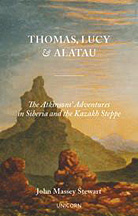
John Massey Stewart’s long-awaited biography of the Atkinsons is now due to be published in late June. Called Thomas, Lucy & Alatau: The Atkinsons’ Adventures in Siberia and the Kazakh Steppe, it is being published by Unicorn Press at £25. According to the advance publicity, it is “the first full biography of an unjustly forgotten man: Thomas Witlam Atkinson (1799-1861), architect, artist, traveller extraordinaire, author – and bigamist“.
We very much look forward to this book’s publication, not least because it contains copies of Atkinson’s paintings that have not been made public previously. Biographically, it will be interesting to see how much it adds to my book, South to the Great Steppe: the travels of Thomas and Lucy Atkinson in Eastern Kazakhstan 1847-1852 (FIRST, 2015), to Susanna Hoe’s superb chapter on the Atkinsons in Travels in Tandem (Holo Books, 2012), Sally Hayles chapter on Thomas in The Hidden Artists of Barnsley (Barnsley Art on Your Doorstep, 2015), Marianne Simpson’s pamphlet on Alatau, To a Higher Destiny, and to the more than 100 postings that have appeared on this blog.
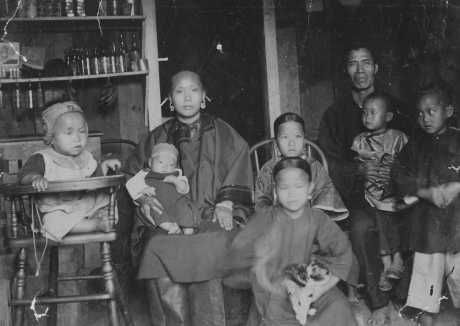
The picture above – sorry for the quality – shows, on the right, the famous author Jack London. Standing alongside him is ALC ‘Jack’ Atkinson, eldest son of Alatau Atkinson and grandson of Thomas Witlam Atkinson.
It was taken in Hawaii in 1907 on one of Jack London’s many visits to the islands he first visited in 1904. He quickly struck up a relationship with Jack Atkinson and the two men were soon known as ‘The Two Jacks’, which is how they are described by Jack London’s wife Charmian in her book Jack London and Hawaii (Mills and Boon, London, 1918). Jack Atkinson was effectively governor of Hawaii at this time and introduced the other Jack to the pleasures of surfing. The picture above appeared in this book.
According to the website Legendary Surfers, “Jack Londonfirst arrived in Hawaii in 1904 and at the end of June, like all visitors of renown, was given his first experience with asurf-ride at Waikiki by local expert canoe-surfers, Jack Atkinsonand Col. McFarlane.” Atkinson later went on to found the Outriggers Canoe Club, the world’s first surfing club, where he also introduced Alice Roosevelt, daughter of US President Theodore Roosevelt, to the pleasures of surfing. Kenneth Atkinson, Alatau’s youngest son, was also a keen surfer who played an active role in the early days of surfing in Hawaii.
Finally, just a quick note to say that this is the 100th posting on this blog, creating an unrivalled body of information on the remarkable exploits of the Atkinson family. Whew!
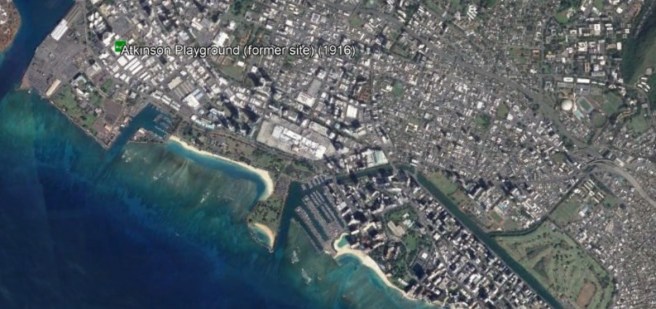
I am publishing today two pictures from Hawai’i. The first was published recently in a pamphlet about the origins of playgrounds and parks in Hawai’i and shows ‘Atkinson Playground’ at its opening in 1916. The Park was one of four created by the Free Kindergarden and Children’s Aid Association and, in part at least, was aimed at providing a place in which youngsters could gather and keep out of trouble. As it was created after 1906 – the year in which Alatau Atkinson died – we must presume it was created in his memory. Alatau Atkinson, who arrived in Hawai’i in 1869, was initially a school teacher, but rose to become Inspector-General of Schools for the islands and well-known for his enlightened attitudes, including the championing of English as the language of instruction and establishing ‘special schools’ for difficult children.
The map below shows the location of the park, which existed up until the 1950s. Today, the playground is buried beneath large warehouses and is at the western end of Ala Moana Drive, which runs along the waterfront in Honolulu, just to the west of Waikiki. We know that Alatau’s son, Robert Atkinson, through his involvement and ownership of the Hawaiian Dredging Company, was responsible for developing much of the land in this area and reclaiming it from the sea. At the east end of Ala Moana Drive is Atkinson Drive, which connects to Kapiolani Drive, one of the city’s major thoroughfares.
Ala Moana Drive runs from north west to south east on this aerial map.
You can see the location of the playground more clearly on the map below – thanks to Peter T Young for pointing it out to me – where it is in the top right quarter.
My second picture, which comes from a postcard, shows a view of Lahainahula High School, which is located on the island of Maui and was the earliest school established by missionaries in Hawai’i; for many years it was the leading educational establishment on the islands.
Atkinson Hall, Lahainahula High School, Maui
In fact, the picture shows the Atkinson Hall at the school. Sadly, the hall no longer exists , but we do know that there is a connection with Alatau. In 1904, in his capacity as Inspector General, Alatau delivered the address at the formal opening of the Lahainaluna Technical High School, where the idea of offering practical subjects to pupils was pioneered. Perhaps that it how the hall got its name. Any further information on this or on Atkinson Playground in Honolulu, would be most welcome. We will come back to this subject.
One of the most remarkable surviving exchanges of correspondence involving Thomas Atkinson is a pair of letters between him and the great Victorian novelist Charles Dickens. The letters, part of the Dahlquist Collection in Hawaii, shed unexpected light on the plight of the Siberian exiles that Thomas and his wife Lucy met during their travels in that vast territory.
Thomas wrote to Dickens in the summer of 1857, very soon after he had first arrived back in England from Russia. “I called at your house yesterday and unfortunately found you had gone to the country for Midsummer. If indeed I had found you at home most probably you would have decided it rude that a perfect stranger should intrude upon you without an introduction. However I determined to present myself without a word or line from anyone and let the object of my visit plead my cause. At least it was not a selfish reason which brought me to your door.”
Dickens’ house at Gad’s Hill Place
Here Thomas is referring to the house at Gad’s Hill Place, near Rochester in Kent. Dickens had only moved into the house a month before, but stayed there for the rest of his life.
Thomas continues: “Having spent seven years wandering through Siberia and the Regions adjoining and occasionally receiving some of your works which often helped to pass away an hour and make me feel as if transported from the wild scenes which surrounded me to the fireside in my own land. It is under such circumstances that a man is made to feel the full force of your thoughts and appreciate your works.”
Ho goes on to say that he also wishes to express the gratitude of others for Dickens’ words: “During my travels in Oriental Siberia I made the acquaintance and in fact lived amongst the political exiles banished into these regions since the accession of the late Emperor Nicholas, many of whom had served in our own Navy and others who had lived in our little island. To these men and their families your works were a boon.”
The exiles he referred to were the Decembrist exiles who had been sent to Siberia for life for opposing the accession to power of Tsar Nicholas I. Later they were followed by their wives and families and their plight became a cause of great sadness amongst the Russian population, who saw them as champions of freedom and democracy. Atkinson continues: “These men were most particularly desirous that I should convey to you a knowledge of the great pleasure your writings had afforded them (in a region so remote and vested by many with such terrible horrors and such great admiration for you as a man they have often said “should we have a Dickens in our country with the free use of his pen and consolation of his thoughts what a blessing it would be for the land and what changes he would work in the moral conditions of the people, but this is denied to us.”
Atkinson concludes by asking Dickens to forgive his intrusiveness and noting that as he was planning to meet some of the exiles again in the future, “I would not leave England without in this slight degree accomplishing their wishes and be unable to say I had made known their feelings of respect to you.”
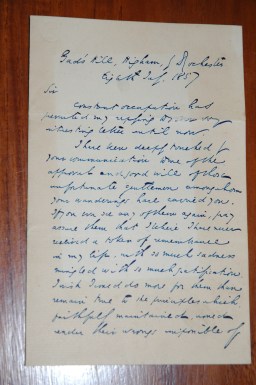
Dickens clearly received the letter and was evidently much affected by it. On 8th July 1857 he replied to Atkinson, as follows:
Sir, Constant occupation has prevented my replying to your very interesting letter until now. I have been deeply touched by your communication to me of the approval and good will of those unfortunate gentlemen among whom your wanderings have carried you. If you can see any of them again, pray assure them that I believe I have never received a token of remembrance in my life, with so much sadness mingled with so much gratification. I wish I could do more for them than remain true to the principles which faithfully maintained, would render their wrongs impossible of infliction. Lord help them and speed the time when their descendants shall speak of their suffering as of the sacrifice that secured their own happiness and freedom,
Faithfully yours,
Charles Dickens
Charles Dickens’ letter to Thomas Atkinson
Strong words indeed from Dickens, who was clearly very moved by Thomas’ note and his story of the Siberian exiles. The letter has never been published before and ought to lead to at least a footnote in the next Dickens biography.
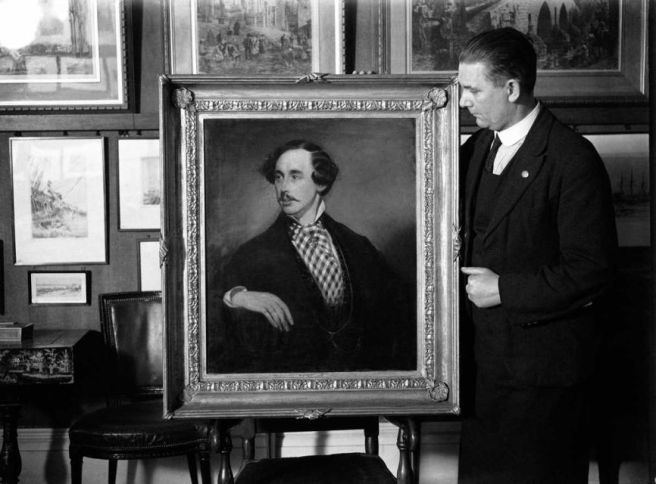
Nor was this the only connection between the two men, although the second connection is somewhat more distant. Alatau Atkinson, Thomas and Lucy’s son, was married in England in January 1868 – seven years after Thomas’ death – to a young woman called Annie Humble, who came from Newcastle-upon-Tyne. Her father in turn was Stephen Humble, who had made a reputation as a fine portrait painter. Humble died in 1858, aged 46, when Annie was only nine years old, but amongst the many people he painted was a young Charles Dickens. This is the portrait, seen on display in the 1930s when it came up for auction:
Charles Dickens as painted by Stephen Humble
Thomas Atkinson never returned to Siberia after his return to England in 1856, although there are accounts of Russians visiting him and Lucy at their home in the Old Brompton Road. The exiles in Siberia probably never knew for sure if their message to Dickens had been delivered. Today, after more than 160 years, we can confirm that it was.
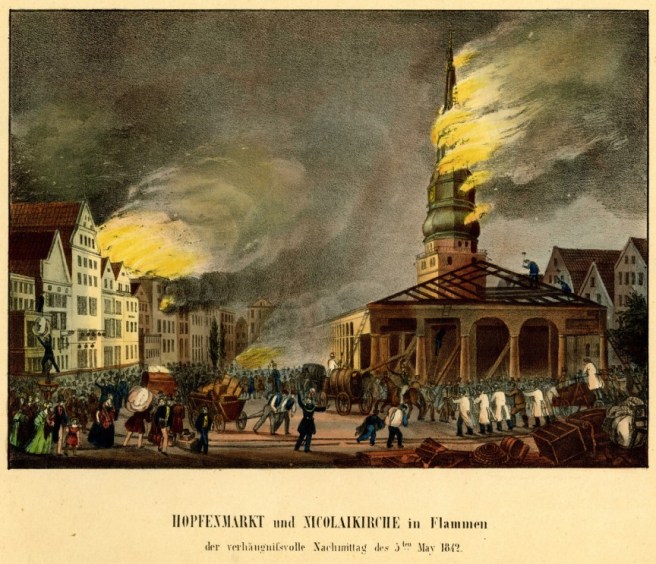
This remarkably fine document, part of the Dahlquist Collection held in Hawaii, is a copy of the passport issued to Thomas Atkinson by the representative of the Hanseatic Republics of northern Europe. It allowed Atkinson to travel to Hamburg in particular, where he had decided to take part in a competition to design a replacement for St Nikolai Kirche, one of the city’s most important churches, which had been destroyed by a disastrous fire at the beginning of May that year.
A contemporary print of the Hamburg fire showing St Nicholas Church in flames.
The document states:
By the Agent and Consul General for the Free Hanseatic Republics of Lubeck, Bremen and Hamburgh, resident in Great Britain.
These are to request and require all those whom it may concern to allow Mr Thomas Witlam Atkinson, National of Great Britain, Gentleman, going to Hamburgh, to pass freely without let or hindrance and to afford him all aid and assistance.
Given at London, the 4th day of July 1842.
The fact that Atkinson received this passport on 4th July 1842 shows that he was well aware of the possibilities that existed in a city that had been devastated by a massive fire that raged for three days, killing over 50 people, destroying 1700 buildings and leaving around 20,000 people homeless.
I have not been able to establish just how long Atkinson stayed in Hamburg. He did not win the architectural competition, which was eventually awarded to another Englishman, George Gilbert Scott. But the likelihood is that there was plenty of work in the city for a jobbing architect. We know that his son from his first marriage, John, died there in April 1846, so it is possible he was a resident in the city for almost four years, After his son’s death, most likely from tuberculosis, Thomas made his way first to Berlin and then to St Petersburg, where, having decided to give up his profession of architect, he began his travels.
The new church was once the tallest building in the world. It was mostly destroyed by Allied bombing during the Second World War, but the spire still stands and is a well-known landmark. Building started in 1846 and the church was finally consecrated in September 1863.
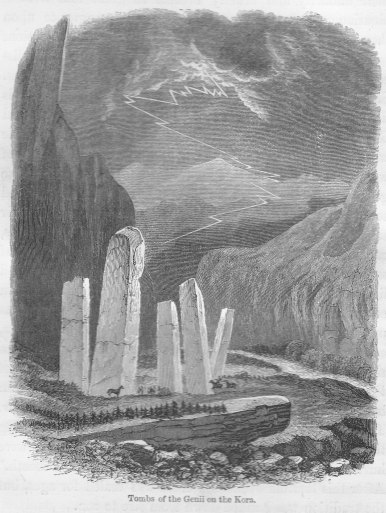
I have been asked by Baltabay, a reader in Kazakhstan, if I know the location of the six large stones drawn by Thomas Atkinson and published in his book Travels in the Region of the Upper and Lower Amoor.
Atkinson’s picture of the stones in the Kora Valley
This is the picture to which Baltabay is referring and it can be found in Chapter 6, which is called ‘The Kora and Traditions’. Many people have been fascinated by this picture as it shows six huge stones precariously perched in the bottom of a steep-sided valley alongside a river. Some have even speculated that they were placed there by aliens or beings with superhuman powers, as they appear to be enormous and unnatural.
Like Baltabay I was fascinated by this picture and very keen to track down the location of the stones. It appears that no-one had previously worked out the precise position. The valley that Atkinson describes is that of the Kora River, which starts at a glacier in the Djungar Alatau Mountains of eastern Kazakhstan and eventually flows into Lake Balkhash. It lies about 10kms to the south of Kapal, the small settlement where Thomas and Lucy stayed from October 1848 until May 1849 and where Lucy gave birth to their son, Alatau.
The Kora Valley – still today almost exactly as described by Atkinson
The valley itself is not easy to get into. Its western end, which terminates at the town of Tekeli, is almost impenetrable due to the very steep sides. However, there is a Buddhist stupa located at the valley entrance, suggesting that it was known about in ancient times.
Buddhist stupa at the entrance to the Kora Valley in Tekeli
Three years ago, with the help of local guides, I was able to reach the only track that can be used by vehicles to access this remarkable valley. Still today, Atkinson’s description of the valley holds true: “From this point the valley was exceedingly rugged, the granite cliffs on the north being nearly perpendicular and rising nearly 1,000 feet. On the south side, a dense forest commences on the bank of the river, extending up a very steep sloe for about 500 yards, to the base of some huge rocky masses. These rose in three terraces till they reached the snow line; in parts they were wooded, in others the cliffs have fallen, forming a mass of debris that extends from the edge of the forest to the lofty crags that stand bristling out of the snow like watch-towers and battlements.”
It is a truly beautiful valley, almost untouched since Atkinson’s day, although there is now a small yurt camp. In the past tigers roamed this area, and although they have long since disappeared there are still bears in the area and remarkable stands of wild flowers. It is a truly beautiful place.
Map showing Tekeli in the west at the mouth of the Kora Valley, which is the main feature, with Kapal to the north and glaciers at the eastern end.
Atkinson describes the five of the huge stones that he later sketched: “As I approached this spot, I was almost induced to believe that the works of the Giants were before me, for five enormous stones were standing isolated and on end, the first sight of which gave me the idea that their disposition was not accidental, and that a mastermind had superintended the erection – the group being in perfect keeping with the scene around. One of these blocks would have made a tower large enough for a church, its height being 76 feet above the ground and it measured 24 feet on one side and 19 feet on the other. It stood 73 paces from the base of the cliffs, and was about 8 feet out of the perpendicular, inclining towards the river. The remaining blocks varied from 45 to 50 feet in height, one being 15 feet square and the rest somewhat less. Two of these stood upright, the others were leaning in different directions, one of them so far that it had nearly lost its equilibrium.”
Atkinson goes on to give an account of local superstitions about the rocks, noting that they were the result of a feud between geniis who inhabited the area and who had been punished by Shaitan and buried beneath the huge rocks. Ever since, locals had been fearful of entering the valley. The world ‘kora’ itself means closed or entombed.
Being such large stones, I assumed that it would not be difficult to find them in the Kora Valley. However, I could find nothing that closely resembled the stones, despite walking almost 15 miles along the bottom of the valley. However, I did find what I think it likely to have been the location for the stones. I also heard an explanation for their absence.
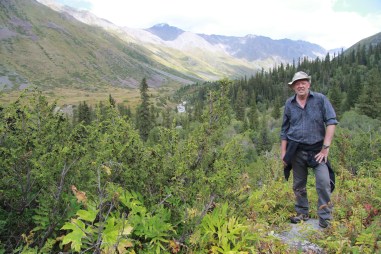
In the Kora Valley searching for the Tombs of the Genii.
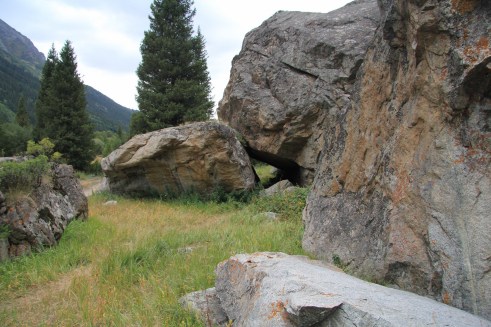
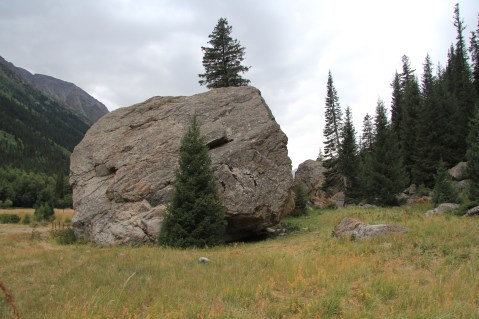
A local climbing guide, now retired, told me that the Kora Valley had been transformed on several occasions by earthquakes. On at least one occasion the valley had been blocked by falling rocks, forming a lake which had later burst and swept downstream large amounts of debris. He thought this could have happened to the stones. This made sense, as close to the spot described by Atkinson there are indeed a number of very large stones standing on their own at the bottom of a cliff. They are not so tall as those Atkinson described, but if the original stones had been knocked over and shattered, the existing stones could easily be the remnants of those he mentioned. Here are my photographs of the existing stones.
Are these the remains of the Tombs of the Genii?
Of course, if you choose not to believe such a rational explanation, they you can join the ranks of sceptics that can be found online speculating about the superhumans who were able to move these massive rocks. Or perhaps you can choose to believe the Kazakhs, for whom this place still holds a sense of mystery.


















 Siberian Steppes