Empires and the importance of horses

In the most recent issue of Asian Affairs, the journal of the Royal Society for Asian Affairs, editor Bill Hayton notes that it is unusual to receive three unsolicited book reviews for the same book. He was referring to David Chaffetz’s brilliant new book Raiders, Rulers and Traders: The Horse and the Rise of Empires[1], which fully deserves the attention it is now receiving.

Chaffetz argues, very convincingly, that to understand the vast interconnected system of trade routes that once constituted the ‘Silk Road’ we need to understand the fundamental role played by the trade in horses in particular. “No animal has had as profound an impact on human history as the horse,” he says. Domestication provided a source of both meat and nutritious milk, as well as transport. Horses regularly needed fresh pastures and this in turn provided the basis for pastoralism as a system that came to dominate the steppe regions.

Thus it was horses, rather than silk that dominated the Silk Roads. Chaffetz shows how the demand for horses bred on the Eurasian steppes came initially from the Chinese and then later from the Mughals and other dynasties in India. Chinese traders travelled as far as Iran, Afghanistan and the Ferghana Valley in present-day Uzbekistan in search of good horses that would give the northern Chinese huge advantages in their military campaigns against their neighbours to the south. As the Chinese Han General Ma Yuan remarked in the 1stC CE, “Horses are the foundation of military power, the great resources of the state…If the power of the horse is allowed to falter, the state will totter to a fall.” With the horses came men from the steppe to develop cavalry brigades and these men too eventually became powerful in their newly adopted homelands.

Mobile horsebreeders helped to connect the world in these early days, bringing sedentary agricultural societies in contact with one another: “Arts, religious beliefs, sports and fashion spread from one end of the old world to the other in the saddlebags of the steppe horsemen,” says Chaffetz. “The horse itself became both a vehicle and a symbol: gods manifested themselves upon them, kings were buried with them, princesses rode them in polo matches and poets praised them in verses that local schoolchildren still recite.”

Although settled peoples quickly began to breed their own horses, the steppe dwellers always held an advantage in the vast open spaces they inhabited. It was hardly surprising that at a certain point a steppe-based empire was able to take on the rest of the world – and win. Genghis Khan’s Mongol empire was the high watermark for the horsebreeders, until gunpowder put an end to their advantages, but not before both the Mughals and the Manchus had also built substantial empires on the back of horse power.

The impact of horses in Western Europe was far less significant. Horses were also used in battle, but usually only by the elites of mediaeval society and later by fancy cavalry regiments. If the peasants could afford a horse, its main use was in agriculture for ploughing – something no self-respecting steppe dweller would ever consider. The typical agricultural labourer could seldom afford to keep a horse. Without the open steppe and its limitless pastures, Western Europe could not sustain large number of animals reliant on grazing.

On the steppe in contrast, everyone rode, women included. And a huge mobile army could be raised in days using the ‘arrow’ system developed by the Mongols. Each rider provided his own horses and learned from childhood how to manoeuvre and perform complex cavalry attacks.

Chaffetz remarks that until now the importance of horses in the development of society has been either overlooked or underestimated by historians. That began to change with the break-up of the Soviet Union, which allowed Ukrainians, Kazakhs, Mongols and other horse-orientated societies to reexamine their histories and to make use of advances in carbon dating and DNA analysis to provide new insights.

The Silk Roads exhibition now showing at the British Museum in London, whilst illustrating the extent of trading links in the ancient world, makes little reference to the importance of horses. It is a pity that its organisers were unable to make use of Chaffetz’s superb research. Those of you who are members of the RSAA may well already have booked a seat for his talk (in person) on 22 January in London. Either way, this book is a must.


[1] David Chaffetz, Raiders, Rulers and Traders: The Horse and the Rise of Empires, WW Norton, New York, 2024, ISBN 978 1 3245 05146 6.
Silk Roads at the British Museum

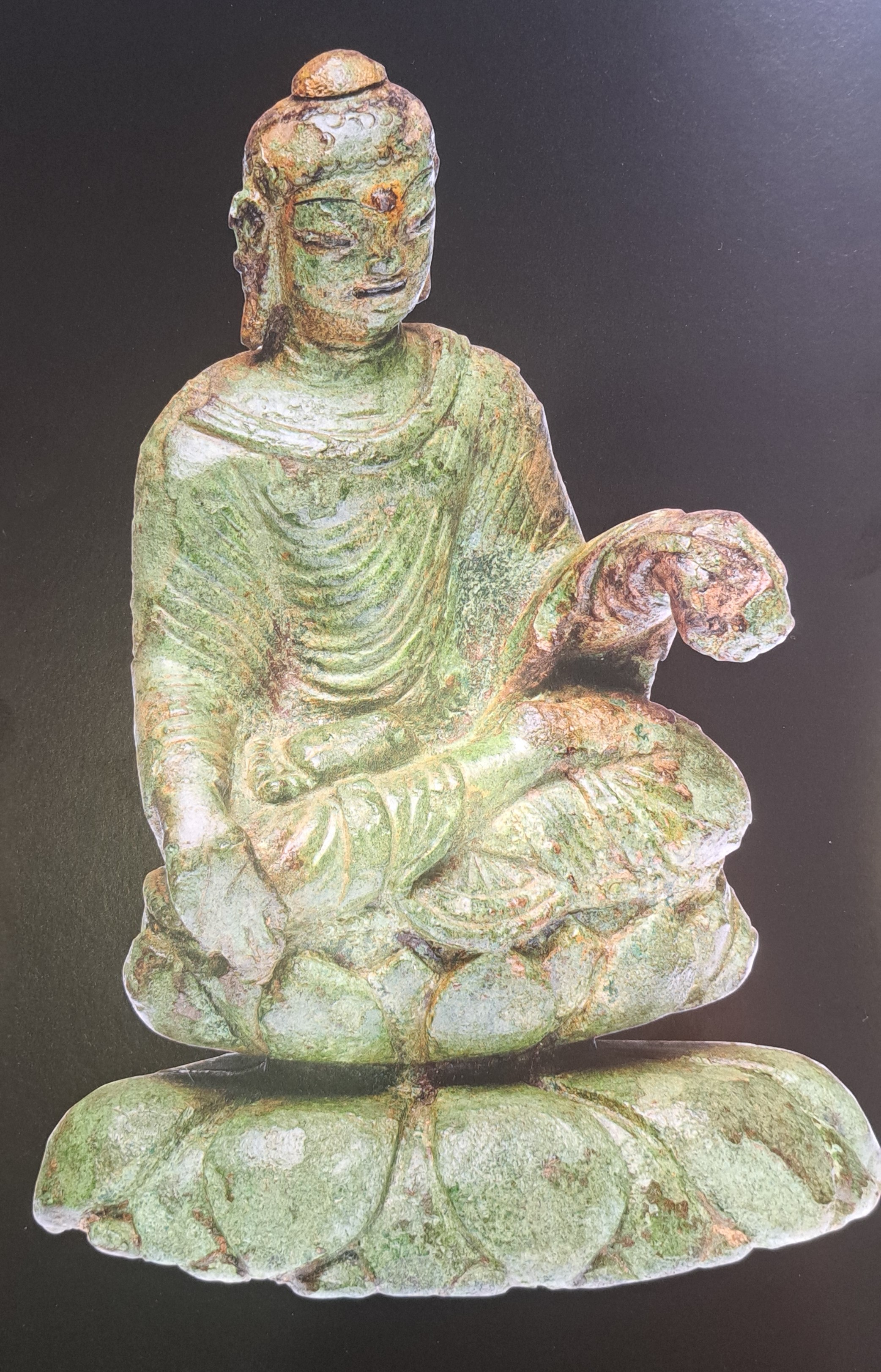
A buddha from Swat Valley found in Sweden

As you walk into the British Museum’s new Silk Roads exhibition the first thing that confronts you in in the otherwise empty entrance hall is a tiny copper alloy buddha only three inches high. The buddha dates from the 6th or 7th centuries CE and was probably made in the Swat Valley in what is now northern Pakistan. But what is remarkable about it is the fact that it was found on the small lake island of Helgö in Sweden from archaeological levels that date to around 800CE.

There in a nutshell is the intellectual proposition that lies beneath the exhibition – that the ‘Silk Roads’ were not simply about camel trains laden with precious consumer goods making their way westwards across the deserts and mountains between China and Europe. No, this is about the extraordinary level of connectedness that existed in ancient history and that trade goods travelled by both land and sea along transport links that spanned most of the known world.

Ever since the German geographer Ferdinand von Richtofen invented the term Seidenstrasse in 1877 the term has had a specific meaning – in part connected to the accounts left behind by travellers such as Marco Polo – of a number of trade routes that start in Western China and progress through the Taklamakan Desert in Xinjiang, across the Pamirs and Hindu Kush towards Iran and then on from there to the Mediterranean coast.

The late 19th– early 20th century discovery of huge numbers of remarkable artefacts at ancient buddhist sites in Xinjiang by such luminaries as Sir Aurel Stein and Albert von Le Coq only added to the attraction of this idea as a way of explaining the importance of international commerce in world history. But as Warwick Ball has pointed out, doubts over the use of this concept have been around since at least the 1940s, when Owen Lattimore refuted the idea that Xinjiang was deliberately opened up by the Chinese to export silk.[1] Hugh Pope called the idea “a Romantic Deception”, while Susan Whitfield, currently Professor of Silk Road Studies at the University of East Anglia, opened her 2020 book Silk Roads with the words “There was no ‘Silk Road’”.[2]

So anyone arriving at the exhibition and looking for vistas of Samarkand and Bokhara or pictures of caravanserai and shaggy Bactrian camels is in for some disappointment. And please note, almost everything on show dates from between the 5th and 10th centuries CE, a period in history about which very few people have a good grasp. Who was ruling China, Central Asia and the Middle East during these turbulent years? And even though the garnets in jewels recovered from Anglo-Saxon burials such as Sutton Hoo likely came from mines that were thousands of miles to the east, little is known about the nitty-gritty that underlay the trade in these kinds of luxury goods.

However, that being said, the curators of this exhibition have been able to give an indication of the extent of international trade during this period of history. They show that trade was not simply east-west, but that north-south interactions were equally important, as was Central Asia’s connection to India. Nor was it simply trade goods such as silk and jewels that were exchanged. War tactics, social customs, diplomacy, pilgrimage, literature and other cultural artefacts were also exchanged over vast distances. Maritime routes, such as those in the Baltic, the Red Sea and Indian Ocean were also central to this interchange of goods and ideas.

Great social transformations, including the expansion of Islam from the 7th Century, the growth of the Tang Dynasty in China, the end of the Roman Empire and the growth of Byzantium and the expansion in the Holy Roman Empire under Charlemagne were also important factors in determining trade routes and exchange objects. This was a time when Christianity, Islam and Buddhism were all expanding.

Small glass cup from Alexandria

So it is hardly surprising that visitors to the exhibition will hear about places never before mentioned in relation to the Silk Road. Heijo-kyo in Japan, Silla in Korea and Chang’an in north-central China are placenames that are unlikely to be on the tip of one’s tongue. And yet the objects found in each of these places tell remarkable tales. Take the small blue glass cup found at Cheonmachong Tomb at Gyeongju in Korea. It dates from the early sixth century and has a honeycomb-patterned decoration produced using a mould-blowing technique. Such glasses can be found across Roman territory, but it was probably made at Alexandria in Egypt.

Items recovered from shipwrecks in the Indian Ocean also provide an insight into ancient trade. During the period in question ships sailed from northern China via the Indonesian islands to India, Persia, Arabia and the east coast of Africa. In 1998 the wreck of the Tang Dynasty ship now known as the Belitung was found near Sumatra, comprising more than 60,000 pieces of Tang ceramics and other objects that date to the 9th Century CE. It was probably on its way back to the Persian Gulf when it sank. Its cargo provides a great cross-section of commercial goods from the period.

The Miraculous Image of Liangzhou

The discovery in 1900 of the Dunhuang caves in the Tarim Basin of Xinjiang provides another great source of trade goods. In Cave 17 Aurel Stein found (and bought) 70,000 manuscripts, paintings and other objects, several wonderful examples of which are in the exhibition. These objects transformed the way in which the culture and history of this region was understood. The Miraculous Image of Liangzhou, more than 2.5 metres in height and embroidered with silk thread on silk and hemp, is one such item.

The exhibition never ceases to amaze the visitor as it demonstrates the extent to which our ancestors traded with one another. Khazars, Vikings, Alans, Eritreans, Sogdians and many other societies knew of each other and sent trade goods huge distances.

So at the end of the exhibition what can we say? The Silk Road is a misnomer? Yes! It was never a single road? Yes! Trade was in both directions, not to mention north and south and often by sea? Yes! In other words, we are talking about international trade and exchange of ideas. It was a phenomenon not restricted to one part of the globe – if we exclude South America – or one culture. But are we throwing the baby out with the bathwater? There is a danger that in generalising our understanding of the Silk Road to include just about all international trade we lose the very specificity that made it a powerful idea in the first place. More than likely that is what is happening. Scholarship on the Silk Road has now outgrown the original subject and awaits a new definition and focus. But for now, go along and see the incredible exhibits. It is crowded and you cannot easily move from one glass case to another, but it’s almost worth the entry just to see that tiny little buddha.


[1] Warwick Ball, The Eurasian Steppe: People, Movement, Ideas, Edinburgh University Press, Edinburgh, 2021.

[2] Susan Whitfield (ed.), Silk Roads: Peoples, Cultures, Landscapes, Thames & Hudson, London, 2021.