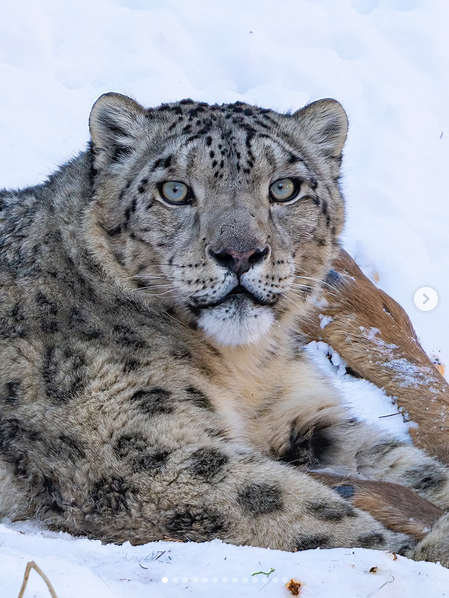
Snow leopard spotted in Almaty

A snow leopard photographed in Almaty three days ago

A friend in Almaty recommended that I check out the Insta account of Dmitry Dotsenko (dots_foto). Three days ago he achieved a lifetime ambition when he spotted a snow leopard on the outskirts of Almaty, former capital of Kazakhstan. Let him tell you in his own words what he saw:


I’m sharing with you a selection of photos of a snow leopard that I managed to take yesterday in the mountains near Almaty. Photographing a snow leopard has long been my dream. In fact, just seeing one with my own eyes in our mountains would be a once-in-a-lifetime event! I’ve been hiking in these mountains since childhood, and the thought that snow leopards live here seems completely natural to anyone from Almaty. We all know about them, we’ve heard about them since we were kids, but at the same time, the snow leopard remains a mystery—something almost mythical, hidden in dense spruce forests and rocky cliffs.

Very few people ever get to see one. Even those whose lives and professions are connected to the mountains often have never encountered this graceful predator. Most of the time, we have to settle for tracks in the snow or rare shots from camera traps.
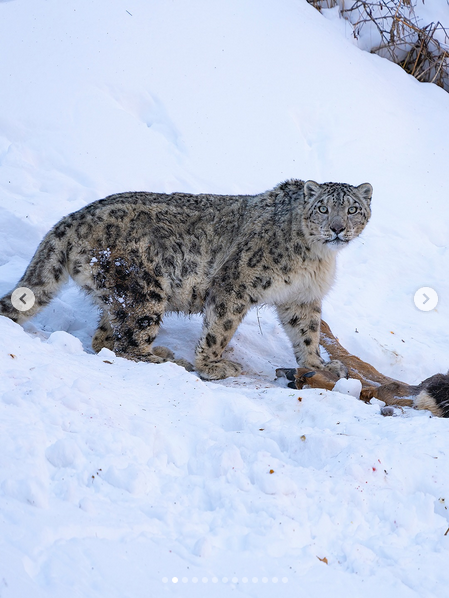
But this time, something truly rare happened. The snow leopard had taken down a maral (a type of deer), throwing it off a cliff. And by a twist of fate, I happened to be in the right place at the right time. After almost an hour of waiting in ambush, the leopard appeared. The feeling was incredible—adrenaline was off the charts, and time seemed to compress into a single moment. It was hard to keep control of myself and the equipment, but in the end, I managed to get these rare and, without exaggeration, unique shots!
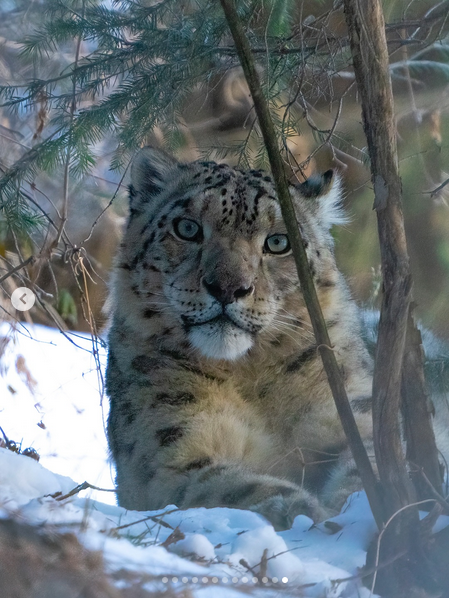
After the shoot, an interesting thought came to me: I’ve walked here hundreds of times, these mountains are like home to me. And now, here I am, photographing the true master of these mountains—the snow leopard. That’s the essence of this shoot. All the stories about leopards in our mountains suddenly stopped being just words—they became reality, right in front of me.

The photos were taken with a 600mm telephoto lens from a safe distance, so as not to disturb the animal—or, let’s say, not to end up as its lunch myself 🙂. This allowed me to get very close and detailed shots. Here it is—our Almaty snow leopard! Look, examine, enjoy every detail: the color, the shapes, that gaze! 😍

By the way, on my Telegram channel, I’ve made a series of covers featuring the Almaty snow leopard for your smartphones. Download them and enjoy. Let every resident of Almaty, every Kazakhstani, have a piece of our nature’s greatness on their phone. 🙌😍”

Snow leopards are now highly protected in Kazakhstan and the policy appears to be paying off. A little bit of good news…

Kazakh tigers start mating

The two tigers that arrived in the Ile-Balkash Reserve last September have begun to mate, as can be seen in the film clip above. Nine-year-old Kuma and 12-year-old Bohdana appear none the worse after surviving their first winter in Kazakhstan. As can be seen in the video, there is still snow on the ground in their compound.

These two tigers arrived from a zoo in Holland and neither of them have ever spent time in the wild. It is unlikely that they will ever be released, as they lack the hunting skills needed to survive. However, any cubs they produce will be kept away from humans and released into the Reserve to fend for themselves when they are about two years old. Tigers give birth after about 20 weeks, so any cubs should be born in July.

During the cubs’ first two years, whilst they are still in captivity prey species such as deer and wild boar will be introduced into their compounds so that they can learn to hunt. This will equip them for life in the Reserve once they are released.

Up to five further tigers from Russia should be arriving in the 415,000-hectare Ile-Balkash Reserve this year. After a short period in compounds they will be released directly into the Reserve and it is hoped they will become the nucleus of a breeding population that could eventually reach more than 100 animals.

Tigers were once common in Central Asia, where they were known as Turanian tigers or Caspian tigers. They are genetically indistinguishable from the Siberian or Amur tigers that inhabit the far east of Siberia. All the tigers being taken to Kazakhstan are from this subspecies, which is adapted to withstand the harsh winters that can see temperatures fall as low as -40 degrees C. Numbers declined due to hunting and poaching and the the last ones were killed in the mid-1950s.

More on Kazakhstan’s tiger programme

One of the tigers that arrived in Kazakhstan this week

The arrival of two tigers from Holland in Kazakhstan in the last few days is the latest development in a programme that has been in place for several years. In June this year the Forestry and Wildlife committee of the Kazakh Ministry of Ecology and Natural Resources signed a cooperation agreement with the Stichting Leeuw Special Centre for Feline Predators at Landgoed Hoenderdaell Zoo in Holland. The zoo agreed to provided a male and a female Amur tiger, to be relocated to the 415,000-hectare Ile-Balkhash State Nature Reserve in the south-east of the country. Now they have arrived it is likely that these first two tigers will not be released into the wild immediately, but that their offspring will be freed to wander throughout the Reserve.

These tigers are genetically identical to the Turanian tiger that once inhabited large parts of Central Asia including Kazakhstan, the last one of which was seen in the country in 1948. Their ability to withstand the freezing winter conditions of Kazakhstan was the main reason they were chosen.

Stichting Leeuw has the largest shelter for big cats in Europe, including the only hunting simulator in the world, which is used to teach rescued big cats the skills they need to return to the wild.

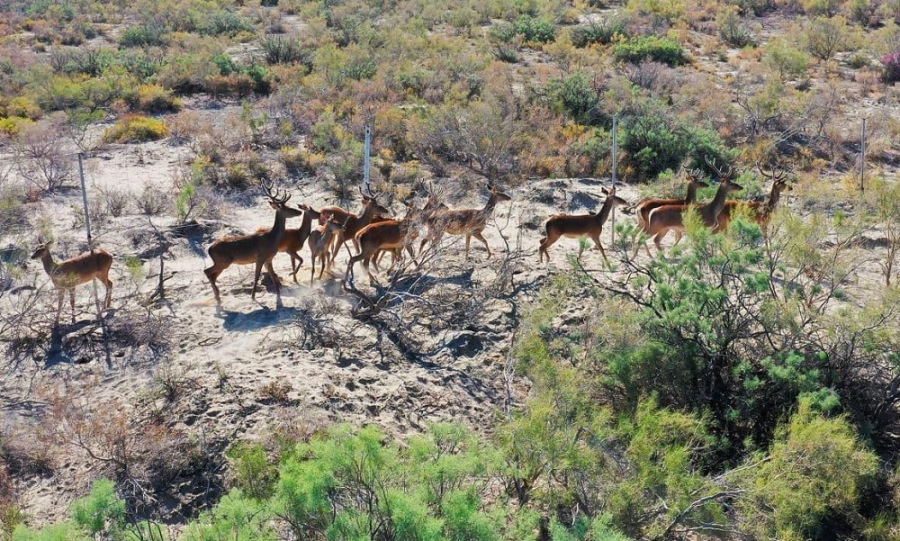
Bukhara deer, over 60 of which were released three years ago into the Ile-Balkhash reserve

In July Kazakhstan’s Ecology Ministry signed a further memorandum of cooperation with the World Wide Fund for Nature. As long ago as July 2021 the Kazakhs introduced 61 endangered Bukhara deer into the area where the tigers will be released. This species had been extinct in the region for the last 100 years. Nine of the deer were fitted with satellite collars to allow the reintroduction team to monitor their movements and warn if they strayed too far from the release site. There were once less than 400 of these deer, but they have been brought back from the brink of extinction and are now thought to number more than 1,400 at sites in Tajikistan and Uzbekistan.

Habitat preparation was also started to provide cover for the big cats. WWF has been consulting with local communities to ensure minimal human-tiger conflict and a compensation scheme for loss of livestock.