Amongst the many less well-known explorers of the Central Asian steppelands, few were quite so intrepid as William Bateson, a Cambridge scientist who spent months alone in the late 1880s searching for fossilised snails in the many large lakes that can be found scattered across what is today northern Kazakhstan.
I recently took the opportunity to read through Bateson’s diaries, held by Cambridge University Library, and was delighted to find that Bateson was an inveterate note-taker – and photographer. The University Library has now published a short article I have written about Bateson and his importance to the history of Central Asian exploration. You can find the article here.
Map showing areas in which Bateson travelled and collected specimens
On Monday 13th May I will be giving a talk at the Royal Geographical Society in London on my work transcribing Thomas Atkinson’s diaries. “Be Inspired – Transcribing the Atkinson Diaries” will take place at RGS headquarters at 1 Kensington Gore, SW7 2AR and starts at 14.30. Having spent the last couple of years travelling regularly to the RGS to work on these remarkable diaries, I will have a lot of fascinating information to share. Atkinson’s diaries cast new light on his relationship with his wife Lucy and provide details of their travels that cannot be found in their books. Click on the link above to book a ticket.
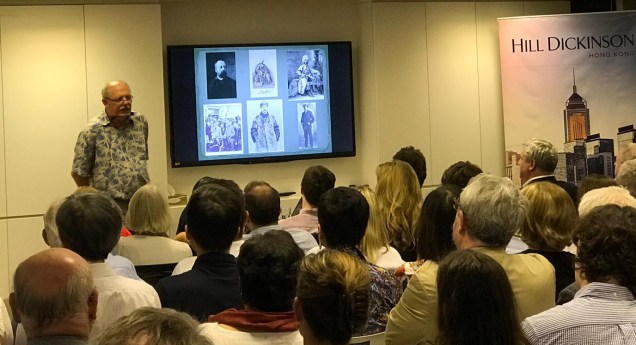
A great turnout for the meeting organised by the Hong Kong branch of the Royal Geographical Society on Tuesday. About 80 people attended the talk, which was partly on the many unknown and obscure travellers that will feature in my forthcoming book about the exploration of the steppe.
For the second part of the talk I was on more familiar territory; it concentrated on the recent expeditions I have organised in the footsteps of Thomas and Lucy Atkinson in Buryatia and Eastern Kazakhstan. Thanks are due to RGS-HK director Rupert McCowan for organising this meeting (and another, the following night, about my work as a reporter in Fleet Street) and to his staff for making the whole thing go so smoothly.
For those of you in Hong Kong – or nearby – I will be speaking at an event on Tuesday evening (9th April, starts at 19.30) organised by the local branch of the Royal Geographical Society. My speech is entitled ‘The Steppes of Central Asia: Rediscovering the History of Central Asian Exploration‘ and will be held at Hill Dickinson, Suite 3205 Tower Two, Lippo Centre, 89 Queensway, Admiralty. Further details can be found here.
Marco Polo, the great Venetian traveller, was probably one of the first Westerners to describe hunting with eagles, as practised to this day by the Kazakhs and other Central Asian people. In Book 2, ch.18 of his Travels of Marco Polo the Venetian he describes seeing eagles at the court of Kublai Khan in Karakorum in present-day Mongolia:
“There are also a great number of eagles, all broken to catch wolves, foxes, deer and wild goats and they do catch them in great numbers. But those specially that are trained in wolf-catching are very large and powerful birds and no wolf is able to get away from them.”
Sir Henry Yule’s edition of the book, published by John Murray in 1874, also includes an illustration of eagle hunting. On coming across this for the first time recently I was surprised to see that it was in fact a woodcut taken from Thomas Atkinson’s book, Oriental and Western Siberia. Atkinson wrote extensively about eagle hunting, providing one of the earliest modern-day accounts of this remarkable phenomenon.
Atkinson’s woodcut of a hunting eagle attacking a deer
In a footnote commenting on Marco Polo’s observation, Sir Henry writes: “In Eastern Turkestan and among the Kirghiz (Kazakhs-ed) to this day, eagles termed Barkut (now well known to be the Golden Eagle) are tamed and trained to fly at wolves, foxes, deer, wild goats, etc. A Kirghiz will give a good horse for an eagle in which he recognises capacity for training. Mr Atkinson gives vivid descriptions and illustrations of this eagle (which he calls ‘Bear coote’), attacking both deer and wolves. He represents the bird as striking one claw into the neck and the other into the back of its large prey, and then tearing out the liver with its beak.”
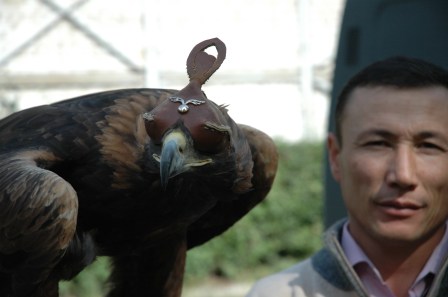
A modern-day Kazakh with his Golden Eagle
At least Sir Henry acknowledged Atkinson’s drawing. Other writers at that time shamelessly plundered his artwork and used it without acknowledgement.



 Siberian Steppes