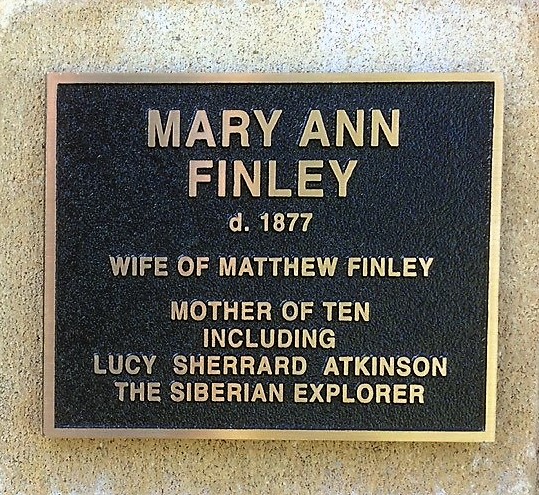
A plaque in memory of Mary Ann Finley, Lucy Atkinson’s mother, has just been installed at the cemetery in Dubbo, New South Wales, Australia, where she was buried in 1877. The plaque was the initiative of Marianne Simpson, who is a descendant of Mary Ann’s third-oldest son, William York Finley (b.1815).
Two years after her husband Matthew’s death in 1847 Mary Ann emigrated to Australia, where her eldest son – also Matthew – was already settled. Together with her children Thomas, George and Mary Ann, she sailed to Australia in December 1849 on the Katherine Stewart Forbes. The ship – a three-masted barque weighing just 457 tonnes – had originally been used to transport convicts to Australia, but when the Finleys sailed they were almost the only passengers, the holds being full of trade goods. They arrived at Port Jackson on 16th May 1850.
Mary Ann’s eldest son, Matthew Smith Finley, was already in Australia working with the Union Bank of Australia. Her son William and daughter Elizabeth married and remained in England. Sons Horatio and Joseph – and maybe also their sister, Maria – travelled separately to Australia. Her eldest daughter Lucy, as we know, travelled to Russia in about 1840 and stayed there until she returned to England with her husband Thomas Atkinson in 1858.
Mary Ann lived out her final years with her daughter Mary Ann Smith’s family on a property near Wellington, NSW. Mary Ann died aged 84 on 1st May 1877, and is buried at Dubbo, NSW.
I hope you enjoy this video of our trip to Kazakhstan this summer. It’s in Russian, but most of the English interviews can be heard in the background and the plot is pretty easy to follow.
I have uncovered another fascinating document in the Manchester Archives about Thomas Atkinson’s activities as an architect in the city.
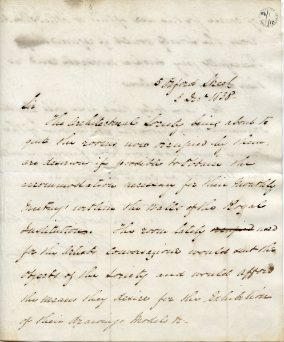
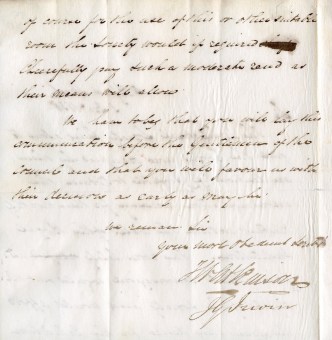
The letter to the Manchester Royal Institution signed by Thomas Atkinson and J G Irwin
(courtesy of Manchester Central Archives)
The document in question is a two-page letter in Thomas’ own handwriting, but signed by him and another prominent Manchester architect called John Gould Irwin. Dated 3rd December 1838 and sent from an address in Oxford Street, Manchester, it is addressed to the secretary of the Royal Manchester Institution and is written on behalf of the Manchester Architectural Society. This latter organisation only had a short life, from about 1837-45, but is noticeable for being the first such professional body of architects in the city. The fact that the letter is signed by Atkinson and Irwin suggests that they were officeholders of the Society.
The letter asks if the Royal Manchester Institution would be willing to let them use a room for their monthly meetings. According to Cornelius P Darcy, in his book The Encouragement of the Fine Arts in Lancashire, 1760-1860 (MUP, 1976): “In order to encourage a greater interest in problems of art and architecture, the Manchester Architectural Society sponsored a series of conversazioni”, evenings at which prominent artist and architects would exhibit their works to municipal leaders to give them an idea of what was currently in fashion.
As Darcy states: “At these conversazioni, painters and architects had an opportunity to discuss with civic leaders problems of art and architecture and to review designs of proposed buildings for the community. In 1838 they examined designs submitted in competition for the Catholic Church, confident that ‘public examination is the most effectual mode of ensuring just decisions in competitions.’ Two years later, when the Society examined some twenty-five designs that were submitted for the new Independent College, ‘The general opinion was, so far at least as the first premium is concerned, the decision had been judicious’.”
The reference to the design for a Catholic Church is interesting because we know that in 1840 Thomas exhibited at the Royal Academy of Arts in London “an interior view of a design for a Catholic church, Manchester”. It was one of several building designs from that period for which Thomas failed to win a commission. I have previously written about two other commissions – for the Athenaeum in Manchester and for a Unitarian Chapel in Upper Brook Street – in which Thomas lost out to the London architect Sir Charles Barry. It is likely that there was a lot of disquiet about the way in which commissions were awarded and this may explain Darcy’s comment about public examination being “the most effectual mode of ensuring just decisions in competitions.” It may have rankled even more with Thomas because in April 1838 he had been declared bankrupt, after one of his building projects was delayed. Even this, however, does not appear to have discouraged him from continuing to play an important role in this pioneering architects’ society.
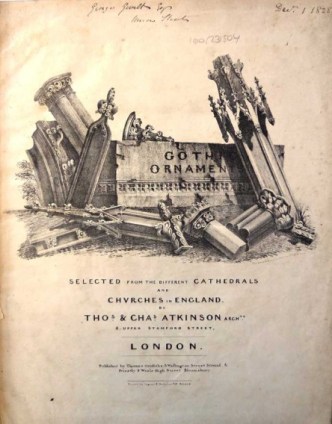
Thomas Atkinson’s first book, Gothic Ornaments selected from the Different Cathedrals and Churches of England, published in 1828-29, continues to intrigue me. I last wrote about it on 16th July, when I commented on the fact that it was in the forefront of architectural books from the first half of the nineteenth century that sought to popularise the Gothic style. I have now had a bit more time to study the book and to consider Thomas’ relationship with his co-author, Charles Atkinson.
Despite the shared surname, it is unlikely that the two men were related. They must have met soon after Thomas first moved to London in the mid-1820s. Before long they were collaborating on the designs for a number of churches, mostly in the neo-Gothic style. Perhaps it was the detailed stone carving work required for these churches that gave Thomas the idea of publishing a book?
The description of Gothic Ornaments as a ‘book’ is actually something of a misnomer. It wasn’t published as a finished product, but ‘in folio’. This means that individual sheets were issued at regular intervals, either to subscribers or for sale to customers of the publishers. Those buying the sheets would collect the set and then have them bound at their own expense. Thus the Literary Gazette for January 1829 includes an announcement from the publisher, Thomas Griffiths of Wellington Street in the Strand, London:
“The Work will be complete in 25 Parts published at intervals of one month, each containing at least Four Subjects in atlas quarto with an ornamental Wrapper, price 4s. each.” The first plates were in fact published as early as September 1828, each of them containing one or two full-size drawings aimed at “the Architect, Carver and Modeller”.
The Gentleman’s Magazine (Vol 26, p452), reviewed plates Nos. I and II: “These ornaments have been selected from our cathedrals and other churches by the Mssrs. Atkinsons, Architects, by whom they are drawn as large as the original bosses, finials, etc. They are highly useful and from their accuracy in size and detail will be of great assistance to the working mason. The present numbers exhibit two finials and a head from Minster in Kent, a boss from Lincoln, a crocket and foliated capital from Lichfield and an ornament from a cornice at Boston Church.”
Review of Gothic Ornaments in The Gentleman’s Magazine
Later in 1829 the Gentleman’s Magazine carried a further small review: “We have already given our opinions of this useful publication. No 9 and 10 have just been published. They consist of many beautiful specimens of Gothic Ornaments in the Lady Chapel, Ely Cathedral, consisting of crockets, finials, bosses and mouldings, which ornament the arches, pediments, cornices, brackets, etc, of that fine ecclesiastical structure. To the admirers of Gothic Architecture, and to artists especially, these specimens will afford much gratification.”
The Literary Gazette noted that the drawings were “delineated with great distinctness and will no doubt be very useful to the architectural students.”
So it is clear that these drawings were aimed at those who were responsible for decorating the stonework of the neo-Gothic church buildings then being built throughout Britain – much as Thomas himself had done from his earliest days, when he started out as a stone mason working for his father.
However, there are several unresolved questions. The first mystery concerns the joint authorship of the book. If we look closely, we can see that the first nine plates are all signed by ‘Thos. & Chas. Atkinson’. Plates 9-40 are signed by T&C Atkinson. However, plates 41-44 (I have not yet found plates 45-48) are signed by TW Atkinson alone. The first 28 plates were printed by Ingrey & Madeley. The next seven were printed by Jardine & co of Cornhill and from No 35 onwards they are printed by G E Madeley at the same address as the publisher, Thomas Griffiths. We know that Ingrey and Madeley dissolved their partnership on 23 March 1829, so that allows us to say that the first 28 plates were printed before the end of March 1829. We also know that Thomas Atkinson and Charles Atkinson dissolved their partnership on 7th August 1929 “by mutual consent”. This could explain why the last few plates are signed by Atkinson alone.
There is one more curious fact that also strengthens the notion that Thomas continued to publish the plates after his partnership with Charles Atkinson was dissolved. In addition to the well-known title page for the plates – the book contains no text – there is a second version of the title page in the British Library that is very different.
The two versions of the title page for Gothic Ornaments. The version on the left appeared before the one on the right.
As you can see, this second version of the title page contains none of the detailed illustrations that appear on the original and only carries Thomas’ name and the statement ‘Published by the Author’. Although I cannot be sure, it seems that this title page was printed following Thomas’s split with Charles in August 1829 and comes from an edition of 48 plates. Although he does not claim to have drawn all the illustrations, my guess is that Thomas was responsible for the bulk of them and that Charles Atkinson possibly helped to fund their publication. When the two men parted company Thomas carried on as best he could, publishing the remaining plates himself.
What happened to Charles Atkinson after his partnership with Thomas came to an end? That will be the subject of a future posting.
(Once again, I am very grateful to Sally Hayles for her diligent research, without which it would have been impossible to write this posting).
A little addendum to my note below about Thomas and his relationship with Vasily Basnin who, by 1850, had become mayor of Irkutsk. Today I checked Lucy’s book, Recollections of Tartar Steppes, for any mention of the Basnin family. Sure enough, several references come up. The first, rather irreverent (but warm) mention is dated March 1852 and although not named, it is clear that she is writing about the Basnin family:
“A most hospitable and amiable family here I have not yet mentioned, and still scarcely a Sunday passes but we dine with them; he is a merchant, and, besides, mayor of the town, we have given him the honourable appellation of ‘lord mayor.’ He is a very clever man, and, being a merchant, has had every opportunity of collecting valuable Chinese ornaments; he has also a splendid library, besides extensive hot-houses. He spends enormous sums of money in collecting plants, and (would you credit it?) he understands nothing about them! The only benefit he derives from his large outlay is to walk through his hot-houses after dinner, and smoke his cigar. Not one of the family has any real love for flowers. His eldest daughter is a clever girl, but with no taste for horticulture; she is, however, an excellent musician, and many a pleasant hour do we spend in hearing her play. The wife is no lover of flowers; indeed I do not know what she is a lover of: she belongs to the old school of Siberian wives, that is, she is literally, an automaton, seldom seen by visitors, and never visiting. I believe the old lady talks to me more than she does to anyone, and her confidence in me is great. This being the first winter her daughter mixes in society, she has begged of me to take charge of her.
Would you like to know how these hot-houses are managed? The mayor has a friend, a counsellor, who undertakes the whole arrangement, and I can assure you he does it well. The one likes to have the shrubs and plants from vanity, and, having a well-stocked purse, is able to gratify it; the other loves them for themselves, and, not having the pecuniary means of gratifying his passion, is able to do so by serving a friend, and thus they are mutually satisfied. But it is quite amusing to see the ‘lord mayor’ asking permission to cut his own flowers, or even to gather a strawberry.”
The second mention is in January 1853 from Barnaul in the Altai region, where Lucy mentions the difficulty of finding appropriate headwear for a ball to which she had been invited: “The last ball I was at I was a little troubled how to arrange for a head-dress: I had never bought one; what on earth should I have done with flowers whilst travelling? In Irkoutsk I managed capitally, as Miss Basnin sent me fresh flowers each time I went out, I was the only one so indulged. Here we cultivated some in our rooms, and I had used the last; what was to be done? I would willingly have gone without, but that could not be. A sudden idea crossed my husband’s mind, so I sent to Miss Annossoff for some ivy leaves, when he made me a beautiful wreath interspersed with red berries made from sealing-wax on the heads of pins, it really looked nice.”
So there you have it. Miss Basnin, probably Vasily’s daughter Lydia, regularly sent fresh flowers to Lucy every time she attended a social occasion in Irkutsk. The mention of flowers confirms it is the same family and at the same time confirms the closeness of the relationship. As she says, “I was the only one so indulged”.
Further confirmation of the close relationship between the Atkinsons and the Basnins can be found in Thomas’ diary for 1851, which contains the following note:
“A list of our effects left in Irkoutsk 23rd May with Mr Basnin, the mayor:
For some time I have been looking for material in the Russian archives that could help to flesh out the biographical details of the Atkinsons. Until today it this had been a very frustrating exercise. Despite the fact that Lucy spent at least 18 years in Russia and Thomas at least a decade, very little has so far turned up that can fill in some of the gaps. However, perhaps my luck is beginning to change.
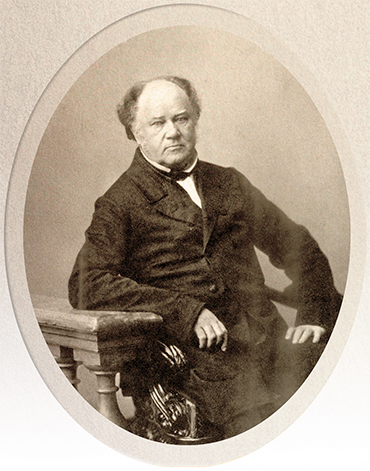
Today I came across a fascinating article by Dr Viktor Kuzevanov, director of the Botanic Garden of the Irkutsk State University. His article Pineapples under the Pine Trees, tells the remarkable story of Vasily Nikolaevich Basnin, scion of a famous merchant family of Irkutsk, who became obsessed with horticulture, so much so that he built a number of wonderful hothouses in Irkutsk in Eastern Siberia in order to grow exotic fruits and plants.
V N Basnin photographed by KA Bergner in 1860 (IZO GIM – Fine Art Dept of State Historical Museum, Moscow)
Working closely with a young finance officer sent out from Moscow called N S Turchaninov, Basnin set about building a Siberian botanical garden that could rival any in the world. Starting in the early 1830s he began planting flowers, shrubs and fruit trees in the gardens and specially built hothouses. Not only did he collect plants from around Lake Baikal and other parts of Eastern Siberia, but he procured seeds from all over the world.
According to Dr Kuzevanov’s article, the gardens eventually covered over half of Basnin’s estate and included a large system of greenhouses comprising three interconnected glass houses and hothouses with a total length of 70 meters and width of 10 meters . The garden itself occupied around 5,000 m2. Local records show that the greenhouses were kept in perfect order: visitors were impressed by the immaculate cleanliness and “artistic” arrangement of plants. The greenhouses themselves contained a special hall for blossoming flowers and in the fruit greenhouse, peaches, pineapples, apricots, pears, apples, cherries, lemons, oranges, grapes, and other fruits were all grown.
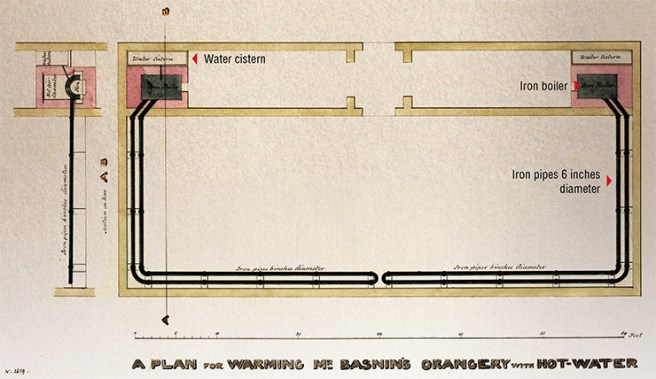
What is fascinating from my standpoint is that Dr Kuzevanoz has found out that Thomas Atkinson designed a heating system for Basnin’s greenhouses. He has even found a drawing of the plan, which I reproduce below.
Thomas Atkinson’s plan for heating Basnin’s hothouses (RGADA, The Russian State Archive of Ancient Arts)
It is not clear if the heating system was ever installed.
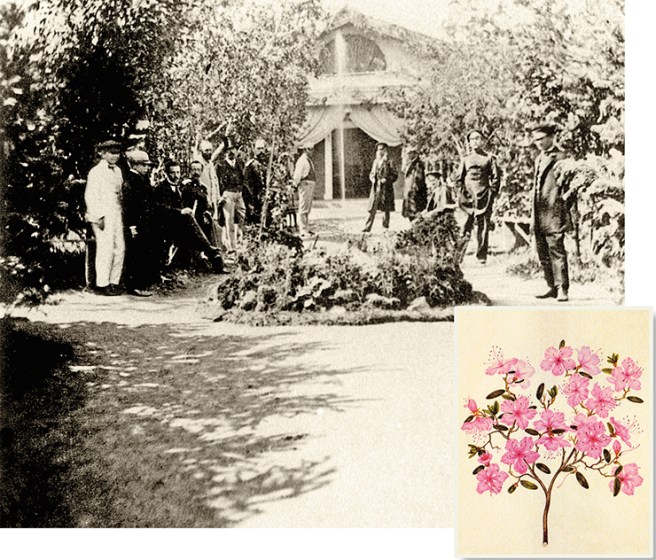
Like Thomas and Lucy, Vasily Basnin was also close to many of the Decembrist exiles, large numbers of whom lived around Irkutsk. He sponsored the brothers A. I. and P. I. Borisov, for example, both of whom collected local plants and drew them for the collection. Sadly the garden only survived until 1879, when a huge fire destroyed most of the old wooden buildings of Irkutsk, although the mansion survived. A new botanical garden was created in the 1930s.
A photo of Basnin’s garden taken in 1869 (from the Zenkovich Archive) together with one of Borisov’s watercolours
This is a wonderful discovery and I hope to be able to add more detail in the coming weeks.
Wherever he travelled in Central Asia and Siberia, Thomas Atkinson always took an interest in archaeological remains. He was not a historian, but would often try to find out about the various impressive ruins and strange earthworks he came across on his travels. For example, in Oriental and Western Siberia he describes a copper knife he had been given by Cossacks, who had found it near the Bouchtarma River in what is now northern Kazakhstan. They cut it in half, he says, believing it to be gold.
On 30th November 1859 Thomas also delivered a paper at the Geological Society in London “On some bronze relics found in an auriferous sand in Siberia”, at which he exhibited the said fragments. He told his audience that the decorated bronze pieces, which appeared to be either from a horse harness or a bracelet, were found in August 1851 on the River Shargan in southern Siberia (lat. 59֯ 30’ N and long. 96֯ 10’ E) and that he was given them only hours later by the director of the goldmine in which they were found. The miners were excavating a bank of gravel and sand and the objects were found at a depth of around 14 feet. “As I have no theory to establish, I give them without any speculations as to the period when these relics were deposited in the sandy gold-bearing bed”, he remarked.
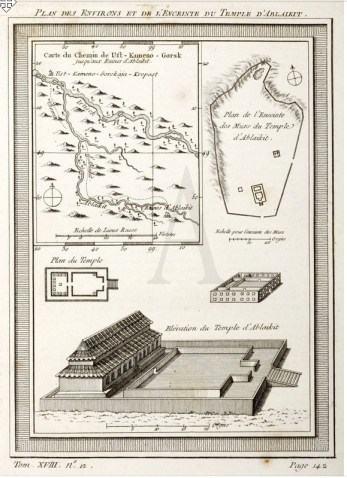
Oriental and Western Siberia also gives a brief description of Thomas’ visit in 1847 to Ablaikit, near Oskemen, (Ust-Kamenogorsk) in north-eastern Kazakhstan. This is the site of a ruined Buddhist monastery compound that dates back to the seventeenth century and which had also been visited and drawn (see below) by Peter Simon Pallas, the German-born scientist who spent the years 1768-74 travelling in Siberia and Central Asia. The site is of great interest to modern-day archaeologists and this summer a major investigation into the site was begun.
Thomas, who was seemingly unaware of Pallas’ writings, writes: “We now turned to the south, riding along about a verst from the foot of the high rocks and had not gone far when we came upon a large enclosure surrounded by a thick wall build of very large blocks, with smaller stones fitted in between them. This wall encloses a space of almost a verst in length and half a verst in width, extending up to the foot of some perpendicular rocks. It has been a work of great labour and must have been built by a different race from the present, who look upon it with wonder. In some parts it is six feet high, in others a little less and seven feet thick. None of the blocks have been cut.” Clearly as a former mason, he was particularly interested in the stone work.
A contemporary view of the site at Ablaikit
He spent some time at the ruins, entering the enclosure, much to the surprise of his Kazakh guides, who declined to follow due to their superstitious beliefs.
Further south, during his journey to Kapal with Lucy in the summer of 1848, as he approached the Djungar Alatau mountains, Thomas came across further examples of earthworks and buildings from prehistory. He remarks in his second book, Travels in the Regions of the Upper and Lower Amoor, on the profusion of kurgans (tumuli) they saw, describing some places where there were literally hundreds of mounds, of all shapes and sizes, dotted across the landscape.
One particular description has always interested me, but until now I have not been able to identify its location. He writes: “The ancient inhabitants of this region rendered it extremely productive. The numerous canals which still exist show their engineering skill and the extent of the irrigation it produced. In some of the channels the water yet runs and where it overflows, the sterile soil is covered with a luxuriant carpet of vegetation, adorned with flowers of singular beauty…The vast number of tumuli scattered over the plain, the extensive earthworks which have been either cities or strongholds, afford convincing evidence that a great people were once located here.”
He describes one such ancient group of buildings in the valley of the Lepsy River, describing it as “a parallelogram about 700 yards in length and 300 in breadth. The earth walls are now about 12 feet high and have been considerably higher. Their thickness is about 16 feet at the bottom and nine feet at the top. This enclosure was entered by four gates, one being in the centre of each side; but the eastern end has been partly destroyed by the river, which is gradually cutting down the bank.
“Half a mile to the north and south are numerous mounds and at about a mile from the western end there is a large tumulus, about 150 feet in diameter and 50 feet high. The people who produced them were a very different race to the present occupiers of the country and had made an extraordinary advance in agriculture and mining.”
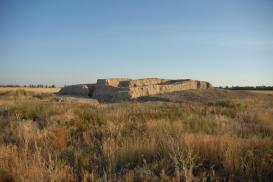
Last year, as I travelled south-west from Lake Alakool towards Lepsinsk, Sarcand and Kapal, I had tried to locate this place, but could find no-one who knew anything about it. However, this week, after a determined online search I think I have found the exact spot, which is in the modern-day village of Koilyk (previously called Kayalyk or, more recently, Antonovka), not far from Sarcand. Read this recent description: “Kayalyk territory was surrounded by a fortified wall, having the form of an irregular quadrilateral with sides of 750 to 1,200 meters. Nowadays, it has been preserved well in the eastern part of the unoccupied area of modern buildings and the height reaches 4 m. Elsewhere it can be observed only fragmentary. Certain significant buildings, such as the Buddhist temple, are located at a distance of a few hundred meters from the city walls. This means that agricultural land, farms, centers of spiritual missions were at a considerable distance from the city, enclosed by the city wall, built from mud brick.” You can read more about this site here.
The irregular ‘parallelogram’ enclosing Kayalyk that Thomas described can easily be seen in this picture, with a large ruin in the Western corner and other ruins close by
From this description I have no doubt that it is the same place described by Thomas as an irregular parallelogram. Recent archaeological investigation has revealed that the site is archaeologically extremely rich, with the remains of a large mosque dating back to the early Islamic period, as well as Buddhist and Manichaean temples. This was once an important town on the Silk Road, close to the ‘Djungarian Gates’ that lead through the mountains eastwards into what is now Xinjiang in Western China.
I am now working on an Atkinson Trail for the Zhetysu region of Eastern Kazakhstan and Koilyk will certainly be one of the highlights.
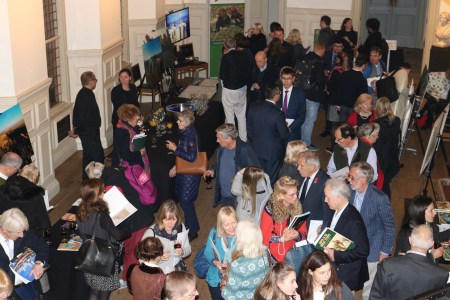
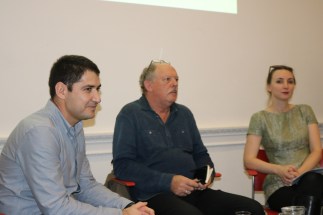
More than 100 people crowded into the Royal Geographical Society on 2 November to hear three speakers, myself included, talk about ‘Unknown Kazakhstan’. Development consultant Sophie Ibbotson gave a broad outline that explained to newcomers the size of the country and the ease of travel. Dr Gai Jorayev, an archaeologist from UCL, spoke about his travels in the country and the exciting archaeological research that is taking place. I spoke mainly about the Zhetysu/Semirechye region where Thomas and Lucy Atkinson spent so much time and which I have now visited three times.
The three speakers
The large turnout and obvious interest from the audience suggests that Kazakhstan – largely unknown to all but the most determined travellers – may be in the process of becoming a more popular destination. One of the ideas that came out of this summer’s visit by the Atkinson relatives is to establish an ‘Atkinson Trail’ and discussions are now going on to make that a reality. The idea is to create an itinerary that travellers can either follow themselves or join a group. I will post more of this as it develops.
(Picture courtesy of the Trustees of the William Salt Library, Stafford)
My picture shows an engraving of the Manchester and Liverpool District Bank building in Hanley, Staffordshire. To the right of the caption you can clearly make out ‘Thomas W Atkinson, Architect, Upper Stamford Street‘. And just beneath the engraving on the bottom left you can also read the name T W Atkinson. So Thomas Atkinson both designed the building and drew the picture upon which this engraving is based. The building itself, which was located on the corner of Town Road and Huntbach Street, was completed in 1833 and this engraving appears to have been a gift from three of the directors to their colleagues and shareholders at the bank.
Thomas’ picture is interesting for several reasons. We know that a year after he completed the Hanley building, Thomas also designed the bank’s headquarters on the corner of Spring Gardens and Marble Street in central Manchester (for more on the Manchester headquarters building, see my posting of 11 October). This was a huge undertaking and was very favourably received by architectural critics, who compared it to the iconic Travellers Club in Pall Mall, London. So it is likely the bank’s directors, having been impressed by the Hanley bank building, decided to give Thomas the contract to design the headquarters building. In the end, ironically, it was this second contract that brought him financial ruin and bankruptcy.
In this mid-1830s drawing by F E Watts, the bank is on the right
The second point of interest is the construction of Thomas’ picture. Unusually for him, the foreground is occupied by a group of people, mostly market traders and their customers. Presumably the bank’s directors were keen to show commerce taking place in front of their rather magnificent building. Women with baskets and bonnets and men in smocks and hats carry on their business in front of the impressive gothic bank building.
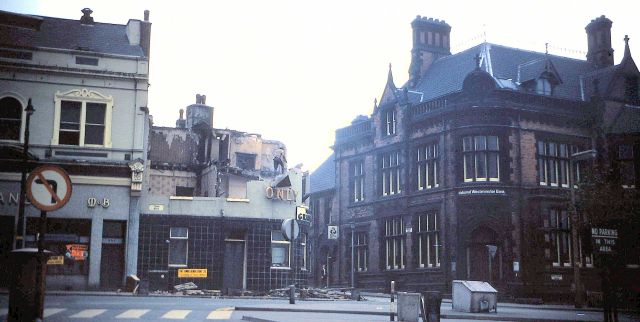
A 1970s photo of the bank building on the right, showing how it was modified in the 1890s.
The building was modified in the 1890s, as can been seen in the picture above. Today, alas, it has disappeared completely, a victim of 1970s town centre redevelopment. The site is now occupied by a ghastly redbrick Natwest bank building.
On the 5th December 2014 I gave a talk at the Royal Asiatic Society in London about Thomas and Lucy’s Atkinson’s travels in Eastern Kazakhstan. At that point I was not long back from a trip to the region where I had been able to locate and visit the Tamchiboulac Spring, after which the Atkinsons named their son.
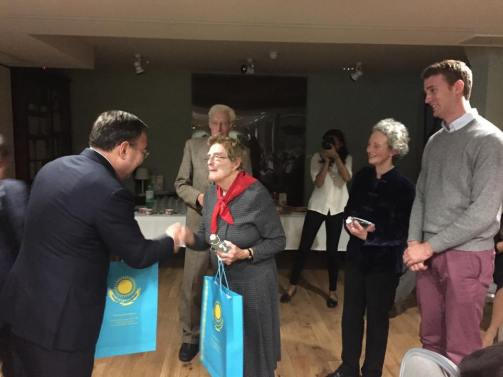
You can listen to a tape of the talk I gave here, where you will also find a set of pics that illustrated the talk. The talk was notable for one thing in particular. I brought back from the spring some of its curative waters, which I then bottled. That evening HE Erzhan Kazykhanov, the Ambassador of Kazakhstan, agreed to present the bottles of water from the Tamchiboulac Spring to several members of the Atkinson family, who had come along to the meeting.
Belinda Brown receives a bottle of Tamchiboulac Spring water from the Kazakh Ambassador
I had almost forgotten that the talk was online, but recently checked and found it was, hence this posting.







 Siberian Steppes