Logo of the RSAA: the horns of the Marco Polo sheep
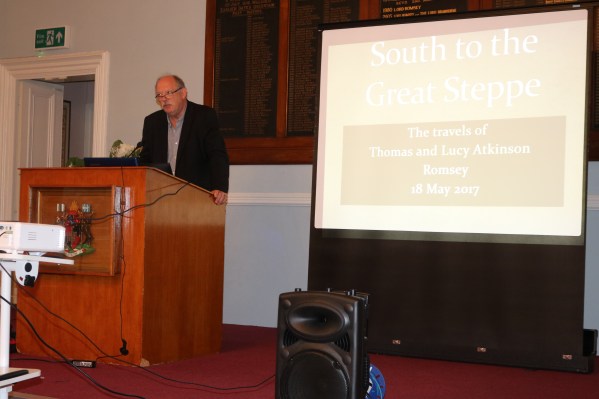
It must be the season for talks, as last night I was the guest speaker at the Royal Society for Asian Affairs in London where I delivered a talk on Pioneers of Central Asian Exploration: The Travels of Thomas and Lucy Atkinson to 20 or so members of the society.
The RSAA was initially formed in 1901 as the Central Asian Society, its founder members including Dr Cotterell Tupp, Captain Francis Younghusband, Colonel Algernon Durand, and General Sir Thomas Gordon – all names associated with the Great Game era of Anglo-Russian rivalry in the region. Its initial prospectus stated:
“At present there is in London no society or institution which is devoted entirely to the consideration of Central Asian questions from their political as well as from their geographical, commercial or scientific aspect, though Societies such as the Royal Geographical and Royal Asiatic Society discuss these subjects incidentally. It is therefore proposed to establish a society to be called the Central Asian Society, with rooms, where those who either have travelled in Central Asia, or are interested in Central Asian questions, could meet one another.”
Later, the organisation became the Royal Central Asian Society and then, in 1975, it adopted its present name. There can be no more appropriate place to have delivered a talk on the Atkinsons who, more than any other British citizens, before or since, explored Central Asia and wrote about its landscape and people.
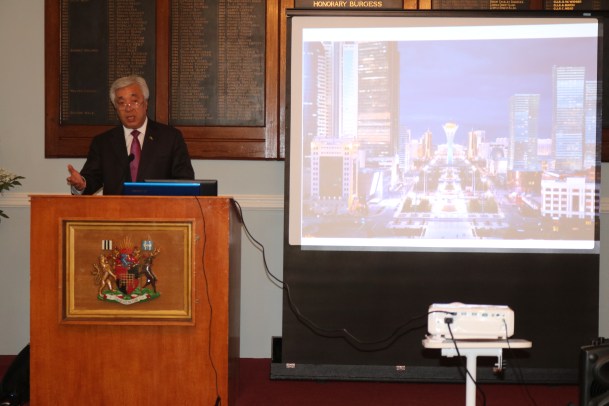
More than 150 people crowded into Romsey Town Hall in Hampshire last night for an event to celebrate the achievements of Thomas and Lucy Atkinson. Guests of honour included the Ambassador of Kazakhstan, HE Erlan Idrissov, the mayor of Romsey, Mr John Parker and Hampshire High Sheriff, the Hon. Mrs Mary Montagu-Scott. The meeting opened up with three songs from the Romsey Voices choir before Thomas and Lucy’s great, great great grandson Steve Brown introduced the ambassador, who spoke warmly about the Atkinsons and the contribution they had made to both Kazakh and British history.
This was followed by a talk by me about the Atkinsons’ travels in Kazakhstan and then a talk from Steve about the history and geography of Kazakhstan. Finally, Steve’s wife, Gill spoke about the trip the Atkinson descendants made to Kazakhstan last summer to visit the birthplace of their ancestor Alatau Tamchiboulac Atkinson at Kapal in November 1848.
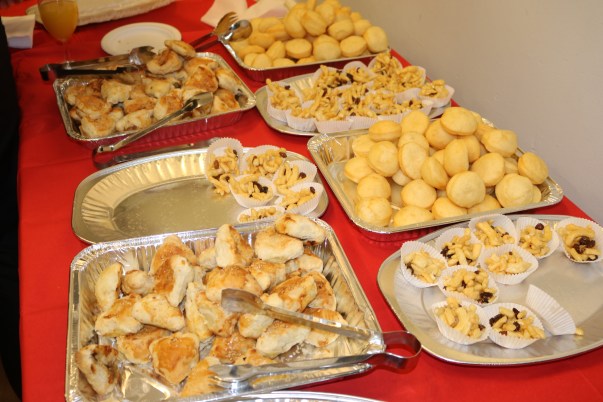
Afterwards guests were treated to a wonderful selection of Kazakh foods and pastries.
I have now given more than 20 talks about the Atkinsons and this was definitely the biggest one so far. Many thanks to everyone who attended and to Steve and Gill for organising it so brilliantly.
Atkinson descendants (l to r) Pippa Smith, Steve Brown, Helen Brown, Cat Brown and Gill Brown, Romsey mayor John Parker, Kazakh ambassador HE Erlan Idrissov, David Brown and yours truly.
Another surprise from the archives! As Sally Hayles was looking into the background of architect Alfred Bower Clayton, who was in partnership with Thomas Atkinson during the mid-1830s, she came across a reference to a ‘Thomas Atkinson’ who was awarded a ‘large silver medal’ by what was then known as the Society for the Encouragement of Arts, Manufactures and Commerce and is today known as the Royal Society of Arts.
A silver Isis Medal similar to the one awarded to Thomas Atkinson
On checking with the RSA it turns out that this was indeed Thomas Witlam Atkinson. He was awarded the society’s prestigious silver Isis Medal in 1827 for “an original composition of architectural ornaments”. The RSA still has his drawing which I reproduce below.
The drawings for which Thomas won a silver medal (courtesy of RSA London)
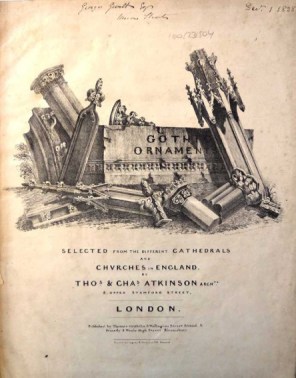
The award of the medal would have been a great fillip for Thomas, who had only recently set up in practice as an architect in Stamford Street, just across the River Thames from the Society’s headquarters in John Adam Street. The following year he would begin publishing his folio book Gothic Ornaments selected from the Cathedrals and Churches of England, and the medal no doubt increased his prestige.
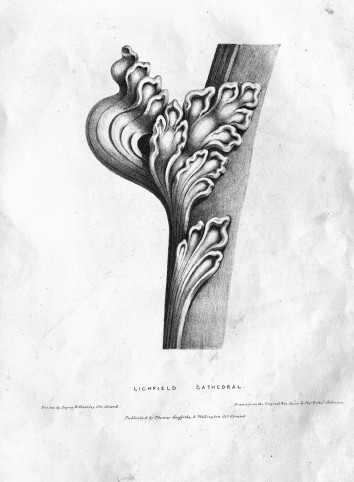
Interestingly, the design he sent in was very similar to the first plate of his book, which shows a detail from Lichfield Cathedral.
The first page of Gothic Ornament, published in 1828
Did the medal survive? It would have been engraved with a citation and his name. It is not in the possession of the family, so if anyone comes across it, please let me know. And once again, many thanks to Sally for spotting this.
In my previous note (5th May) I mentioned that in 1852 Thomas Atkinson made a serious attempt at climbing Mount Belukha, the highest peak in the Altai chain in southern Siberia, which stands at just over 4,500m and is by no means an easy climb. He and his guide Yepta were forced to turn back due to the poor weather and their lack of suitable equipment.
That he took the climb seriously can be established from one of the contemporary documents that survives in the collection of his papers held by his descendant Paul Dahlquist in Hawaii. This is a handwritten translation of a work by Dr Frederic Gebler (1771-1850), a German physician who had moved to Barnaul in the Altai in 1810, where he founded a museum and became a highly-respected correspondent of scientific institutions throughout Europe, particularly for his collection of thousands of insects. He was also inspector of Hospitals in the Altai and travelled extensively in the region, including close the Mount Belukha, where a glacier is now named after him.
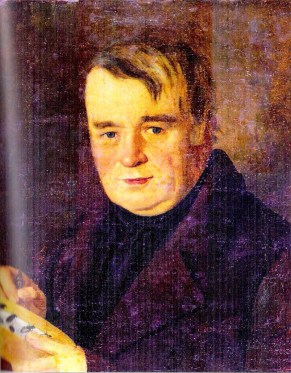
Dr Frederic Gebler
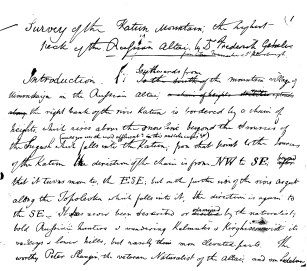
Thomas became a good friend of Dr Gebler following his first visit to the town in 1847. “I spent many happy hours in his company during my first visit to Barnaul,” he says in his book Oriental and Western Siberia and “from him I gathered much information relative to my journey in these regions.” It seems likely that it was Dr Gebler who persuaded Thomas to attempt a climb on the great twin-peaked Belukha, as the handwritten document amongst Thomas’ papers is a translation of Dr Gebler’s 1837 paper on the Katun Mountains and in particular Mount Belukha. It has never been formally translated into English from its original German, but goes by the title Survey of the Katun Mountains; Bielukha, the highest peak of the Russian Altai. Although I cannot be sure, I am almost positive that it was Lucy who did the translation.
An extract from Lucy’s translation of Dr Gebler’s paper on Mt Belukha
Lucy herself comments on Thomas’ two attempts to climb the mountain, in her book Recollections of Tartar Steppes. She first saw the mountain when they travelled through the southern Altai in 1848:
“It was our intention to have gone to the Bielouka; men, horses, and provisions had been prepared at Ouemonia for that purpose, but after a sojourn of a few days in the mountains, on the morning of the 3rd, my husband was obliged reluctantly to turn his horse’s head, but with a determination to return at some future period. I would gladly have accompanied him had he determined to go on, but I was rejoiced when he said we must not proceed farther; we had travelled over versts of morass, our horses sinking up to their saddle-flaps, and at night encamping on the snowy mountains, with a bleak cutting wind penetrating to the very bones.”
Four years later, in 1852, she had not lost her sense of adventure, regretting the fact that she had not accompanied her husband when he returned to the mountain for his second attempt on the summit:
“I have been induced, through the very urgent entreaties of our friends, to allow my husband to go alone this summer to ascend the Bielouka. I consented the more readily, as I had visited the regions round about before; and, besides, Colonel Sokolovsky had intended joining him in this excursion. He was prevented by his departure for Petersburg, which did not take place till the 8th of August, and Mr. Atkinson having remained to see him off, the season was far advanced. Many of our friends thought it too late, as the winter begins in the high regions so early; but he did not seem inclined to defer his journey till another season. He now tells me he regrets much that I did not go, as I have missed some fine scenery; and besides, he says, he missed his companion. He also missed the little arrangements I was able to make for our comfort; I always tried to do this, though scarcely able, at times, to move from fatigue.”
As we know, Thomas’ second attempt on the peak was also unsuccessful, due to his lack of equipment and the bad weather due to the fact he had started out so late in the season. That being said, it is still remarkable that, together with his Kalmuck companion Yepta, he was able to get to the source of the River Katun and the glacier that leads down from the saddle between Belukha’s twin peaks. My guess is that this was about 3-400 metres below the summit. It would be more than 50 years before anyone else got so high and 70 years before the peak was finally conquered.
Thomas’ portrait of Yepta, his climbing companion on Mt Belukha
The rapidity with which Thomas and Lucy Atkinson’s travels were forgotten by the exploring fraternity sometimes astonishes me. By the beginning of the twentieth century, 40 years after Thomas’ death and less than a decade after that of Lucy, no-one (with a few honourable exceptions) seems to have remembered their achievements.
This point was brought home to me recently when reading Siberia: a record of Travel, Climbing and Exploration (1905) by Samuel Turner. Turner was a butter merchant and amateur climber who spent many summers climbing in the Alps, but took advantage of a butter-buying journey to southern Siberia to go climbing in the beautiful and remote Altai Mountains. His intention was to climb Mount Belukha, the highest in the range at 14,784 ft (4,506m).
Samuel Turner, climber and butter merchant
Turner says that he was told in England that there were no mountains in Siberia, but that during a trip to the Royal Geographical Society “I found that all the literature the Society possessed which dealt with the Altai Mountains consisted of a few lines translated from the Russian Geographical Society’s Journal, to the effect that Professor Sapozhnikoff had climbed 13,300 feet of the south side of Belukha and from that elevation had determined the altitude of the mountain to be 14,800 feet, which is the height of the Matterhorn.”
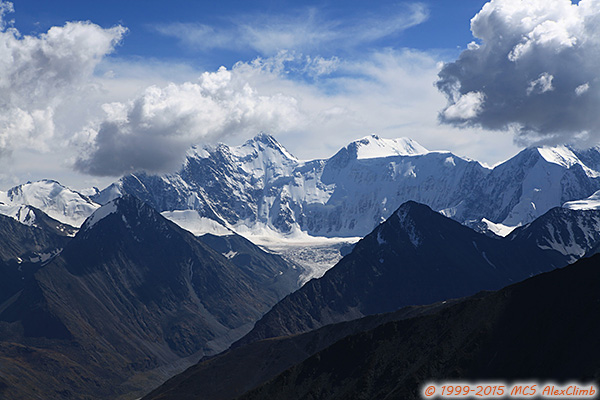
The twin peaks of Mount Belukha
In March 1904 Turner set off on his journey and eventually reached the Belukha massif in mid-April after an arduous journey from Barnaoul involving riverboats, horses and hiking. He soon began his attempt on Belukha itself and congratulated himself on his endeavour:
“The indescribable beauty of the view before me and the consciousness that I was gazing upon a scene that had never yet been desecrated by the camera or described by any human being, was one of a lifetime, and amply repaid me for the difficulties and inconveniences I had experienced on my way. Here all was virgin ground. There were not passes known and labelled; no well-trodden routes to be followed; no Mark Twain had ever made the ascent of these peaks in imagination; no telescope had scaled their heights before my Zeiss binocular; no avalanche had hurled its hapless victims to an untimely death; no Alpine hut vulgarised the slopes or rides or obscured the view of the summit; no Baedeker enumerated the guides or reduced the glories of the ascent to a matter of pounds, shillings and pence.”
Except, of course, he was not the first person to climb in the Altai. Thomas Atkinson beat him to it by more than 50 years. In his book Oriental and Western Siberia, chapter 23 is entitled ‘Ascent of the Bielouka’. Here Thomas describes a visit he made to the Altai in the late spring of 1852, during which he ascended the valley of the River Katounaia – now called the Katun River – and made an attempt to climb the main peak of Belukha. In fact, he had even made an attempt to conquer the peak on his second visit to the region in 1848, when travelling with Lucy.
According to Thomas’ account of the 1852 attempt, he had ascended the mountain together with a Kalmuck hunter called Yepta, making good progress: “Having proceeded about five versts, we reached the bend in the valley, where Bielouka stood before us in all his grandeur. I lost no time in seeking out a good point whence to sketch this monarch of the Altai chain.”
He reached the source of the Katounaia River and the base of the mountain’s twin peaks: “To the west the vast steppes of the Kirghis stretched till lost in hazy distance. To the south were some high peaks and many ridges descending towards the steppes on the east of Nor Zaisan and to the Desert of Gobi. Several lakes were visible in the mountains and on the distant steppes. Innumerable rivers were winding their courses in the deep valleys like a network of silver threads. It was a splendid vista – so many snowy peaks starting up from the purple ridges and green valleys around them.”
However, with no mountaineering equipment at all, no maps or guides and the onset of bad weather, Thomas and Yepta decided to abandon their attempt on the summit, although not before accurately describing the route by which the mountain would eventually be climbed. Fifty years later, Turner failed in his attempt and in fact the peak was not climbed until 1914. You can find a more detailed history of the climbing of Belukha here.
Turner’s book, which is worth reading, is only one example of a book written about Central Asia and Siberia that omits any mention of the journeys carried out by the Atkinsons. In fact, Thomas made at least three journeys to the Altai, on one of which he was accompanied by Lucy. Little by little, we will correct the record.
I am delighted to be able to publish here a detailed essay about Charles Atkinson, an early collaborator – but not a relative – of Thomas Atkinson. Like Thomas he was an architect and artist and the two men were in partnership in London during the late 1820s. It was at that time that they published Gothic Ornaments Selected from the Different Cathedrals and Churches of England, about which I have written in the past.
Thomas and Charles’ book, Gothic Ornaments
To date, little has been written about Charles, but Sally Hayles, the author of this essay, has researched her subject extensively and follows his trail from London surveyor and architect, via shipwreck off the coast of Brazil, to what was then known as Van Diemen’s Land, but is today called Tasmania. There he had mixed fortunes, but is today remembered for a series of well-executed and early lithographs showing views of this remote penal colony. He also worked on one of the wonders of Tasmania, namely the Ross Bridge, with its wonderful stone carvings.
Sadly, Charles Atkinson died aged only 32 following a tragic accident involving a carriage – but rather than hear the story from me, read it here: Charles Atkinson-SH-April2017.
In my last posting I mentioned five of the Kazakhs that Thomas and Lucy Atkinson met on their journeys in Central Asia in the middle of the nineteenth century – Sultan Souk, Sultan Boulania, Sultan Alie Iholdi, Sultan Beck and Sultan Sabeck. I have now had a chance to research further and below you will find five more of the tribal leaders that the couple met during their travels. I will continue to publish further details in batches of five. There are no existing drawings of the leaders mentioned, but Thomas’ descriptions of their clothing and personalities are detailed.
My aim is to find the descendants of as many of these great Kazakh sultans and khans as possible. This should be possible, even after 168 years. Kazakhs, like other central Asians, generally know their genealogy very well for many past generations. So, I appeal to my readers, particularly those in Kazakhstan, to help me in this project and to let me know if you can identify these historical figures or their living relatives. In some cases the spelling may not correspond with present-day usage. This is hardly surprising, as Thomas would only have heard the names being pronounced and did not know enough Kazakh to be able to interpret the names properly. So, if you see a name that looks similar, please let me know anyway.
Most of these khans and sultans lived in the Semirechye region in today’s Eastern Kazakhstan, or possibly even further east in what is now the Djungaria region of Xinjiang. Some lived north-east of Lake Balkash (which Thomas called Lake Tengiz), but most are from the area south of the Tarbagatai Mountains, down to the Ili River. In each case I will give the name and any biographical details provided by Atkinson.
The Atkinsons met most of the leaders mentioned below during the spring of 1849 as they migrated with their vast flocks of sheep and herds of cattle and camels from their winter camps on the littoral of Lake Balkash into the jailoo (high pastures) in the Djungar Alatau Mountains for the summer.
Sultan Kairan: Thomas met him in his aoul (encampment), consisting of 13 yurts and 90 inhabitants as he was making his way with his flocks from Lake Balkash into the Alatau Mountains during the annual spring migration. Aged about 50, “with broad and heavy features, a wide mouth, small and deeply-set black eyes, a well-formed nose and a large forehead. His head was shaved and he wore a closely-fitting blue kanfa cap, embroidered with silver and coloured silks. His neck was as thick and as sturdy as one of his bulls; he was broad-shouldered and strongly built: taking him altogether, he was a powerful man. His dress was a Kokhand cotton kalat striped with yellow, red and green, reaching down to his feet and was tied round his waist with a red and green shawl.”
Urtigun: Thomas met him close to the place he met Sultan Kairan. “He was a tall, well-built man, about 40 years old, with the audacity of a captain of freebooters; indeed, he would not have disgraced with illustrious robber chief (Kenisary) whose region I had just left, by claiming descent from him. It was obvious that we were to each other objects of interest, while to his followers, who had crowded into the yurt, I appeared a great curiosity…I spent more than an hour with this chief and then departed with the usual salutations. When outside the yurt, I observed a fine bearcoot (eagle) chained to his perch and several splendid dogs ranging about; they were of a particularly fine race, somewhat like the Irish wolf-hound, were powerful animals and exceedingly fleet. Urtigun held my horse and gave me his hand to the saddle; he then mounted his own steed and accompanied my party to a small stream about a mile from his aoul. Here we parted, when he expressed a wish that we might meet again in the mountains and hunt deer with his bearcoot.”
Thomas’ drawing of the gorge of the Ac-Sou River
Sultan Djani-Bek: Thomas met him twice, close to the Ac-Sou River in the plains at the foot of the Djungar Alatau, not far from Kapal. He was “a man about 40 years of age, with a burly figure and a jolly, Friar Tuck-looking face, which showed that abstemiousness formed no part of his creed. Four other Kazakhs were sitting in front of us, his boon companions; beyond these there sat a small number of his retainers and herdsmen scanning my face and figure with their small sparkling eyes, evidently wondering from what part of the globe I had come.”
Kal-matai: This chief was also first seen between the Ac-Sou River and the Bascan River, shortly after Thomas left the aoul of Djani-Bek. Kal-matai’s aoul consisted of seven yurts, but this was only part of his tribe. “The aoul belonged to a rich chief, Kal-matai, and some of his children, with one of his wives, were here, with their numerous attendants and herdsmen. In four days the chief was expected to join with his other herds, by which time this part of his tribe would have selected the pastures and established themselves in the upper valleys of the Alatau. All the camels, horses and other animals had been assembled close around the yurts, as the space on which these had been pitched was limited.”
Thomas also described one of Kal-matai’s wives: “My hostess was a woman about 45, with strong Kalmuck features – showing that she had descended from that race and most probably had been stolen from them when young. She wore a black kanfa kalat, a scarlet and green shawl round her waist and a fox-skin cap; yellow leather tchimbar (trousers) embroidered round the bottom and the usual high-heeled boots…. Notwithstanding her finery, she was occupied with her domestic duties, preparing cheese from a mixture of sheep and cow’s milk. It is formed into squares like our cream cheese, and then dried in the sun on a rush mat. I have eaten it and when fresh the flavour is not bad.”
Each spring the tribes moved from Lake Balkash up to the pastures in the Djungar Alatau Mountains.
Barak: This was the next aoul after that of Kal-matai, located closer to the Bascan River. Barak gave Thomas and Lucy a warm welcome. “From him I learned that it was utterly impossible to ascend to the glaciers in which the Bascan has its source, as the route was still deep in snow and the river so much swollen that it had stopped their march. I therefore accepted his offered hospitality to remain the night…Few people possess such a spot: Barak could sit at the door of his yurt and look at his tens of thousands of animals feeding on the mountain slopes. He could also enjoy a view of his domain in which beauty and savage grandeur were combined.” Thomas added: “My host was a Bee (magistrate) and had great influence with the people. During the evening a man was brought before him, charged with having stolen five horses and two camels. The theft was observed by a couple of witnesses and the animals were discovered among his herds.” Thomas describes the trial of the man in detail, how witnesses described the colour of his robes, which appeared not to match those the accused was wearing and how his three kalats were removed to expose the one he was wearing during the theft. “This condemned him and the Bee ordered the restitution of the stolen animals, at the same time imposing a fine of ten horses and four camels. The trial did not last more than an hour and speedy justice was awarded. Thieving of this kind is instantly punished among the Kazakhs.”
I will soon publish further details of the tribal leaders the Atkinsons met in Semirechye.
During his travels in Central Asia Thomas Atkinson met many local and tribal leaders. Unlike many of his contemporaries, Thomas decided to give them a place in his narrative, both by describing his encounters and conversations and, more importantly, by making artistic drawings and paintings of the people he met, which were later published in his books.
Today, those descriptions – literary and artistic – are often the only surviving record of the people who were prominent on the Steppes during the middle of the nineteenth century. Having made contact with the descendants of Thomas and Lucy Atkinson and helped them to travel to today’s Kazakhstan to see the places associated with their ancestors, it seems only right to try and trace the descendants of the Kazakh people they met during their journeys.
So I am publishing here Thomas’ portraits of the people that he and Lucy met on their travels in the late 1840s. I will include the names as they were recorded at the time. In many cases the spellings of the names in use today will be different, but it should not be too difficult to work out who they are. If you know any of these figures or their present-day families, please let me know. I am sure there will be people, particularly in Kazakhstan, who know some of these people.
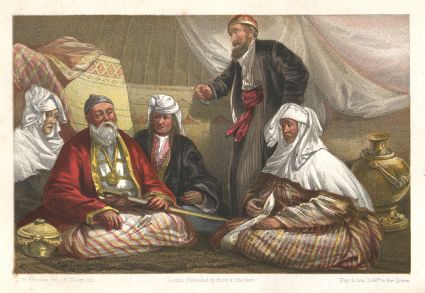
I will start with Sultan Souk and his family. The Sultan, seen here wearing a medal from Tsar Alexander I, was a prominent nobleman who became a close friend of Thomas Atkinson. Aged at least 80 at this time, he was a leader of the Great Horde and Thomas describes him taking part in a meeting held at Kapal in January 1849 that brought
Atkinson’s painting of Sultan Souk and his family
together all the leaders to decide on a boundary between the Great and the Middle Hordes. Sultan Souk was determined that the northern boundary of the Great Horde’s lands in Semirechye region should be the Ac-Sou River, not the Bean or any other river.
The next character is Sultan Boulania. This Sultan, who had also received a medal from Tsar Alexander, was also a prominent leader. Thomas wrote of him that he was “reported to be by far the most enlightened and talented among the Kazakhs.” He found him in the hills around the headwaters of the Lepsou River in Semirechye. Here is his portrait:
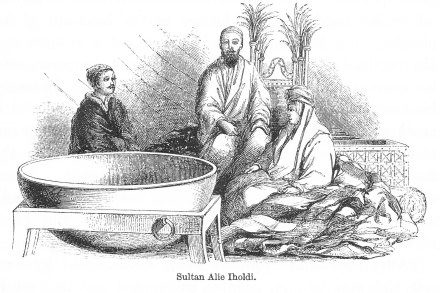
Soon after meeting Sultan Boulania, Thomas met with Sultan Alie Iholdi. He says he was “a distinguished man, who claims his descent from Timour Khan ; indeed, his son bears his name, as though destined to march the wild men of these regions across the Himalaya, like his ancestor… Behind him stands the chair of state, which is carried before him on a camel when the yurt is removed from one spot to another. The plumes of peacock’s feathers are a mark of great distinction among these people. The sultana is sitting on a pile of carpets, and the son behind the great iron caldron, standing on an iron frame, in which the sheep are cooked.”
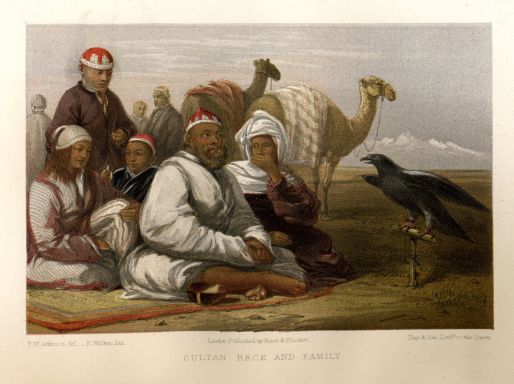
Next we hear of Sultan Beck, “the largest man and most wealthy Kazakhs in the steppes. He has ten thousand horses, and camels, oxen, and sheep in proportion to this vast herd.” His aoul was not far from the eastern end of Lake Balkash. Thomas writes: “He saluted me by touching the chest in the usual manner, after which we sat down and became friends. He drank tea with me, and remained to partake of his own mutton; and while this was preparing, he ordered his poet to sing for us. The man obeyed, and chanted forth songs, describing the prowess and successful plundering expeditions of my host and his ancestors, which called forth thunders of applause from the tribe. After spending more than two hours in the company of the sultan and his bard, we separated on friendly terms.” Thomas says he was fond of hunting with eagles, as is shown by the portrait he drew:
Sultan Beck with his favourite beercoote (eagle)
We next hear of Sultan Sabeck, whom Thomas met during a long journey into Dzungaria, Mongolia and then back into Eastern Kazakhstan. The precise place he met Sultan Sabeck is unclear, although it was very close to the Chinese border, north of Alakool Lake. Thomas says of the Sultan: “Sultan Sabeck was a tall man, with a ruddy, intelligent countenance, black eyes, and a dark beard. His kalat was of kanfa (Chinese satin), of a deep purple colour, with flowers embroidered in various-colored silks, which produced a beautiful robe. A rich yellow crepe scarf was tied round his waist; his cap was sable, turned up with crimson silk ; and he wore light green boots and yellow over-shoes.”
Thomas did not publish a picture of Sultan Sabeck, but there is enough detail here to identify him.
I will publish further names and details shortly. In the meantime, if you can identify any of these important figures in Kazakh history, please let me know.
Amongst the papers held by Thomas Atkinson’s direct descendant Paul Dahlquist in Hawaii is one remarkable document about a final book he had intended to publish. The document is a draft contract in Thomas’ own handwriting, dated 1861, for a book to be entitled The Exiles of Siberia. He spells out his structure of the book, noting it would contain “about six hundred pages and (give) an account of the Russian political exiles, the Polish and the criminals sent to work in the mines. Also an account of the mode in which they are employed in the gold mines and their colonization, with illustrations by the said T W Atkinson”.
The only reason Thomas Atkinson did not write this book is that he died in August the same year. He had not been able to write anything before then, despite his and Lucy’s close and warm contacts with many of the Decembrist exiles during their years of travel in Siberia, because he was so indebted to the Russian Tsars for permission to travel in the remotest parts of their empire. Indeed, his book Oriental and Western Siberia, published in 1858, is dedicated by special permission “To His Imperial Majesty, Alexander the Second”. In the preface he also notes that he was “deeply indebted” to Alexander’s predecessor, Tsar Nicholas I, “for without his passport I should have been stopped at every government and insurmountable difficulties would have been thrown in my way.”
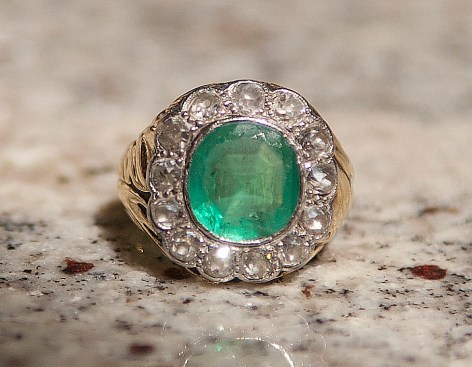
Both emperors, father and son, must have been impressed by Thomas too because each gave him a valuable jewel-encrusted ring, one of which is still retained by the family. We know he met Tsar Alexander and it is very likely he also met Nicholas before he died in 1855. Lucy also mentions being in the same room as Tsar Nicholas, possibly when he came to visit her employer in St Petersburg, General Mikhail Nikolaevitch Muravyev.
A diamond and emerald ring presented to Thomas Atkinson by Tsar Nicholas I
The idea that Thomas could have written about the Decembrists in his books would have been unthinkable in the light of the special privileges they had given him that allowed him to travel so extensively throughout Siberia and Central Asia.
It was the connection with the Muravyev family that gave Thomas and Lucy such remarkable – possibly unprecedented – access to the Decembrist exiles in Siberia. At least five members of the family had taken part in the attempted coup in December 1825. One of them, Sergei Muravyev-Apostol, was one of the five Decembrists who were hanged on the orders of the new Tsar, Nicholas I.
In February 1848, when family members heard that Thomas and Lucy were setting out for Siberia, they begged them to take gifts and goods for those members of the family still living in exile after more than 20 years, including Sergei’s brother, Mattvei Muravyev-Apostol, who they found in the town of Jaloutroffsky, to the east of Ekaterinburg. As Lucy recalled in her book Recollections of Tartar Steppes (1863):
“On entering the dwelling, a gentleman in the prime of life came forward to meet us; he appeared not a little surprised at seeing strangers, Jaloutroffsky being off the great post road. I enquired for Mouravioff; he said he was the person I required. I told him I had come from Petersburg, and gave him my maiden name; I was instantly received with open arms; he then hurried us into his sitting-room, giving me scarcely time to introduce my husband. I was divested of all my wrappings, although we stated that our stay would be short; he then seated me on a sofa, ran himself to fetch pillows to prop against my back, placed a stool for my feet; indeed, had I been an invalid, and one of the family, I could not have been more cared for, or the welcome more cordial.”
A painting of Mattvei Muravyev-Apostol by Nikolai Utkin
Later, in Eastern Siberia, the Atkinsons were to meet more of the Decembrist exiles, including the artist Nikolai Bestuzhev and his brother Mikhail at their home in Selenginsk. Whilst in Irkutsk, Thomas even gave some of his precious Winsor and Newton watercolour paints to Prince Sergei Volkonsky, another of the exiles.
By the time Lucy published her book in 1863, she was free of the political constraints that had bound her husband. The emancipation of the serfs in Russia had taken place and most of the surviving Decembrist exiles – but not the Poles or criminals – had been allowed to return to European Russia. Indeed, some of them had actually come to London to meet her. Thus we find many stories about the Decembrists in her book.
This is not the place to go into a full discussion of Thomas and Lucy’s connections with the Decembrist exiles, but we cannot over-estimate the importance of their meetings. One or two other travellers, including Charles Cottrell and Samuel Hill, also met some of the exiles, but none experienced the level of intimacy over such a long period of time that was conferred on Thomas and Lucy, due to the latter’s employment in the household of General Muravyev in St Petersburg. The intriguing question is did Thomas ever paint any of the Decembrists? The fact that he mentions that his proposed book was to contain illustrations strongly suggests this to be the case. If so, where are these illustrations now?









 Siberian Steppes