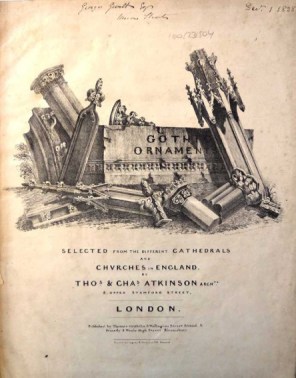
I am delighted to be able to publish here a detailed essay about Charles Atkinson, an early collaborator – but not a relative – of Thomas Atkinson. Like Thomas he was an architect and artist and the two men were in partnership in London during the late 1820s. It was at that time that they published Gothic Ornaments Selected from the Different Cathedrals and Churches of England, about which I have written in the past.
Thomas and Charles’ book, Gothic Ornaments
To date, little has been written about Charles, but Sally Hayles, the author of this essay, has researched her subject extensively and follows his trail from London surveyor and architect, via shipwreck off the coast of Brazil, to what was then known as Van Diemen’s Land, but is today called Tasmania. There he had mixed fortunes, but is today remembered for a series of well-executed and early lithographs showing views of this remote penal colony. He also worked on one of the wonders of Tasmania, namely the Ross Bridge, with its wonderful stone carvings.
Sadly, Charles Atkinson died aged only 32 following a tragic accident involving a carriage – but rather than hear the story from me, read it here: Charles Atkinson-SH-April2017.
In my last posting I mentioned five of the Kazakhs that Thomas and Lucy Atkinson met on their journeys in Central Asia in the middle of the nineteenth century – Sultan Souk, Sultan Boulania, Sultan Alie Iholdi, Sultan Beck and Sultan Sabeck. I have now had a chance to research further and below you will find five more of the tribal leaders that the couple met during their travels. I will continue to publish further details in batches of five. There are no existing drawings of the leaders mentioned, but Thomas’ descriptions of their clothing and personalities are detailed.
My aim is to find the descendants of as many of these great Kazakh sultans and khans as possible. This should be possible, even after 168 years. Kazakhs, like other central Asians, generally know their genealogy very well for many past generations. So, I appeal to my readers, particularly those in Kazakhstan, to help me in this project and to let me know if you can identify these historical figures or their living relatives. In some cases the spelling may not correspond with present-day usage. This is hardly surprising, as Thomas would only have heard the names being pronounced and did not know enough Kazakh to be able to interpret the names properly. So, if you see a name that looks similar, please let me know anyway.
Most of these khans and sultans lived in the Semirechye region in today’s Eastern Kazakhstan, or possibly even further east in what is now the Djungaria region of Xinjiang. Some lived north-east of Lake Balkash (which Thomas called Lake Tengiz), but most are from the area south of the Tarbagatai Mountains, down to the Ili River. In each case I will give the name and any biographical details provided by Atkinson.
The Atkinsons met most of the leaders mentioned below during the spring of 1849 as they migrated with their vast flocks of sheep and herds of cattle and camels from their winter camps on the littoral of Lake Balkash into the jailoo (high pastures) in the Djungar Alatau Mountains for the summer.
Sultan Kairan: Thomas met him in his aoul (encampment), consisting of 13 yurts and 90 inhabitants as he was making his way with his flocks from Lake Balkash into the Alatau Mountains during the annual spring migration. Aged about 50, “with broad and heavy features, a wide mouth, small and deeply-set black eyes, a well-formed nose and a large forehead. His head was shaved and he wore a closely-fitting blue kanfa cap, embroidered with silver and coloured silks. His neck was as thick and as sturdy as one of his bulls; he was broad-shouldered and strongly built: taking him altogether, he was a powerful man. His dress was a Kokhand cotton kalat striped with yellow, red and green, reaching down to his feet and was tied round his waist with a red and green shawl.”
Urtigun: Thomas met him close to the place he met Sultan Kairan. “He was a tall, well-built man, about 40 years old, with the audacity of a captain of freebooters; indeed, he would not have disgraced with illustrious robber chief (Kenisary) whose region I had just left, by claiming descent from him. It was obvious that we were to each other objects of interest, while to his followers, who had crowded into the yurt, I appeared a great curiosity…I spent more than an hour with this chief and then departed with the usual salutations. When outside the yurt, I observed a fine bearcoot (eagle) chained to his perch and several splendid dogs ranging about; they were of a particularly fine race, somewhat like the Irish wolf-hound, were powerful animals and exceedingly fleet. Urtigun held my horse and gave me his hand to the saddle; he then mounted his own steed and accompanied my party to a small stream about a mile from his aoul. Here we parted, when he expressed a wish that we might meet again in the mountains and hunt deer with his bearcoot.”
Thomas’ drawing of the gorge of the Ac-Sou River
Sultan Djani-Bek: Thomas met him twice, close to the Ac-Sou River in the plains at the foot of the Djungar Alatau, not far from Kapal. He was “a man about 40 years of age, with a burly figure and a jolly, Friar Tuck-looking face, which showed that abstemiousness formed no part of his creed. Four other Kazakhs were sitting in front of us, his boon companions; beyond these there sat a small number of his retainers and herdsmen scanning my face and figure with their small sparkling eyes, evidently wondering from what part of the globe I had come.”
Kal-matai: This chief was also first seen between the Ac-Sou River and the Bascan River, shortly after Thomas left the aoul of Djani-Bek. Kal-matai’s aoul consisted of seven yurts, but this was only part of his tribe. “The aoul belonged to a rich chief, Kal-matai, and some of his children, with one of his wives, were here, with their numerous attendants and herdsmen. In four days the chief was expected to join with his other herds, by which time this part of his tribe would have selected the pastures and established themselves in the upper valleys of the Alatau. All the camels, horses and other animals had been assembled close around the yurts, as the space on which these had been pitched was limited.”
Thomas also described one of Kal-matai’s wives: “My hostess was a woman about 45, with strong Kalmuck features – showing that she had descended from that race and most probably had been stolen from them when young. She wore a black kanfa kalat, a scarlet and green shawl round her waist and a fox-skin cap; yellow leather tchimbar (trousers) embroidered round the bottom and the usual high-heeled boots…. Notwithstanding her finery, she was occupied with her domestic duties, preparing cheese from a mixture of sheep and cow’s milk. It is formed into squares like our cream cheese, and then dried in the sun on a rush mat. I have eaten it and when fresh the flavour is not bad.”
Each spring the tribes moved from Lake Balkash up to the pastures in the Djungar Alatau Mountains.
Barak: This was the next aoul after that of Kal-matai, located closer to the Bascan River. Barak gave Thomas and Lucy a warm welcome. “From him I learned that it was utterly impossible to ascend to the glaciers in which the Bascan has its source, as the route was still deep in snow and the river so much swollen that it had stopped their march. I therefore accepted his offered hospitality to remain the night…Few people possess such a spot: Barak could sit at the door of his yurt and look at his tens of thousands of animals feeding on the mountain slopes. He could also enjoy a view of his domain in which beauty and savage grandeur were combined.” Thomas added: “My host was a Bee (magistrate) and had great influence with the people. During the evening a man was brought before him, charged with having stolen five horses and two camels. The theft was observed by a couple of witnesses and the animals were discovered among his herds.” Thomas describes the trial of the man in detail, how witnesses described the colour of his robes, which appeared not to match those the accused was wearing and how his three kalats were removed to expose the one he was wearing during the theft. “This condemned him and the Bee ordered the restitution of the stolen animals, at the same time imposing a fine of ten horses and four camels. The trial did not last more than an hour and speedy justice was awarded. Thieving of this kind is instantly punished among the Kazakhs.”
I will soon publish further details of the tribal leaders the Atkinsons met in Semirechye.
During his travels in Central Asia Thomas Atkinson met many local and tribal leaders. Unlike many of his contemporaries, Thomas decided to give them a place in his narrative, both by describing his encounters and conversations and, more importantly, by making artistic drawings and paintings of the people he met, which were later published in his books.
Today, those descriptions – literary and artistic – are often the only surviving record of the people who were prominent on the Steppes during the middle of the nineteenth century. Having made contact with the descendants of Thomas and Lucy Atkinson and helped them to travel to today’s Kazakhstan to see the places associated with their ancestors, it seems only right to try and trace the descendants of the Kazakh people they met during their journeys.
So I am publishing here Thomas’ portraits of the people that he and Lucy met on their travels in the late 1840s. I will include the names as they were recorded at the time. In many cases the spellings of the names in use today will be different, but it should not be too difficult to work out who they are. If you know any of these figures or their present-day families, please let me know. I am sure there will be people, particularly in Kazakhstan, who know some of these people.
I will start with Sultan Souk and his family. The Sultan, seen here wearing a medal from Tsar Alexander I, was a prominent nobleman who became a close friend of Thomas Atkinson. Aged at least 80 at this time, he was a leader of the Great Horde and Thomas describes him taking part in a meeting held at Kapal in January 1849 that brought
Atkinson’s painting of Sultan Souk and his family
together all the leaders to decide on a boundary between the Great and the Middle Hordes. Sultan Souk was determined that the northern boundary of the Great Horde’s lands in Semirechye region should be the Ac-Sou River, not the Bean or any other river.
The next character is Sultan Boulania. This Sultan, who had also received a medal from Tsar Alexander, was also a prominent leader. Thomas wrote of him that he was “reported to be by far the most enlightened and talented among the Kazakhs.” He found him in the hills around the headwaters of the Lepsou River in Semirechye. Here is his portrait:
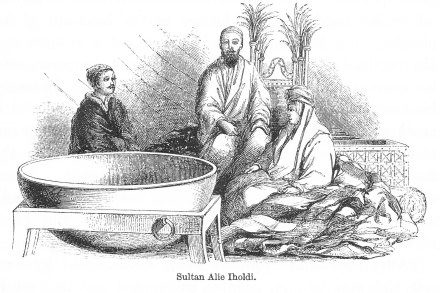
Soon after meeting Sultan Boulania, Thomas met with Sultan Alie Iholdi. He says he was “a distinguished man, who claims his descent from Timour Khan ; indeed, his son bears his name, as though destined to march the wild men of these regions across the Himalaya, like his ancestor… Behind him stands the chair of state, which is carried before him on a camel when the yurt is removed from one spot to another. The plumes of peacock’s feathers are a mark of great distinction among these people. The sultana is sitting on a pile of carpets, and the son behind the great iron caldron, standing on an iron frame, in which the sheep are cooked.”
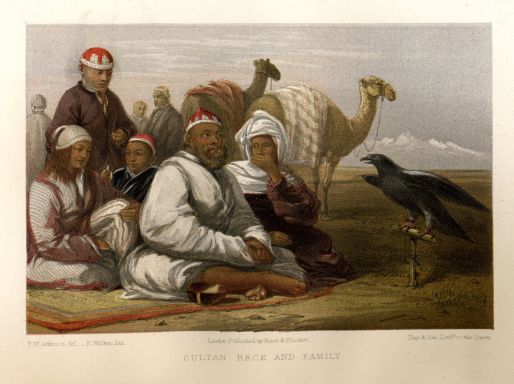
Next we hear of Sultan Beck, “the largest man and most wealthy Kazakhs in the steppes. He has ten thousand horses, and camels, oxen, and sheep in proportion to this vast herd.” His aoul was not far from the eastern end of Lake Balkash. Thomas writes: “He saluted me by touching the chest in the usual manner, after which we sat down and became friends. He drank tea with me, and remained to partake of his own mutton; and while this was preparing, he ordered his poet to sing for us. The man obeyed, and chanted forth songs, describing the prowess and successful plundering expeditions of my host and his ancestors, which called forth thunders of applause from the tribe. After spending more than two hours in the company of the sultan and his bard, we separated on friendly terms.” Thomas says he was fond of hunting with eagles, as is shown by the portrait he drew:
Sultan Beck with his favourite beercoote (eagle)
We next hear of Sultan Sabeck, whom Thomas met during a long journey into Dzungaria, Mongolia and then back into Eastern Kazakhstan. The precise place he met Sultan Sabeck is unclear, although it was very close to the Chinese border, north of Alakool Lake. Thomas says of the Sultan: “Sultan Sabeck was a tall man, with a ruddy, intelligent countenance, black eyes, and a dark beard. His kalat was of kanfa (Chinese satin), of a deep purple colour, with flowers embroidered in various-colored silks, which produced a beautiful robe. A rich yellow crepe scarf was tied round his waist; his cap was sable, turned up with crimson silk ; and he wore light green boots and yellow over-shoes.”
Thomas did not publish a picture of Sultan Sabeck, but there is enough detail here to identify him.
I will publish further names and details shortly. In the meantime, if you can identify any of these important figures in Kazakh history, please let me know.
Amongst the papers held by Thomas Atkinson’s direct descendant Paul Dahlquist in Hawaii is one remarkable document about a final book he had intended to publish. The document is a draft contract in Thomas’ own handwriting, dated 1861, for a book to be entitled The Exiles of Siberia. He spells out his structure of the book, noting it would contain “about six hundred pages and (give) an account of the Russian political exiles, the Polish and the criminals sent to work in the mines. Also an account of the mode in which they are employed in the gold mines and their colonization, with illustrations by the said T W Atkinson”.
The only reason Thomas Atkinson did not write this book is that he died in August the same year. He had not been able to write anything before then, despite his and Lucy’s close and warm contacts with many of the Decembrist exiles during their years of travel in Siberia, because he was so indebted to the Russian Tsars for permission to travel in the remotest parts of their empire. Indeed, his book Oriental and Western Siberia, published in 1858, is dedicated by special permission “To His Imperial Majesty, Alexander the Second”. In the preface he also notes that he was “deeply indebted” to Alexander’s predecessor, Tsar Nicholas I, “for without his passport I should have been stopped at every government and insurmountable difficulties would have been thrown in my way.”
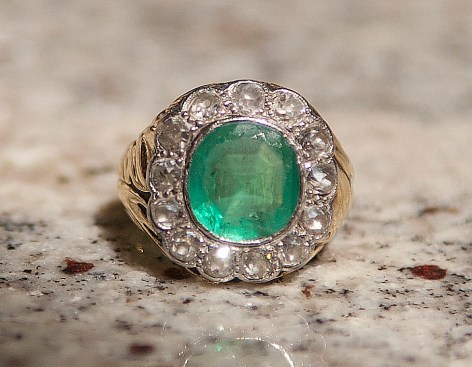
Both emperors, father and son, must have been impressed by Thomas too because each gave him a valuable jewel-encrusted ring, one of which is still retained by the family. We know he met Tsar Alexander and it is very likely he also met Nicholas before he died in 1855. Lucy also mentions being in the same room as Tsar Nicholas, possibly when he came to visit her employer in St Petersburg, General Mikhail Nikolaevitch Muravyev.
A diamond and emerald ring presented to Thomas Atkinson by Tsar Nicholas I
The idea that Thomas could have written about the Decembrists in his books would have been unthinkable in the light of the special privileges they had given him that allowed him to travel so extensively throughout Siberia and Central Asia.
It was the connection with the Muravyev family that gave Thomas and Lucy such remarkable – possibly unprecedented – access to the Decembrist exiles in Siberia. At least five members of the family had taken part in the attempted coup in December 1825. One of them, Sergei Muravyev-Apostol, was one of the five Decembrists who were hanged on the orders of the new Tsar, Nicholas I.
In February 1848, when family members heard that Thomas and Lucy were setting out for Siberia, they begged them to take gifts and goods for those members of the family still living in exile after more than 20 years, including Sergei’s brother, Mattvei Muravyev-Apostol, who they found in the town of Jaloutroffsky, to the east of Ekaterinburg. As Lucy recalled in her book Recollections of Tartar Steppes (1863):
“On entering the dwelling, a gentleman in the prime of life came forward to meet us; he appeared not a little surprised at seeing strangers, Jaloutroffsky being off the great post road. I enquired for Mouravioff; he said he was the person I required. I told him I had come from Petersburg, and gave him my maiden name; I was instantly received with open arms; he then hurried us into his sitting-room, giving me scarcely time to introduce my husband. I was divested of all my wrappings, although we stated that our stay would be short; he then seated me on a sofa, ran himself to fetch pillows to prop against my back, placed a stool for my feet; indeed, had I been an invalid, and one of the family, I could not have been more cared for, or the welcome more cordial.”
A painting of Mattvei Muravyev-Apostol by Nikolai Utkin
Later, in Eastern Siberia, the Atkinsons were to meet more of the Decembrist exiles, including the artist Nikolai Bestuzhev and his brother Mikhail at their home in Selenginsk. Whilst in Irkutsk, Thomas even gave some of his precious Winsor and Newton watercolour paints to Prince Sergei Volkonsky, another of the exiles.
By the time Lucy published her book in 1863, she was free of the political constraints that had bound her husband. The emancipation of the serfs in Russia had taken place and most of the surviving Decembrist exiles – but not the Poles or criminals – had been allowed to return to European Russia. Indeed, some of them had actually come to London to meet her. Thus we find many stories about the Decembrists in her book.
This is not the place to go into a full discussion of Thomas and Lucy’s connections with the Decembrist exiles, but we cannot over-estimate the importance of their meetings. One or two other travellers, including Charles Cottrell and Samuel Hill, also met some of the exiles, but none experienced the level of intimacy over such a long period of time that was conferred on Thomas and Lucy, due to the latter’s employment in the household of General Muravyev in St Petersburg. The intriguing question is did Thomas ever paint any of the Decembrists? The fact that he mentions that his proposed book was to contain illustrations strongly suggests this to be the case. If so, where are these illustrations now?
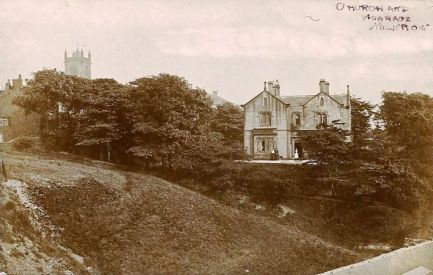
I am grateful to Geoff Cowling, the former church warden at St James’ Church, Milnrow, near Rochdale in Lancashire, for sending me the book extract above, which contains a few more details about the rectory building designed and constructed by Thomas Atkinson. I knew nothing about this building or Atkinson’s involvement in its design until I received the cache of documents recently from Manchester archives – see my posting of 16 February below.
In addition to a good view of the rectory in its more or less original state, including the Gothic windows which have since been modified, the book also has a fine picture of the Reverend Canon F R Raines, for whom it was built. It says the rectory was erected in 1833 on land donated by Mr R G Townley at a cost of £1,500 and was built of stone “quarried on the site”.
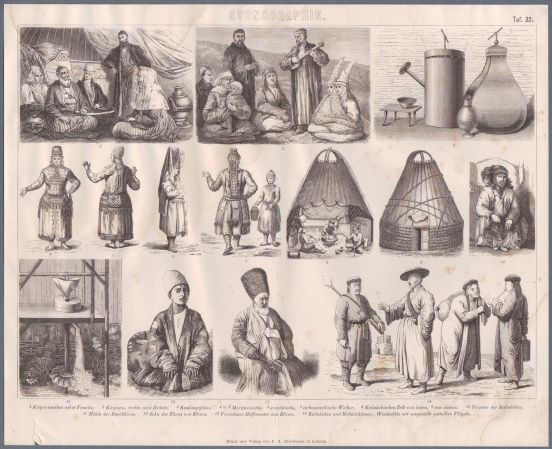
Yet more evidence of plagiarism of Thomas Atkinson’s drawings. I have just come across two large encyclopaedia pages, from 1882 and 1892, which both use illustrations taken from Atkinson’s books on Siberia and Central Asia.
German encyclopaedia page that uses some of Atkinson’s illustrations
The first page (above) comes from a world atlas published by F A Brockhaus in Leipzig in 1882, although the first edition appeared in 1870. The first two illustrations on the top line and the last illustration on the second line are Thomas’ drawings, although not credited.
From and English encyclopaedia
In this further example, published in England in 1892, the second illustration on the second line and the first on the third line are poor quality versions of Thomas’ drawings. Again, neither is credited. Leaving aside the issue of copyright infringement, it appears that for many years Thomas’ drawings and paintings were the one of the main – often uncredited – sources of images of the people who lived on the Central Asian steppes in the nineteenth century.
I have unearthed another fantastic cache of Thomas Atkinson letters and drawings from the Manchester archives that throw further light on the buildings he designed and constructed. Dating from 1832-38 they were mostly addressed to the Royal Manchester Institution and concern paintings and architectural drawings he was submitting for exhibition at the Institution. I have written previously about some of these designs, but now we have a much fuller picture.
Surprisingly, the archive also holds nine original plan drawings for St Luke’s Church, Cheetham Hill, reckoned by many to be Atkinson’s finest building. Now partially demolished, its wonderful spire still stands as a landmark over the area.
Two of Thomas’s drawings for St Luke’s Church, Cheetham Hill.
A letter from Atkinson dated 2 August 1832 lists 10 drawings for inclusion in one of the Institution’s regular exhibitions. The drawings are absent, but the names themselves are revealing. Some, like Hough Hill Priory in Stalybridge and St Nicholas’ Church, Tooting, we know already. But others are new. These include a house designed for John Ashton of Newton, Cheshire, a chapel in Wales, Portland House in Ashton under Lyne, which was built for the local industrialist and mill owner Samuel Swire and Barnby Hall, near Cawthorne, which was built for John Spencer Stanhope of Cannon Hall, the estate on which Thomas had been brought up.
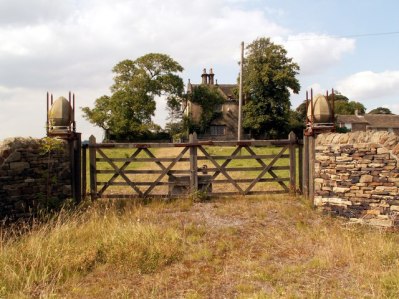
The entrance to Barnby Hall, Cawthorne
The following August Thomas writes to inform Mr Winstanley, secretary of the Royal Institution, that he is submitting two cases of drawings for approval for their summer exhibition. These include the headquarters of the Manchester and Liverpool District Bank in Spring Gardens, Manchester and the Bank’s office in Hanley, Staffordshire (see my posting of 10 November 2016), both of which I have previously mentioned. Also included are proposals for a new grammar school in Birmingham, a school in Wakefield, Yorkshire and a rectory for the Reverend F R Raines at Milnrow near Rochdale. The two schools were not built, but the rectory, for the well-known antiquarian Dr Raines, was completed and still stands, although somewhat modified.
An old postcard showing the rectory in Milnrow near RochdaleA view of the rectory today
The list of paintings – none of which are in the Manchester archives – also includes designs for a gateway and cottages for Messrs Cheetham’s cotton mill in Stalybridge, a house in Hither Green in Kent, lodges for Charles Hindley in Dukinfield, Atkinson’s design for the tomb of Walter Spencer Stanhope in Cawthorne Church, a lodge for Hough Hill Priory and a design for Kirkstall Church near Leeds.
In a separate (undated) letter, Atkinson also lists several paintings, including a view of Llanberis Lake and Dolbadarn Castle in North Wales, a view of Sudely Castle in Gloucestershire and a view near Ffestiniog, also in North Wales.
Already I have been able to track down pictures of some of these buildings, although several of them no longer exist. The list of Thomas’ architectural projects continues to grow and I feel sure we are not yet at the end of it. More will appear here on the buildings as it emerges from the vaults of obscurity. And who knows? Maybe one day some of the landscape paintings will turn up!
We are publishing today a detailed biographical essay about Lucy and Thomas Atkinson’s son, Alatau Tamchiboulac Atkinson, written by Marianne Simpson, who is a direct descendant of Lucy’s brother, William York Finley. The essay discusses Alatau’s move to the then very remote Hawaiian Islands in 1869 and his subsequent career there in journalism and education, as well as his significant role in the American annexation of the territory. It is no less fascinating than the history of his parents. Below is a short precis of the essay, but those of you who wish to read Marianne’s full essay can find it here: to-a-higher-destiny-alatau-atkinson
TO A HIGHER DESTINY
The life of Alatau Tamchiboulac Atkinson (1848-1906)
By Marianne J E Simpson
“Convinced that circumstances had inevitably linked the destiny of Hawaii with that of the United States of America, he wrought, in season and out of season, to make the political alliance secure and permanent. Abandoning for the time his duties as school master he took up the editorial pen and through the medium of journalism did master work for annexation. To him more than to any other one man it is due that, during the long period of waiting which followed the first enthusiastic hopes of annexation, the determination to unite Hawaii’s fortunes with those of America, never faltered.”[1]
These remarks were part of the fulsome obituary for Alatau Tamchiboulac Atkinson that appeared in the columns of The Hawaiian Gazette at the time of his death in April 1906. Alatau Atkinson, a name well known in Honolulu for 40 years, left his mark on the evolution of modern Hawaii, both with respect to its annexation by the United States and the forging of an education system in which English was the single medium of instruction. With this international language, he helped prepare the island nation to enter into meaningful exchange with the rapidly advancing world beyond.
Alatau Atkinson was born on 16 November 1848 in Kapal, Kazakhstan to English parents, Thomas Witlam Atkinson and Lucy Sherrard Atkinson. Thomas, an architect and artist, had obtained a passport from the Czar of Russia giving him open access to all parts of the Czar’s dominions. Although there are conjectures concerning the reasons for the journey, one outcome is indisputable: it generated several hundred works of art, many of which were subsequently exhibited in London and some of which were reproduced in the two books Thomas subsequently wrote, Oriental and Western Siberia: A Narrative of Seven Years’ Explorations and Adventures (1858) and Travels in the Regions of the Upper and Lower Amoor (1860).
Alatau was born nine months into a journey which would take the family down into the rugged Kazakh Steppes, to Siberia and to the very border of China. His birth was premature, which was attributed by the doctor to the fact that Lucy had spent every day of the preceding months on horseback. Lucy later wrote that, had he been born in a native yurt, they would both undoubtedly have died. However, wonderfully, he survived and early became accustomed to the icy mountain streams in which his mother bathed him and being held close in her encircling arms while eagles hovering above swooped for their prey.
After almost seven years of travels, the family arrived back in St Petersburg just before Christmas 1853 and remained domiciled there until 1858. Andrew Dickson White, subsequently one of the cofounders of Cornell University, met Alatau and his parents at that time, recording that “The Atkinsons had also brought back their only child, a son born on the Siberian steppe, a wonderfully bright youngster…”.[2] That Alatau made a lasting impression on Dr White is shown by the following item from The Hawaiian Star:
“For about fifty years Dr White had tried to find [Alatau] but without result…The rumour was that the young fellow had gone into the navy in after years and so Dr White often but vainly enquired after him at British naval depots…”.[1]
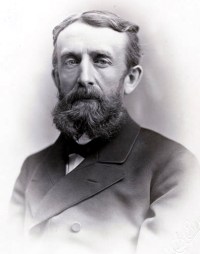
Andrew Dickson White
Thomas Atkinson died in England in 1861 and, in straitened circumstances, Lucy was encouraged by her friends to write a book of her experiences, Recollections of Tartar Steppes and Their Inhabitants (1863). This work was rewarded by a British pension, and Alatau’s future was further assisted when a number of eminent gentlemen, including Charles Dickens, joined together to pay for him to complete his education at the prestigious Rugby School.
We can only imagine what a jolt the transfer to school must have been to Alatau. Speaking Russian equally as well as English and only four years in the country, during which time it is believed that he was educated at home by his mother, then suddenly thrust into the hurly-burly of a boys’ boarding school. Not to mention the burden of his name – inherited from the region where he was born, the Alatau mountains and the Tamchiboulac Spring, with which his parents had become captivated. In a surviving letter, his mother writes that he had just left for school and she hoped he would do well there!
As his later life showed, Alatau embraced learning, so it may be surmised he did not disappoint. Upon leaving Rugby, he returned to Russia in 1867 as secretary of the Turkoman-Russian boundary commission. He was afterwards a writer for the Newcastle Courant newspaper and then went to Durham Grammar School as a teacher. In January 1868 he married Annie Humble in Newcastle-upon-tyne and their first child, Zoe, was born at the end of that year. The following year he left England – as far as we know, never to see the country again – and the little family made their way to Hawaii, via Panama and San Francisco.
In Honolulu, Alatau was first Master at St Alban’s Missionary School and subsequently principal of its successor, St. Alban’s Collegiate Grammar School. The Pacific Commercial Advertiser reported that “Among the many educational establishments on these islands…none deserves more to be noticed for its efficiency than St Alban’s College”. Alatau was also musically endowed. In 1873, he was engaged as organist at Kawaiaha’o Church and in February 1874, as choirmaster, participated in the funeral service of King Lunalilo.
St Alban’s College in Honolulu
In March 1878 Alatau was appointed Principal of the Fort Street High School, described as the leading public school of the city. Around this time, he was also reported as playing a major role in the establishment of a Teachers’ Association of the Hawaiian Islands.
In January 1881, while retaining his position at Fort Street School, Alatau also became editor of The HawaiianGazette, and public opinion was thenceforth to be largely shaped by his own convictions. His views were formed from observations of Hawaii as he experienced it, which was very different from the Hawaii that Captain James Cook had found a century earlier when the Islands were ruled by local chieftains and the combined population has been estimated at 300,000. The islands were gradually united in the 1780s and 1790s due to successive conquests by Kamehameha the Great.
After Cook’s arrival, the region was visited by European explorers, traders and whalers. By 1820 Eurasian diseases, famine and wars among the chiefs had killed more than half of the native population and, by 1876, the population had further declined to 53,900. At the 1896 census (organised by Alatau), the population comprised 31,019 Hawaiians, 8,485 part-Hawaiians, 3,086 Americans, 2,250 British, 1,432 German, 15,191 Portuguese, 21,616 Japanese and 1,534 other nationalities.
In 1874 King Kalakaua was elected to the throne. His spending habits and gambling losses put the government continually into debt and he was poorly advised by his corrupt Prime Minister, Walter Murray Gibson. Both men were satirised in pamphlets written by Alatau. On 30 June 1887 a meeting of residents demanded that King Kalakaua dismiss his cabinet and that a new constitution be written. The King was advised to accept the demands and the Constitution which followed severely curtailed his power.
One of Alatau’s pamphlets satirising the King and his advisors
In the wake of the new order, in August 1887, Alatau was appointed Inspector-General of Education. In his new position, his responsibilities were to visit the schools of Hawaii, report upon their proficiency, and give advice and instruction to teachers. After 1887, his name frequently appears in the shipping columns of the press, either departing from or returning to Honolulu, as he continually criss-crossed the Islands in the discharge of his duties.
On 17 January 1893, anti-royalist insurgents composed largely of United States citizens living and conducting business in Hawaii, engineered the overthrow of King Kalakaua’s successor, Queen Lili’uokalani. A Provisional Government was proclaimed and, in 1894, a constitution was drawn up for the now proclaimed “Republic of Hawaii”. Alatau played no small part in the events leading up to the overthrow, being one of the 14 original members of the pro-annexation Hawaiian League.
Eight years of constant travel took a toll on Alatau’s health and in January 1896 he resigned from his position. A year later, he took up his new post as editor of The Hawaiian Star. He wasted no time in declaring his views, the following being published in the paper a few days after he took over:
“ANNEXATION – PURE AND SIMPLE
The policy of this paper under its present management may be at once laid down. It will advocate the annexation of the Hawaiian Islands to the United States in season and out of season. There is no other great issue before us. It is either annexation or a feeble state that is anybody’s meat…
“The Hawaiian Islands are the outpost of Western civilization in the Pacific…Can it be possible that the United States will leave an outlying fort unassisted? For the battle of the Eastern and the Western civilizations is sure to come, and come much quicker than many people forsee [sic]. Where will the United States be if they leave so strong an outpost at the mercy of an enemy? Held in other hands Hawaii would be a constant menace to the commerce of the United States in time of war. Held by the United States the practical command of the Pacific is obtained.”
In light of subsequent history, prophetic words indeed!
In April 1897 the Republic of Hawaii opened negotiations for a political union with the United States. Shortly after, Alatau was elected on the ticket of the American Union Party to serve in the last session of the House of Representatives acting for a sovereign country.
The official transfer of power to the United States took place on 12 August 1898. The following year Alatau was appointed as Special Agent in charge of the United States 1900 census of the Territory of Hawaii and was directed to proceed to Washington for discussions and further instructions. The HawaiianStar reported his visit: “Alatau T. Atkinson…had an extended interview with President McKinley… [who] displayed not only great interest in the Islands, but a keen knowledge of them”.
It also reported his return: “The preparation for the Hawaiian census,” Mr Atkinson said, “is practically complete…One of the most important features of the census in the Islands…was the decision to enumerate by race and not by color. On the mainland the enumeration will be by color. I insisted, however, that there was no color line here and that enumeration by race was not only the most scientific but the method that harmonized with our social and political ideas and conditions.”[3]
In June 1900 the Territory Governor appointed Alatau to the new position of Inspector General of Public Instruction, which position he held until the year before his death.
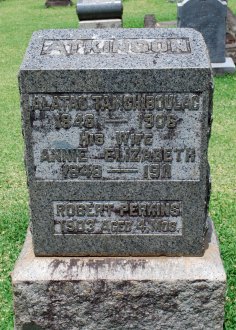
Alatau Atkinson died in Honolulu on 24 April 1906, survived by his wife, three sons and four daughters. On the day of his funeral, the Board of Education and all schools in Honolulu closed for half a day as a mark of respect. One of the obituaries which appeared in The Hawaiian Star[4], alluding to his outstanding contribution, stated the following:
Alatau’s gravestone in Oahu, Hawaii.
“…no enumeration of the individual achievements of his career, however complete, and highly creditable as these are, would in any degree do justice to his life work, without a recognition and appreciation of the…prophetic ideal which he held throughout his career…For such possibilities as he foresaw for Hawaii it was needful that she have a world language. No great destiny was possible for an isolated people speaking a little known tongue, having neither a literature nor a vocabulary of commerce or science…If Hawaii were to accomplish her high destiny, every faculty and gift of all her people must be given the best possible training and opportunity…”.
The Japanese press was also fulsome, the Hawaii Shimpo reporting, “Mr Atkinson worked among a population of a dozen races and…always held that it was the duty of the state to educate all…the Japanese especially appreciate the policy that gave them equal right in the schools and respect the memory of the man who did so much to bring it about.”[5]
And what kind of a man was Alatau? According to The Hawaii Herald (Hilo)[6], “Brilliant far beyond his opportunities, he was in every sense a man who could not fail to leave his work wherever he may have travelled”. From The Evening Bulletin[7]: “Constantly in public life…he encountered many of life’s open battles and they always found him unruffled and unprejudiced.” And from The Hawaiian Star[8], who knew him well, “Enthusiastically fond of Hawaii, he believed it possible for her to achieve a great and glorious destiny…To that ideal he devoted great talents, an indomitable energy, an enthusiasm that never failed or faltered and a luminous zeal.” The editor of The Hawaii Shimpo wrote, “Those who knew Mr. Atkinson saw in him a scholar and a thinker, an eloquent and powerful writer and a strong organizer, and more than this – they could not but feel in his presence, the influence of a true heart and a broad human charity and friendship.”
I have previously mentioned some of the unauthorised foreign editions of Thomas Atkinson’s books on his and Lucy’s travels in Siberia and Central Asia. Here are a couple more, including one from Germany and even one from England.
First the German version. I have recently obtained a copy of Reisen in den Steppen und Hochgebirgen Sibiriens und der angrenzenden Lander Central Asiens (Travelling in the Steppes and Highlands of Siberia and neighbouring countries of Central Asia), published in Leipzig in 1864 and edited by Anton von Etzel and Herman Wagner.
The book is almost entirely based on Thomas Atkinson’s two books, although it also refers to writings by two other German travellers – Middendorf and Rabbe. Most of the illustrations, as with the Spanish book mentioned below and various French publications, are copies of the etchings and lithographs contained in Thomas’ books, but in this case they are not credited. Here is the first page that refers to Thomas’ travels: The book continues for another 250 pages, following Atkinson’s own books exactly, even down to the page headings and complete with dozens of newly commissioned woodcuts based on those that Thomas had already published.
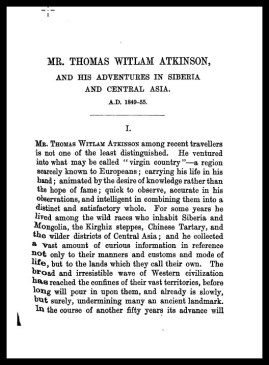
The British pirated version of Thomas’ writings was published in 1885 by the Society for Promoting Christian Knowledge and written by W H Davenport Adams:
Davenport Adams’ book contained about 70 pages taken from Thomas’ two books. He is very complimentary about Atkinson and clearly holds him in high regard: “Mr Thomas Witlam Atkinson among recent travellers is not one of the least distinguished,” he writes. “For some years he lived among the wild races who inhabit Siberia and Mongolia, the Kirghiz steppes, Chinese Tartary and the wilder districts of Central Asia; and he collected a vast amount of curious information in reference not only to their manners and customs and mode of life, but to the lands which they call their own.” Did Lucy receive any royalties for any of these publications? I doubt it.
Before the Atkinsons there were precious few European travellers in Central Asia. Those that did visit, like the Scotsman John Bell or the German Peter Simon Pallas, were mostly just passing through on their way from Moscow to China. Alexander von Humboldt and Roderick Murchison briefly visited the steppes along the southern border of Siberia to the south of the Altai Mountains, in the 1820s and early 1840s respectively, and there was a sprinkling of others, but few of them actually spent time in the region or travelled extensively across the great steppelands.
Even after the Atkinsons it was some years before others followed them into Central Asia. There were a few Russians, like Pyotr Semyonov and Nikolai Severtsof, who were engaged in mapping and exploring the lands newly conquered by the Tsar’s imperial armies. But British colonial rulers in India were reluctant to allow anyone to cross the Himalayas from the south. In fact, when the tea merchant Robert Shaw and adventurer George Hayward visited Kashgaria in 1868 it was in defiance of this long-standing policy.
Robert Shaw (to the right of centre) and his attendants
It was because of this Indo-centric view of the world that the Atkinsons’ remarkable journeys were little known in the Raj. The Atkinsons, of course, had travelled not from British India, but from St Petersburg and barely met another Englishman during the entire seven years they spent travelling in Central Asia and Siberia.
However, as I recently found out, Robert Shaw himself certainly did know about Thomas and must have read his books. He makes two references to Thomas in his book Visits to High Tartary, Yarkand and Kashgar (1870). Writing on 10th November 1868 from his tent which was pitched on the flat roof of a fort on the Karakash River on the northern side of the Karakorum Pass, Shaw notes how for the first time he came across people speaking a dialect of Turkish: “Now, as three days ago my knowledge of Toorkee was confined to the word ‘yok’ – no – which I had picked up in Atkinson’s book, and as they know no Persian, and, of course, no Hindostanee, we have to make up by smiles and signs for our lack of common words”, he writes.
A few pages later Shaw describes his first view of a nomad’s yurt: “There was no mistaking it after reading Atkinson’s books. A circular structure, with a low dome-shaped roof, covered with a dirty-white material, evidently felt.”
So in some circles at least, Thomas Atkinson’s writings were known and respected. Within a generation, however, he and Lucy had been all but forgotten.

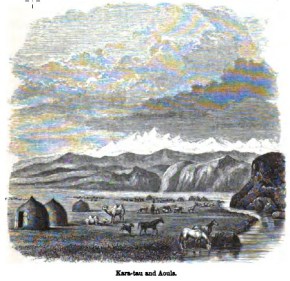
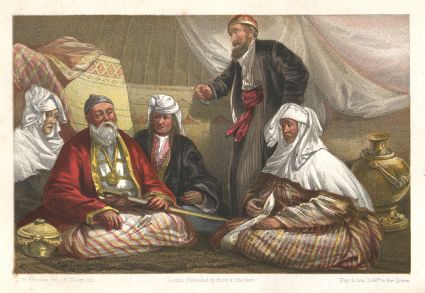










 The book continues for another 250 pages, following Atkinson’s own books exactly, even down to the page headings and complete with dozens of newly commissioned woodcuts based on those that Thomas had already published.