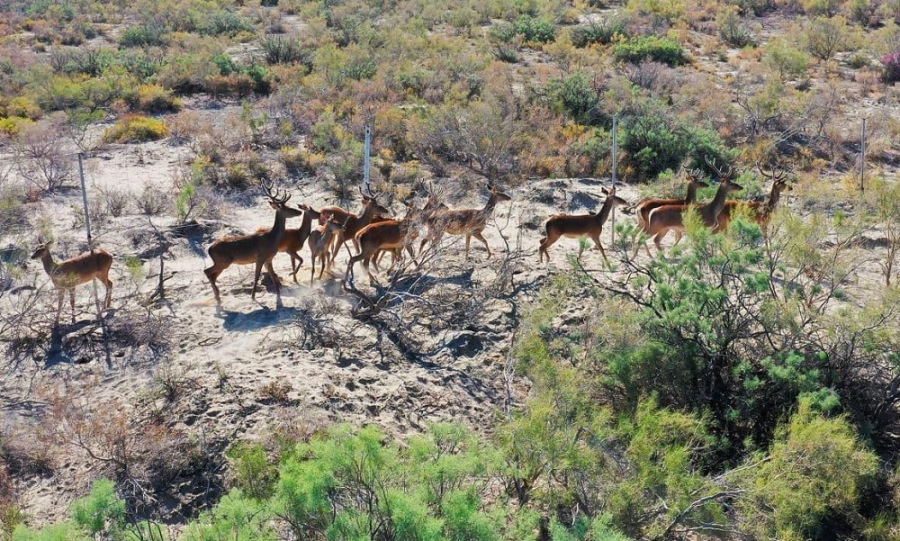
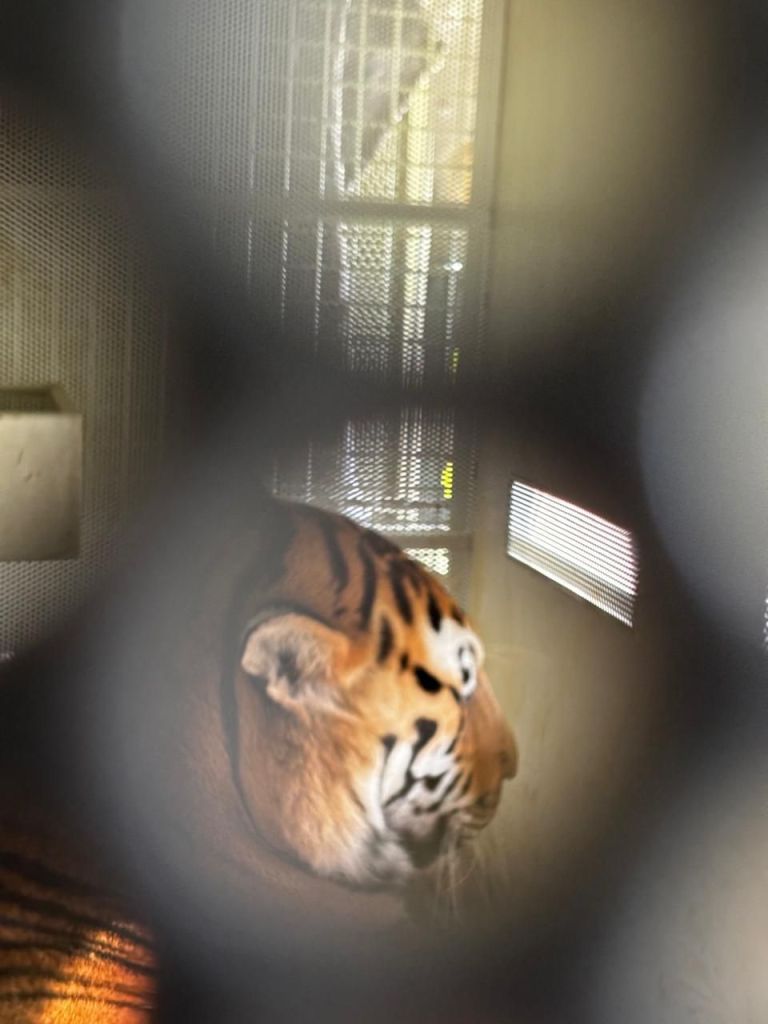
I can exclusively reveal the first photos of tigers arriving in Kazakhstan. The two tigers – a male and a female, both from a Dutch zoo – arrived by helicopter at a secret location near Lake Balkhash.
The chopper in which the two tigers arrivedOne of the Amur tigers
After a period of aclimatisation, the two animals will be released into a specially prepared area where there are already plenty of prey animals for them. More will arrive next year. Watch this space for further updates.
Two Amur tigers are due to arrive in Kazakhstan by the end of this month in the first stage of a programme that will eventually see up to 40 of the highly endangered animals released into the wild.
Four more will arrive next year from Russia, with the rest coming by the end of 2026. This species, which is found along the Amur River in Eastern Siberia, is able to withstand the harsh Central Asian winters. It once flourished as far west as Iran and Turkey, but the last one in Kazakhstan was seen in 1948.
Tigers were a common motif on the clothes of Scythian warriors 2,500 years ago and are the subject of many Kazakh folk stories. The aim is to reintroduce them to the forests and reedbeds where the River Ili flows into Lake Balkash in the south-eastern Zhetysu region.
A Kazakh tiger skin from a photo taken in approx 1900
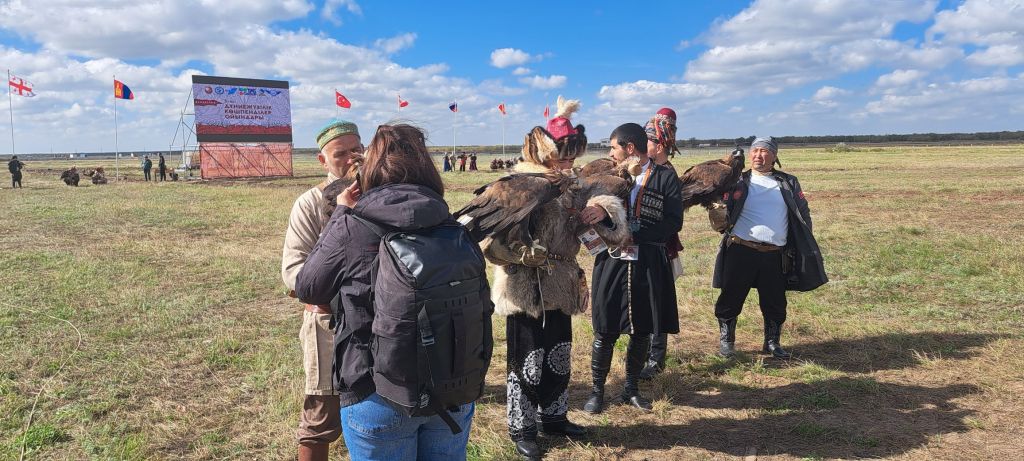
The World Nomad Games in Astana have now come to an end. The riders and wrestlers, tuggers and throwers, hunters and gamers have left and will meet again in Kyrgyzstan in two years’ time. It was a fantastic showcase for both the competitors and the Kazakhs who hosted it. Here are a few more pics of the eagle and hawk hunters to show you what you missed.
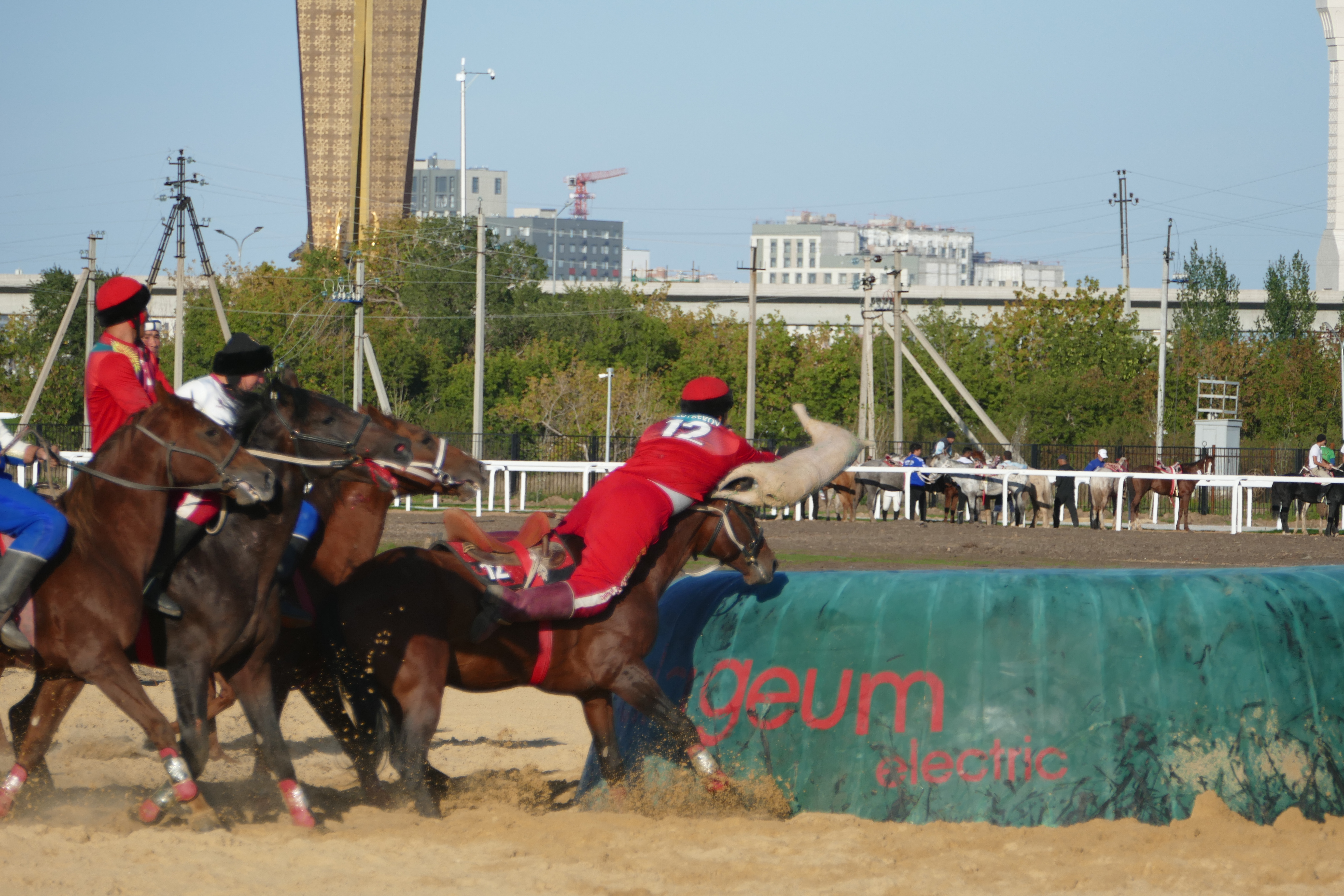
With several thousand competitors and more than 100,000 spectators, the World Nomad Games in Astana, Kazakhstan has got off to a great start. Athletes from more than 80 nations are competing in archery, horse sports and wrestling, as well as intellectual games, such as toguz kumalak to win the top prizes. Here’s a few pics from the kokpar competition in which teams of riders attempt to pick up a (not real) goat carcass and drop it into a large container at one end of the competition area. Not many other rules, really, in this very physical game. This match was between Kyrgyzstan and Russia. The Kyrgyz won by a good margin. More soon.
The Astana Times, an English-language publication in Kazakhstan, has published my article on the long and noble history of nomadic games. You can find a copy here. I will be in Astana from 7-14 September attending the Games and also delivering a paper at the Scientific Conference that is running alongside the Games.
I am very grateful to reader Christian Winkler for pointing out to me that Willie Read, the mysterious hunter I successfully identified last year following my trip to Kashmir, also wrote up his travels for a prestitious magazine. His article, spread across three pages, was featured in the Country Life edition of 11 April 1914. Country Life is the magazine of the landed gentry and in the time before the First World War often featured pieces written by hunters who had travelled in remote places.
The edition of Country Life that printed Willie Read’s article.
There is little in the article that we do not already know. Read writes that he set off from Srinagar on 15th May 1912, meeting his shikari Rahima in Bandipur, downstream on the River Jhelum. “Our route was via Gurais, the Burzil Pass, Godhai, Gilgit, the Kaujut Valley to Merenski”, he writes. He crossed the Killik Pass and after spending 10 days hunting for big sheep and ibex in the Pamir Mountains, made for Kashgar and then Aksu in Chinese Turkestan. From Aksu he entered the Muzart Valley and crossed the pass into the Tekkes Valley in the Tian Shan Mountains before heading on to Kuldja in October. The article is illustrated with some of the images from his magic lantern slides.
The first page of Willie Read’s article.
It always surprised me that I could not find any article or book that mentioned Read’s journey, which took the best part of seven months and involved a journey of almost 3,000 miles through some of the toughest terrain on earth. Now at least we know that he recorded the journey for posterity in the pages of Country Life.
On 8th September more than 3,000 competitors from over 100 countries will gather in Astana, Kazakhstan to take part in the 5th World Nomad Games. Competitors in 21 different sports will compete for almost 90 medals. The sports include the world-famous Kokpar, in which two teams of 12 compete to deliver a serke (dummy sheep) into a hole at either end of the pitch; Kazak kuresi wrestling, in which competitors seek to throw their opponents onto their back; Alysh (belt wrestling); tug-of-war; the Powerful Nomad Strongman competition; Tenge Ilu, in which riders on horseback attempt to pick up objects on the ground; traditional archery; horseback archery; Kuzbegilik – hunting with birds of prey; and Togyzkumalak – a strategy board game involving beads.
Kazakh kuresi wrestling has been popular for hundreds of years
Alongside the Games there will be a scientific conference on nomadism and many cultural events that celebrate nomadic culture.
Horse racing competitions, traditional archery and hunting with birds, as well as horse riding competitions will be held at the Kazanat racetrack and on the Ethnoaul site. The Ushkempirov Wrestling Palace and Alau Ice Palace will host the wrestling competitions, martial arts and folk games, and traditional intellectual games will be held in the Duman complex. The Qazaqstan Athletics Sports Complex will house the WNG Accreditation and Equipment Centers.
The WNG cultural programme will be held in the Universe of Nomads, Ethno-village (Ethno-Aul), which is located on a 10-hectare site adjacent to the Kazanat race course in the south-western side of the city. Cultural activities will also be held at various venues in Astana, including city squares, parks, public gardens, other public spaces, theatres, concert halls, cinemas, museums and exhibition halls.
As well as covering the events, I will also be presenting a paper at the scientific conference on Historial Images of Nomadism. These games promise to be spectacular and I urge any of you that can to make your way to Astana and enjoy a real treat.
Vasily Vasilyevich Vereshchagin (1842-1904) is one of Imperial Russia’s greatest artists. His most famous pictures document the Russian military’s advance through Central Asia in the second half of the nineteenth century. They are rightly considered masterpieces, illustrating the brutality of war on both sides, refusing to turn away from even the most blood-curdling events. His style was more like a war photographer than painter. His paintings were both condemned as ‘unpatriotic’ and defeatist and lauded as great works that emphasised the real nature of war.
However, there is another side to Vereshchagin’s painting that has seldom been highlighted. During two extended trips to Central Asia in 1868-69 and 1870-71 he travelled extensively in what is now Eastern Kazakhstan. At one point he even crossed into ‘Chinese Turkestan’ (Xinjiang), along with a sotnia of Cossacks. He also visited the Chui Valley that marks the border between today’s Kazakhstan and Kyrgyzstan.
The paintings that resulted from these tours through the Kazakh homelands depict the everyday life of the nomads, their migrations, camps and costumes. They show a deep respect for the local culture and an appreciation of the nomadic way of life and are very different from the pictures through which he made his reputation. The only painters who had visited the region previously were Thomas Witlam Atkinson, who was there in the late 1840s, and Pavel Kosharov, who accompanied P P Semenov Tianshansky on his journeys into the Tian Shan Mountains.
The essay is longer than most articles that appear on this blog, so I have presented it as an attached file. I would be delighted to hear from readers who would like to comment on it.
Sheep wool is of fundamental importance for the rapidly dwindling number of Central Asian nomads. In particular it provides the raw material for felt which is used to build their primary dwellings – yurts – as well as twine, candle wicks, floor coverings and a host of other items. Whilst the processes needed to create felt and twine are well understood and documented, the equipment used to shear animals is much less well known. That has all changed with the publication of an important new book by textile collector Peter Umney-Gray. Scissor Bags and Sheep Scissors in the Nomadic Tradition neatly fills this gap and will become an important reference book on this subject.
Peter, who is a fellow member of the Oxford Asian Textile Group, began researching the book in 2012. He quickly discovered that there is little in the literature about the bags and boxes made to contain such scissors, despite worldwide interest in textiles from Central Asia. Even less is known about ‘end-pivot scissors’ that nomads have used for generations to shear their animals. Unlike typical modern scissors, end-pivot scissors are not pinned in the middle of the two blades. Instead, they are held together by a wooden (usually) spar at one end. They are used with two hands, the right hand acting as a spring opening the scissors with the thumb on the top blade and the thumb and fingers of the left hand then squeezing the blades together. Occasionally the blades are marked or signed by the maker.
End-pivot scissors (pic: Vedat Karadag)
These scissors, which can be found from Bulgaria to China, came as a surprise to me. I have often seen the long scissors used for embroidery and textile making and usually associated with Bukhara, but these are completely different. Mostly they are made by local blacksmiths, but in Iran itinerant tradesmen follow the nomads during their migrations and supply them with scissors, as well as pots and pans and other equipment. The shearing technique can be glimpsed in the photo below, which shows a shearer holding the base of the scissors in his right hand while his left hand manipulates the blades. A shearer can process around 40 sheep a day.
Shearing a sheep in Xinjiang (Pic: Vedat Karadag)
Peter’s main interest – and the inspiration for his book – is the wonderful small bags (usually woven) that are used to hold the scissors when not in use. These vary enormously. In their most basic form a thin strip of leather is simply wound around the blades. In the Toros Mountains in Turkey containers are made of wood. In north-eastern Iran region of Turkmen Sahra the Yomud make their scissor bags from felt, with minimal decoration, but also bags in knotted pile as illustrated in the two examples. However, the Shahsavan nomads of north-western Iran weave beautiful oblong bags with vivid patterns.
A Turkmen felt scissor bag
Turkmen Goklen woven scissor bag (both sides) from Golestan Province in north-eastern Iran
Yomut Turkmen scissor bags from the same region
The Turkmen Goklen bag above, which is just over 42cm in length, was woven in one long strip before overcasting was woven on all four sides. It was then folded and sewn up. It is sturdy enough to hold the scissors for many years.
Only in the last two decades has the use of end-pivot scissors begun to disappear amongst the Sarikecili in the Toros Mountains, as cheap modern bowed scissors find their way into the market places. However, in northern Iran and in Central Asian countries, the end-pivot scissors continue to be used in many places.
At the same time, they are absent from most ethnographic museum collections. Where they are present, they are often misidentified as weapons, such as ring-pommel knives. Peter is very aware that there is a lack of scholarship on this subject and urges anyone who has further knowledge to contact him at argali@umneygray.plus.com.
His book is available at £55 plus postage via the same email address.
Today I am publishing a wonderful essay by Marianne Simpson. Regular readers of this blog will be familiar with Marianne’s work. She is a direct descendant of Lucy Atkinson’s brother William Finley and has written about many aspects of the family history, including the connections with Waltzing Matilda composer, Banjo Paterson, and with Lucy’s distant relative Benjamin Coulson Robinson. She has also written about James Michener’s writings on Hawaii and the connection with Alatau Atkinson, as well as the biography of Alatau.
Marianne’s latest essay (below) examines the relationship between Lucy Atkinson’s uncle Joseph Sherrard – who left Lucy a substantial legacy in his will – and George Rowlett, who was a close friend of Charles Darwin and accompanied him on the voyage of HMS Beagle. Sherrard was married to Rowlett’s half-sister, Lucy, after whom Lucy Atkinson was likely named. You can find the essay here: