Vasily Vasilyevich Vereshchagin (1842-1904) is one of Imperial Russia’s greatest artists. His most famous pictures document the Russian military’s advance through Central Asia in the second half of the nineteenth century. They are rightly considered masterpieces, illustrating the brutality of war on both sides, refusing to turn away from even the most blood-curdling events. His style was more like a war photographer than painter. His paintings were both condemned as ‘unpatriotic’ and defeatist and lauded as great works that emphasised the real nature of war.
However, there is another side to Vereshchagin’s painting that has seldom been highlighted. During two extended trips to Central Asia in 1868-69 and 1870-71 he travelled extensively in what is now Eastern Kazakhstan. At one point he even crossed into ‘Chinese Turkestan’ (Xinjiang), along with a sotnia of Cossacks. He also visited the Chui Valley that marks the border between today’s Kazakhstan and Kyrgyzstan.
The paintings that resulted from these tours through the Kazakh homelands depict the everyday life of the nomads, their migrations, camps and costumes. They show a deep respect for the local culture and an appreciation of the nomadic way of life and are very different from the pictures through which he made his reputation. The only painters who had visited the region previously were Thomas Witlam Atkinson, who was there in the late 1840s, and Pavel Kosharov, who accompanied P P Semenov Tianshansky on his journeys into the Tian Shan Mountains.
The essay is longer than most articles that appear on this blog, so I have presented it as an attached file. I would be delighted to hear from readers who would like to comment on it.
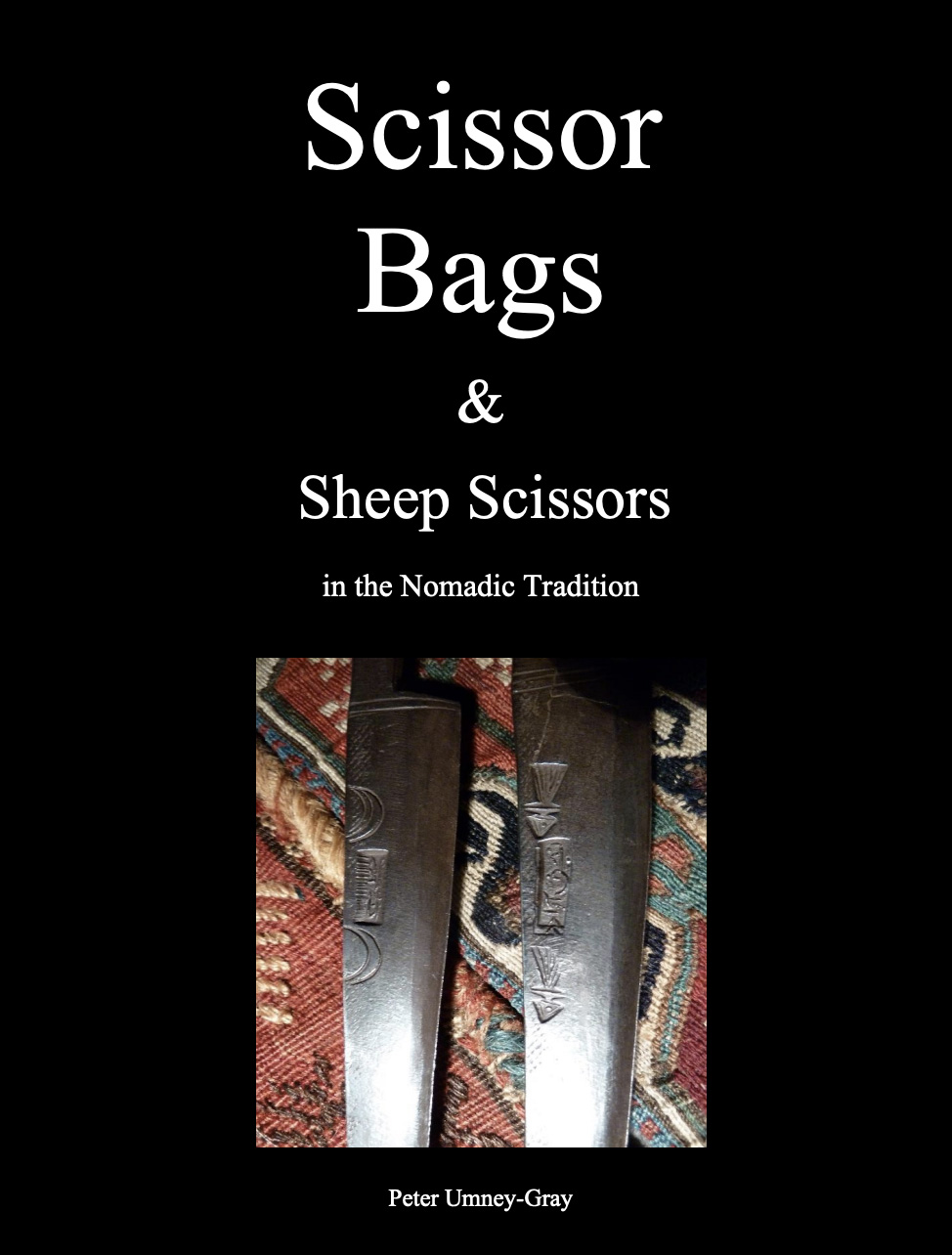
Sheep wool is of fundamental importance for the rapidly dwindling number of Central Asian nomads. In particular it provides the raw material for felt which is used to build their primary dwellings – yurts – as well as twine, candle wicks, floor coverings and a host of other items. Whilst the processes needed to create felt and twine are well understood and documented, the equipment used to shear animals is much less well known. That has all changed with the publication of an important new book by textile collector Peter Umney-Gray. Scissor Bags and Sheep Scissors in the Nomadic Tradition neatly fills this gap and will become an important reference book on this subject.
Peter, who is a fellow member of the Oxford Asian Textile Group, began researching the book in 2012. He quickly discovered that there is little in the literature about the bags and boxes made to contain such scissors, despite worldwide interest in textiles from Central Asia. Even less is known about ‘end-pivot scissors’ that nomads have used for generations to shear their animals. Unlike typical modern scissors, end-pivot scissors are not pinned in the middle of the two blades. Instead, they are held together by a wooden (usually) spar at one end. They are used with two hands, the right hand acting as a spring opening the scissors with the thumb on the top blade and the thumb and fingers of the left hand then squeezing the blades together. Occasionally the blades are marked or signed by the maker.
End-pivot scissors (pic: Vedat Karadag)
These scissors, which can be found from Bulgaria to China, came as a surprise to me. I have often seen the long scissors used for embroidery and textile making and usually associated with Bukhara, but these are completely different. Mostly they are made by local blacksmiths, but in Iran itinerant tradesmen follow the nomads during their migrations and supply them with scissors, as well as pots and pans and other equipment. The shearing technique can be glimpsed in the photo below, which shows a shearer holding the base of the scissors in his right hand while his left hand manipulates the blades. A shearer can process around 40 sheep a day.
Shearing a sheep in Xinjiang (Pic: Vedat Karadag)
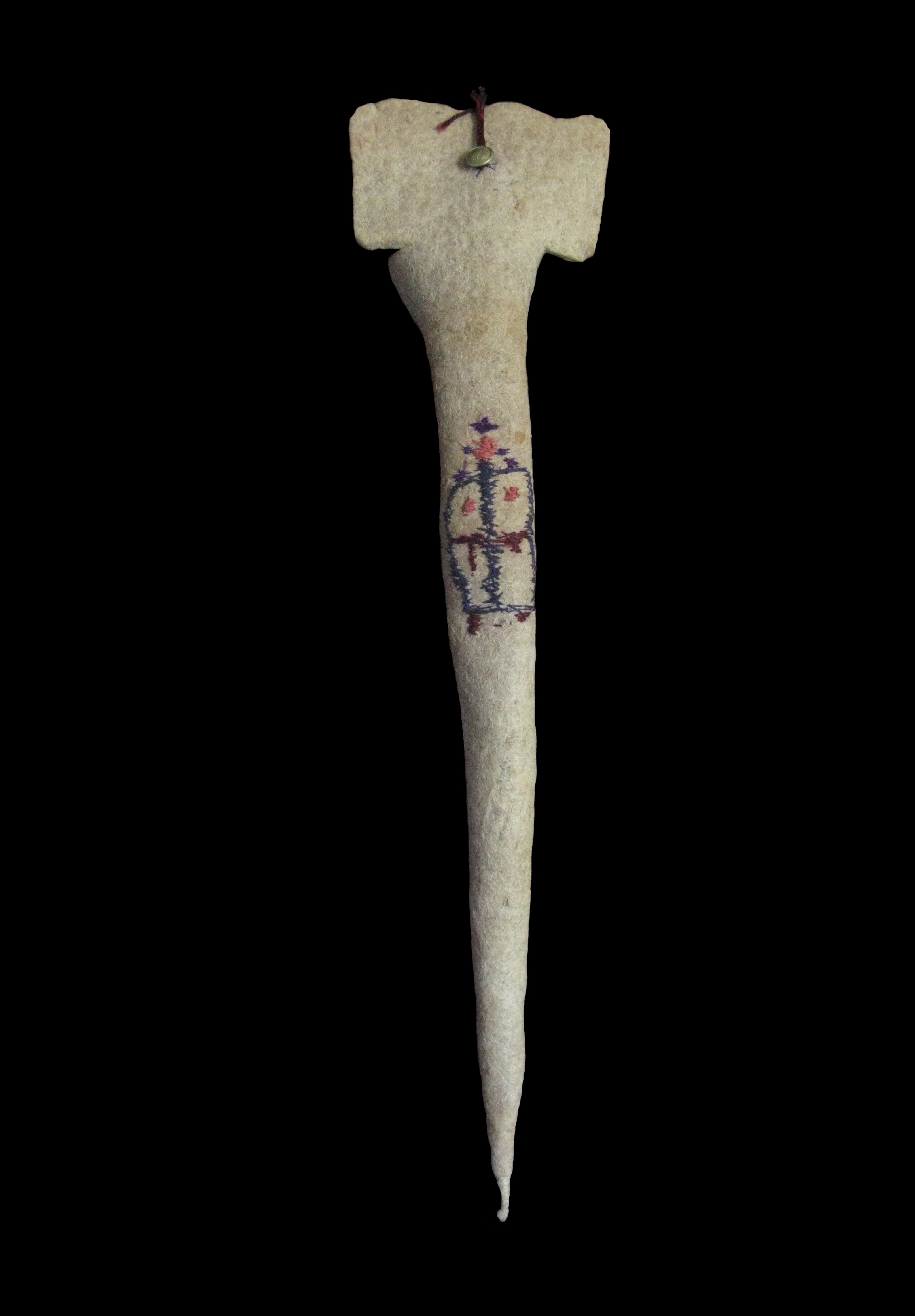
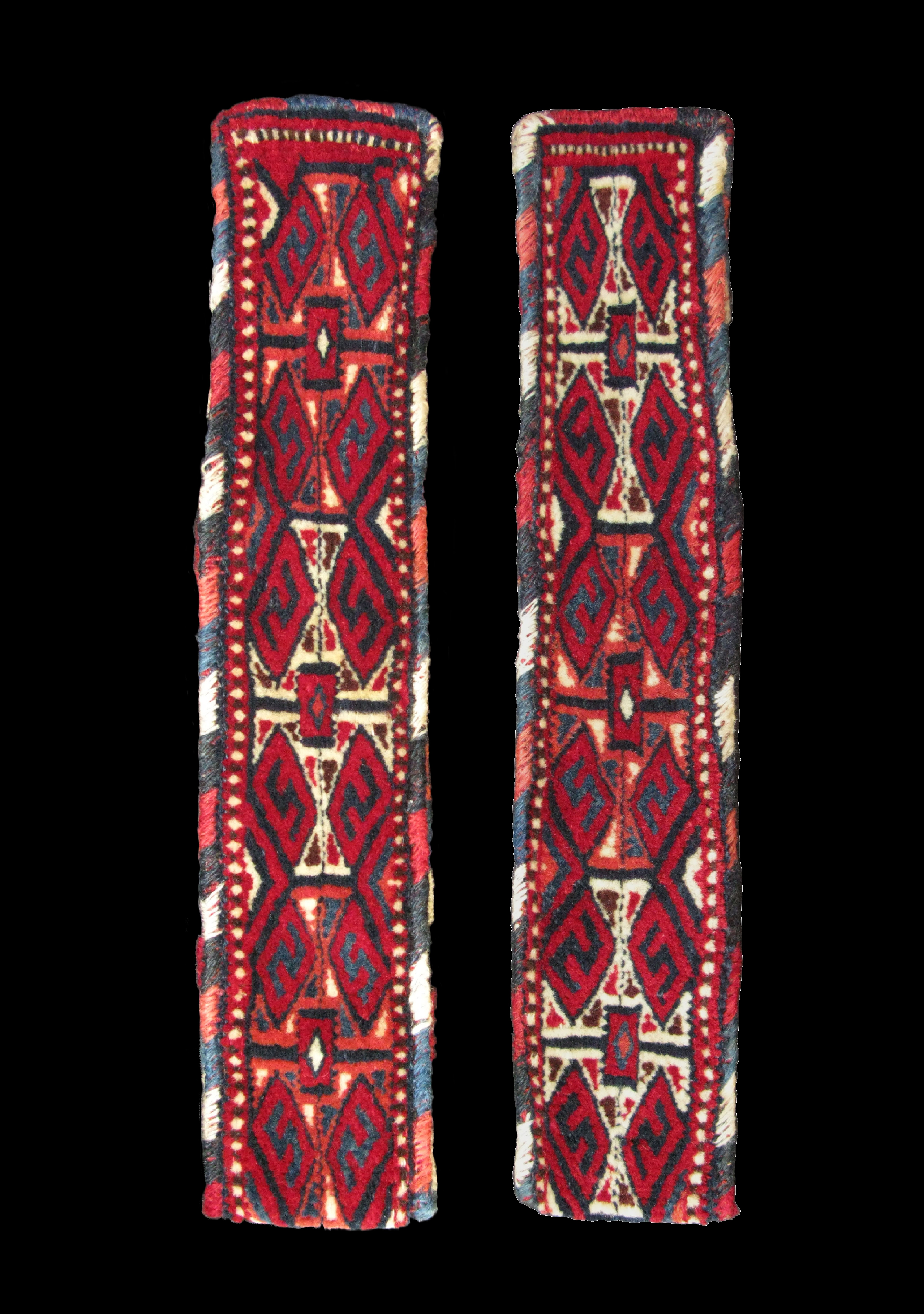
Peter’s main interest – and the inspiration for his book – is the wonderful small bags (usually woven) that are used to hold the scissors when not in use. These vary enormously. In their most basic form a thin strip of leather is simply wound around the blades. In the Toros Mountains in Turkey containers are made of wood. In north-eastern Iran region of Turkmen Sahra the Yomud make their scissor bags from felt, with minimal decoration, but also bags in knotted pile as illustrated in the two examples. However, the Shahsavan nomads of north-western Iran weave beautiful oblong bags with vivid patterns.
A Turkmen felt scissor bag
Turkmen Goklen woven scissor bag (both sides) from Golestan Province in north-eastern Iran
Yomut Turkmen scissor bags from the same region
The Turkmen Goklen bag above, which is just over 42cm in length, was woven in one long strip before overcasting was woven on all four sides. It was then folded and sewn up. It is sturdy enough to hold the scissors for many years.
Only in the last two decades has the use of end-pivot scissors begun to disappear amongst the Sarikecili in the Toros Mountains, as cheap modern bowed scissors find their way into the market places. However, in northern Iran and in Central Asian countries, the end-pivot scissors continue to be used in many places.
At the same time, they are absent from most ethnographic museum collections. Where they are present, they are often misidentified as weapons, such as ring-pommel knives. Peter is very aware that there is a lack of scholarship on this subject and urges anyone who has further knowledge to contact him at argali@umneygray.plus.com.
His book is available at £55 plus postage via the same email address.
Today I am publishing a wonderful essay by Marianne Simpson. Regular readers of this blog will be familiar with Marianne’s work. She is a direct descendant of Lucy Atkinson’s brother William Finley and has written about many aspects of the family history, including the connections with Waltzing Matilda composer, Banjo Paterson, and with Lucy’s distant relative Benjamin Coulson Robinson. She has also written about James Michener’s writings on Hawaii and the connection with Alatau Atkinson, as well as the biography of Alatau.
Marianne’s latest essay (below) examines the relationship between Lucy Atkinson’s uncle Joseph Sherrard – who left Lucy a substantial legacy in his will – and George Rowlett, who was a close friend of Charles Darwin and accompanied him on the voyage of HMS Beagle. Sherrard was married to Rowlett’s half-sister, Lucy, after whom Lucy Atkinson was likely named. You can find the essay here:
A date for your diary. On 22nd January at 2.30pm I will be giving a lecture and slide show at the Royal Geographical Society in London on the remarkable story of Willie Read and his 1912 hunting expedition from Srinagar in Kashmir to Barnaul in Siberia – a journey of almost 3,000 miles.
Willie Read served in the Royal Flying Corps during 1WW
Regular readers will recall my articles earlier this year about how I identified Willie Read as the creator of a set of magic lantern slides that I had purchased. My talk at the RGS, entitled A Magic Lantern Mystery Tour, and presented as part of the ‘Be Inspired’ series organised by Eugene Rae, will give me the opportunity to talk about my findings in public for the first time. It will also be available online. Free for RGS/IBG members and £5 for others. More information here. Hope to see you there.
John Massey Stewart, whose book on the Atkinsons greatly added to the growing literature on the travels of the intrepid couple, passed away on 26th October at the age of 90.
Mr Stewart’s book, Thomas Lucy and Alatau Too: The Atkinsons’ Adventures in Siberia and the Kazakh Steppe, was published in 2018, and – as the title suggests – remains the only publication that offers a perspective on the couple’s six years of travels throughout the Russian Empire.
He was an authority on Russia and the former Soviet Union and had visited the USSR/Russia dozens of times. In 1961 he and David Ashwanden, made a wonderful journey across the Soviet Union in a Mini Minor lent to them by the British Motor Corporation. They travelled from Leningrad south through the Ukraine to Odessa, by ship to Yalta and ship again to the east coast of the Black Sea through Georgia and over the Caucasus. The journey resulted in Mr Stewart’s first book, Across the Russias (Harvill Press, 1969).
During the course of his life Mr Stewart created an extensive collection of images of Russia, particularly in the form of postcards that illustrated subjects such as peasant life in Imperial Russia under the Romanovs and on to the 1917 revolution and the Soviet regime, as well as costume, rituals, traditions, the arts, architecture and places. He also took many photographs himself, all of which can now be accessed through the Mary Evans Picture Library. He also donated his papers to the Royal Asiatic Society. His funeral will take place on Friday 24th November 2023 at St Michael’s Church, South Grove, London, N6 6BJ at 1.30 p.m.
I was delighted this week to take part in a couple of online seminars for school students from Pavlodar Secondary School No 26 in northern Kazakhstan. Several of the students have started a project to trace the journeys of Thomas and Lucy Atkinson through their country in the 1840s. I would like to thank their teacher, Kalamkas Zhangazina for organising the seminars so efficiently. And to Arman and Dilnaz, I would like to say Senderge jumysta sattilik tileimin. Iske sat!
School students from Pavlodar Secondary School No 26 and teacher Kalamkas Zhangazina
I am delighted to announce that Kashmir Pen has just published an article by me about my quest to find the identity of a British hunter, who mounted an extraordinary hunting expedition from Kashmir into Central Asia at the beginning of the 20th century. You can find my article, Solved! The Mystery of the Unknown Hunter and the Kashmiri Shikaris, here. My thanks to Kashmir Pen editor Mushtaq Bala, without whom I would not have been able to solve this fascinating puzzle. Thanks also to Dr Mohd. Amin Malik and Dr Abdul Qayoom Lone for all their assistance during my visit to Kashmir.
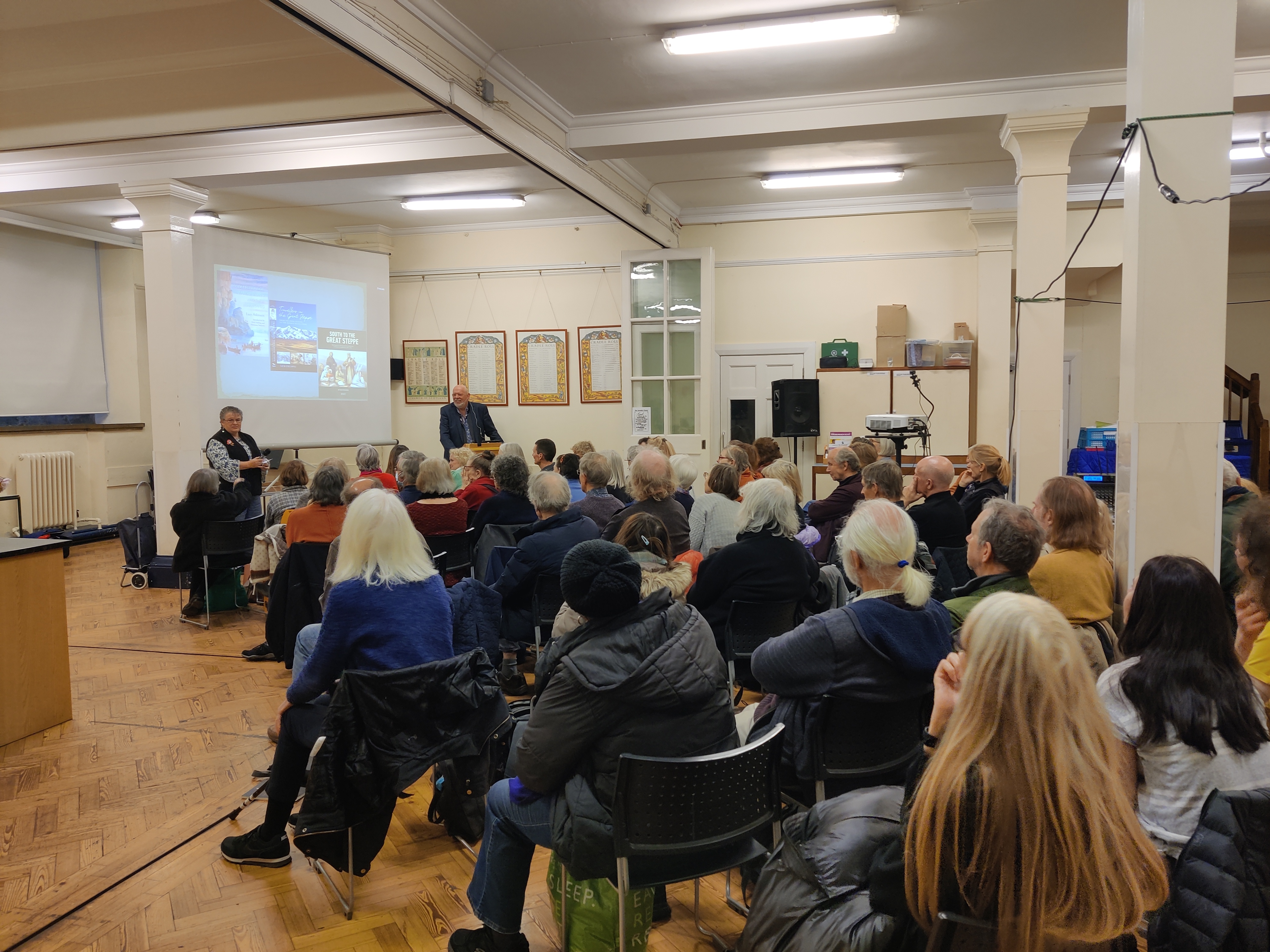
A great crowd of over 100 people turned out in London yesterday to hear me give a slideshow and talk on my travels in Central Asia in the footsteps of the Atkinsons. The talk was hosted by the Globetrotters Club, which has existed for more than 70 years and specialises in those who are interested in travel that is off the beaten track.
Thanks to everyone who came to what was a very enjoyable event.
The purpose of my recent trip to Kashmir was to identify a European hunter who mounted a remarkable expedition through Central Asia, as illustrated by a superb set of magic lantern slides that I had purchased a few months back. Fortunately, I had been able to identify one of his Kashmiri guides (shikaris) shown in the photographs and then, through a series of fortuitous connections, make contact with the shikari’s descendants.
Raheem Lone
It turned out that this shikari, Raheem Lone, was widely regarded as one of the greatest of his generation. So much so that the hunter even took him to England at the end of the expedition. Later, the Roosevelt brothers Theodore and Kermit, sons of the American president at the time, took him to China on an expedition. Famed for his eyesight and strong organisational skills – not the mention his mastery of Central Asia languages – Raheem Lone stood head and shoulders above his contemporaries, as the many letters of recommendation still held by his family testify. It was one of these letters that allowed me to identify my anonymous hunter as Captain ‘Willie’ Ronald Read MC, DFC, AFC and bars, a much-decorated 1WW pilot.
But in fact Raheem Lone was not the only shikari of great repute in Kashmir at the beginning of the twentieth century. One of his great friends, also from Bandipore in the north of present-day Kashmir, was a man called Ghulam Hassan Bhat, who died in 1952.
Like Raheem, Hassan Bhat (as he was known) was very familiar with the routes from Kashmir up into the Pamir Mountains and from there onwards to Kashgar and the hunting grounds of the Tien Shan Mountains in present-day Kazakhstan, where many an English army officer took leave in order to shoot ibex, maral deer, Marco Polo sheep and game. At the beginning of the 20th century these areas were still largely unknown and unmapped.
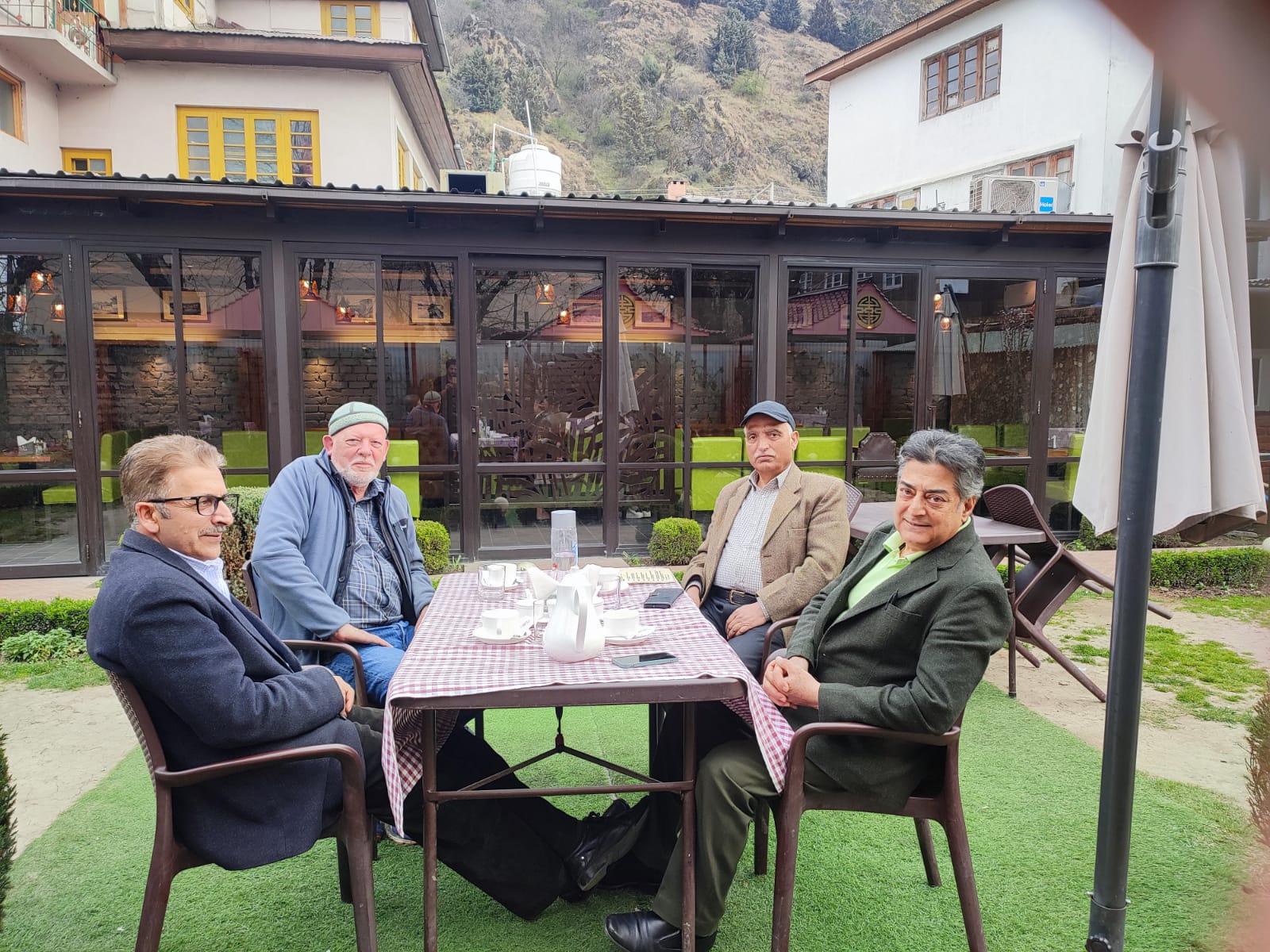
So it was a wonderful surprise to be taken by descendants of Raheem to meet the descendants of Hassan Baht, who today still live in Bandipora. The two families are close. That is how I met 94-year-old Ghulam Ahmad Bhat, Hassan’s son, and his grandsons, Ibraheem and Mohammad. At their wonderful house I was shown yet another folder of letters, this time from Hassan’s clients. As with Raheem, they included some hugely important names.
Ahmed Bhat and his sons Ibraheem Owais and Mohammad Umar
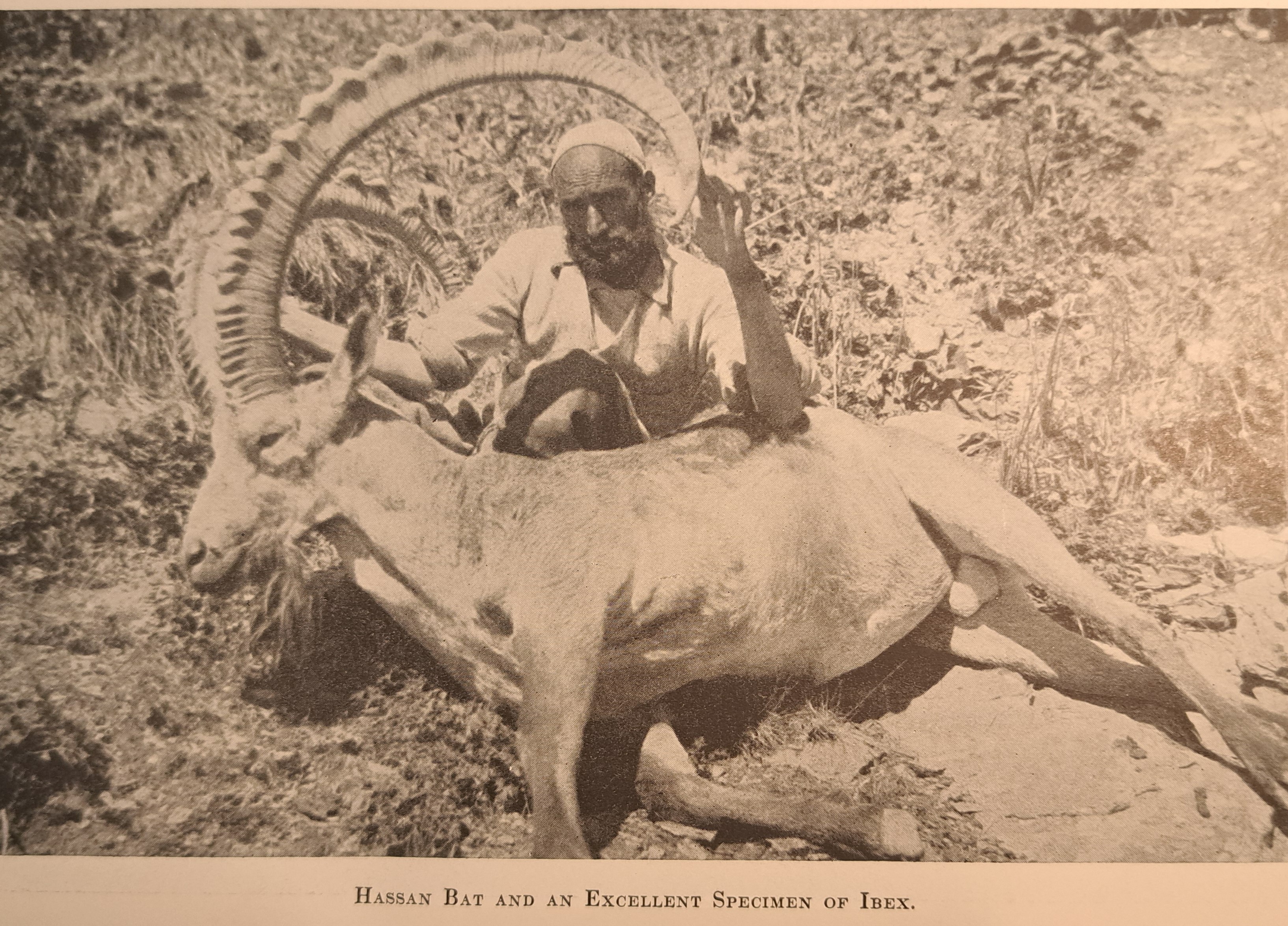
In particular, I noticed the name of William J Morden. Morden was a leader of the 1926 Morden-Clark Asiatic Expedition of the American Museum of Natural History in New York. He had been deputed to collect specimens for the museum from Central Asia and the story of the 8,000-mile expedition is told in his book Across Asia’s Snows and Deserts ( G P Puttnam’s, New York, 1927). Incidentally, the book contains three photographs of Hassan Bhat, taken during the expedition.
Hassan, as portrayed in Morden’s book
There is no doubt that Bhat impressed his employers. In a recommendation dated 23 September 1926 Morden says that Hassan Bhat is “an excellent hunter, an excellent caravan leader and a good servant. He is conscientious and the hardest worker I have ever known. He speaks a very useful amount of Turki and the various local dialects of this country, besides English.” In fact, as his descendants told me, he spoke seven languages.
In another letter written directly to Hassan, expedition co-leader and Museum deputy director James L Clark states “Mr Morden and I are to lunch with Mr Kermit Roosevelt next Monday. We always talk about your fine cooking when we get together and all want to come back some day.” He was still writing to him many years after the expedition finished. E A Waters of the Universities of Pennsylvania and Harvard thanked him in 1930 for looking after him and his wife on a trip to Kashgar in Chinese Turkestan. “We feel that all things considered we cannot speak too highly of Hassan Bhat’s services to us and we are already planning a trip to the Tien Shan which we should not think of taking without him.”
Morden’s recommendation for Hassan Bhat.
So there you have it. Both Hassan Bhat and Raheem Lone have between them dozens of testimonials from some of the most prominent hunters and specimen collectors in the world. The animals they shot are still on display at museums in Chicago, New York and Philadelphia. Without their skills it is doubtful if their clients could have shot a thing or found their way through the difficult terrain up into Central Asia. Their descendants, whilst no longer supporting the kind of extensive hunting trips that happened in the past, are proud of the achievements of their forbearers, who knew some of the world’s most remote places better than almost anyone else.
For the last couple of months I have been trying to identify a hunter whose remarkable collection of magic lantern slides, illustrating a ground-breaking journey from Kashmir to Siberia, I recently purchased. Two weeks ago I got on a plane to Kashmir in order to try to solve the problem by speaking to people who may know something of the story. And I am delighted to announce that the outcome was positive!
But first, more about my trip to Kashmir. I particularly wanted to speak to the family of the shikari (hunting guide) whose identity I had confirmed, due to his participation in an expedition organised by the Roosevelt brothers, Theodore and Kermit, to Central Asia in search of specimens for various American natural history museums. This shikari, Raheem Lone, I have since found out, was regarded by many as one of the best of his generation, with a wide knowledge of Central Asia and the languages in the region.
I received a wonderful reception in Srinagar from Dr Mohd. Amin Malik and Dr Abdul Qayoom Lone, both descendants of Raheem. Mr Mushtaq Bala, editor of Kashmir Pen, also gave me tremendous support. It was in his magazine that I first read about Raheem Lone and his involvement with the Roosevelt brothers.
From left: Dr Mohd. Amin Malik, myself, Dr Abdul Qayoom Lone and Mr Mushtaq Bala in Srinagar, Kashmir
Dr Malik had in his possession a large file of letters sent to Raheem by grateful clients that he had taken on shooting expeditions into the mountains. They dated from 1896 until the 1920s and included glowing references from the Roosevelts, as well as many others, most of whom were British Army officers. From these I thought I would have a good chance of identifying my hunter.
The day after meeting the relatives, Dr Malik took me to Bandipora, about 50 miles north of Srinagar, where we visited the house that Raheem built to entertain his guests. Although empty at present, it is a wonderful building. Members of the family, including Dr Umar Qayoom Lone, live nearby and Raheem himself is buried in a grave only a short walk away.
Raheem Lone’s house in Bandipora
Dr Malik in the house of his great-grandfather, Raheem Lone
Later we visited the home of Ghulam Ahmed Baht, whose father Ghulam Hassan Baht, was also a famous shikari and close friend of Raheem Lone. More of Ghulam Hassan in a separate article. Ghulam Ahmed is 94 and still remembers Raheem, who died in the 1950s, very clearly.
On my return to England last Saturday I began to examine the letters that I had copied from Dr Malik. Several were from a person who was a good candidate for my hunter. He wrote of having enjoyed his journey to Central Asia with Raheem, which took place in 1912, and also sent him letters from Egypt and elsewhere asking after him. His name was Captain, later Wing Commander, William Ronald Read (1885-1972) of the Royal Flying Corps/RAF.
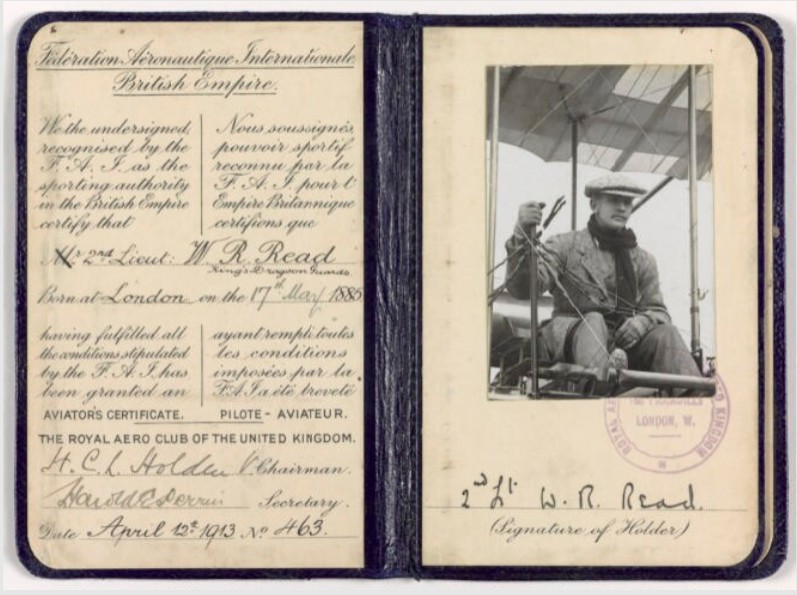
Read is a World War I flying ace and war hero, awarded the Military Cross, Distinguished Flying Cross and, almost uniquely, the Air Force Cross (three times!). His family home, Gorse Cliff in Shoreham by Sea, was used as a hospital for Sikh soldiers during WW1. Originally a soldier in the Royal Dragoon Guards, he transferred to the Royal Flying Corps in April 1914 and later fought in France and Palestine and was several times wounded in action. In September 1930 he was appointed to be Commander of RAF Boscombe Down before retiring the following year. Below are some pictures of Read during his RAF days.
Is that one of his hunting trophies he is wearing?
‘Willy’ Read’s pilot’s license, issued in 1913
As you can see, the resemblance with my anonymous hunter is unmistakeable:
Mystery hunter, now identified as Captain W R Read
One final point. In one of his letters to Raheem, Read mentions that the trophy heads he obtained in Central Asia and which are shown in his magic lantern slides, were still with Rowland Ward, who specialised in mounting such trophies. We should also remember that one of the slides mentions his “record Ovis Littledalei 57 1/2 inches”. Having looked at the Rowland Ward records for the period up to 1914, we find the following:
Second on the all-time list, with a length on the front curve of 58″ is W R Read, our man. I guess his trophy was re-measured on his return to the UK. I should add that Read also mentions that Raheem Lone visited his house in Shoreham, so my thought is that the latter completed the journey with Read from Kashmir all the way to Omsk in southern Siberia, afterwards travelling to England, before returning by sea to Kashmir. (Lone also travelled to China with the Roosevelts, but I will tell that story another time).
There is much more to this story, which I will tell over the coming days. But for now, I can announce without any doubt that our mystery hunter is WW1 war hero Captain ‘Willie’ Ronald Read MC, DFC, AFM and bars. What a story!












 Siberian Steppes