In February 1917 we published a detailed biographical study of Alatau Tamchiboulac Atkinson by Marianne Simpson. The article noted that Alatau – the son of famous Victorian explorers Thomas and Lucy Atkinson, had migrated to Hawai’i in 1869 with his wife and infant daughter to take up a position of Master at St Alban’s Missionary School.
Alatau later rose to become Inspector General of Schools, a position he held until being appointed Superintendent of the 1896 Census. He was also editor of the Hawaiian Gazette from 1881 and the Hawaiian Star from 1897, the latter dedicated to union with the United States.
Between February and July 1898 Alatau served as district representative in the legislature of the Republic of Hawai’i. Atkinson Drive in the Ala Moana area of Honolulu is named in his memory. Alatau and his wife Annie had seven children, of whom Alatau Leonard Charles Atkinson (1871-1927, known as Jack) was their first son.
Documents that have recently come to light about the life of Jack Atkinson reveal another chapter in the story of a remarkable family and show how, through his close friendship with Theodore Roosevelt he nearly became Governor of Hawai’i. Marianne Simpson continues the story.
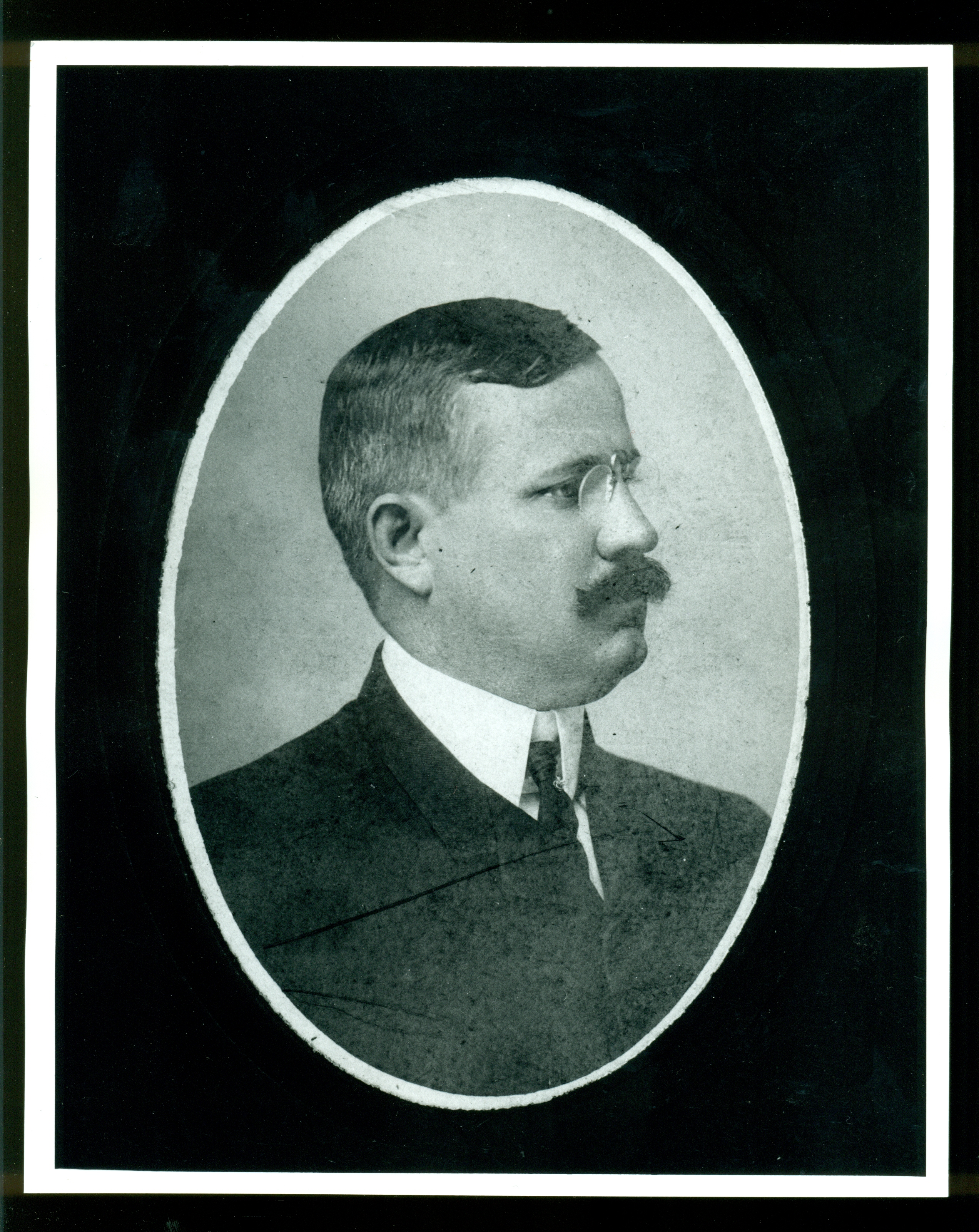
Alatau Leonard Charles (popularly known as “Jack”) Atkinson (1871-1927) was the oldest son of Alatau Tamchiboulac Atkinson. Between 1903 and 1907 he occupied the second top post in the government of Hawaii – Secretary (Lt. Governor) of the Territory – during which time he acted as Governor over extended periods. I provided a summary of his life at the end of the biography I wrote about his father, published on this blog in February 2017.
Since then, I have become aware of other aspects of his life which deserve much closer scrutiny. These concern, first, the significance of Jack Atkinson’s granting Sun Yat Sen, founder of the Chinese Republic, a US birth certificate and, second, his relationship with President Theodore Roosevelt, which led to the active role he played in Roosevelt’s Progressive Party. [1]
“Jack” Atkinson and Sun Yat Sen
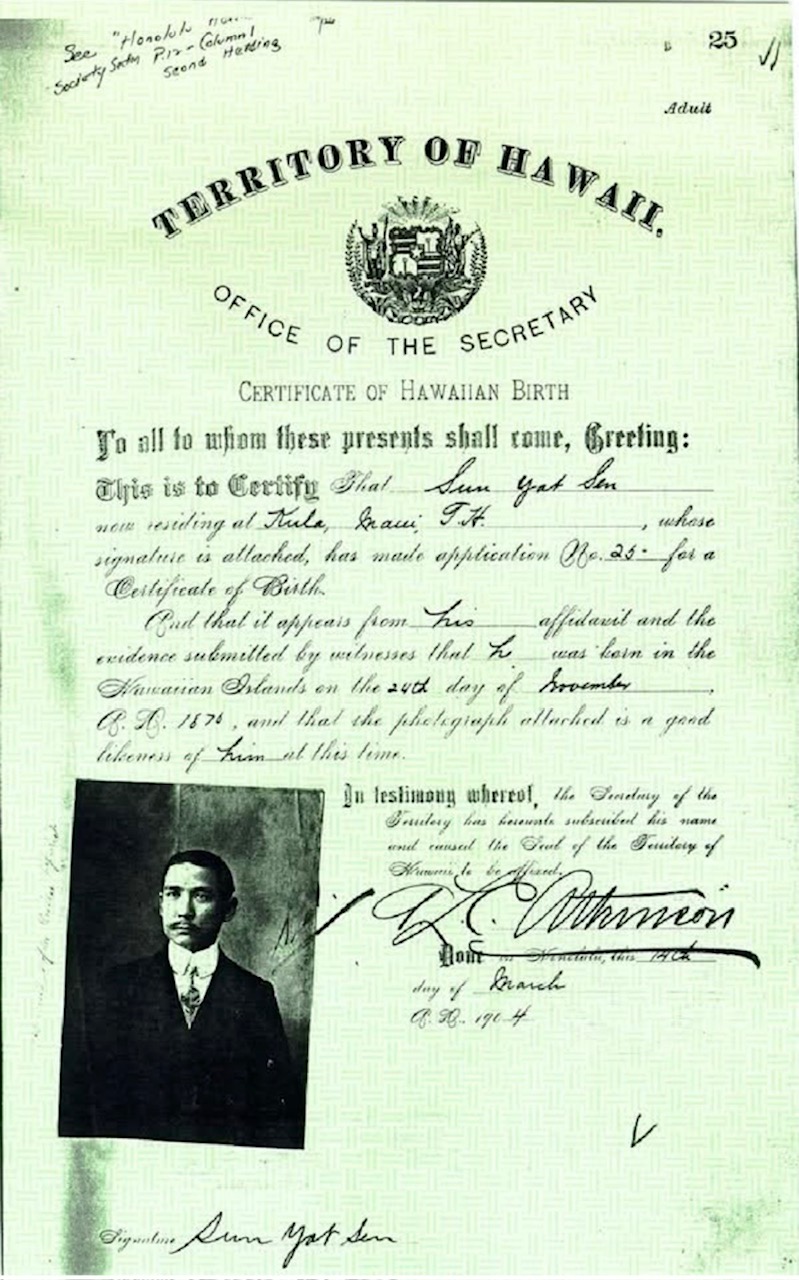
In 2018 this blog published a paper referencing an essay by Patrick Anderson on the reasons why in 1904 Jack Atkinson, Secretary of the Territory of Hawaii, issued Sun Yat Sen, exiled from China since 1895, a certificate falsely stating that he was born in Hawaii. This document was immensely valuable to Sun because, in the wake of the US 1882 Chinese Exclusion Act, he had also been barred from entry to the United States. The certificate instantly conferred on him citizenship of the United States and, with the territorial passport that went with it, he was, three weeks later, allowed into San Francisco.
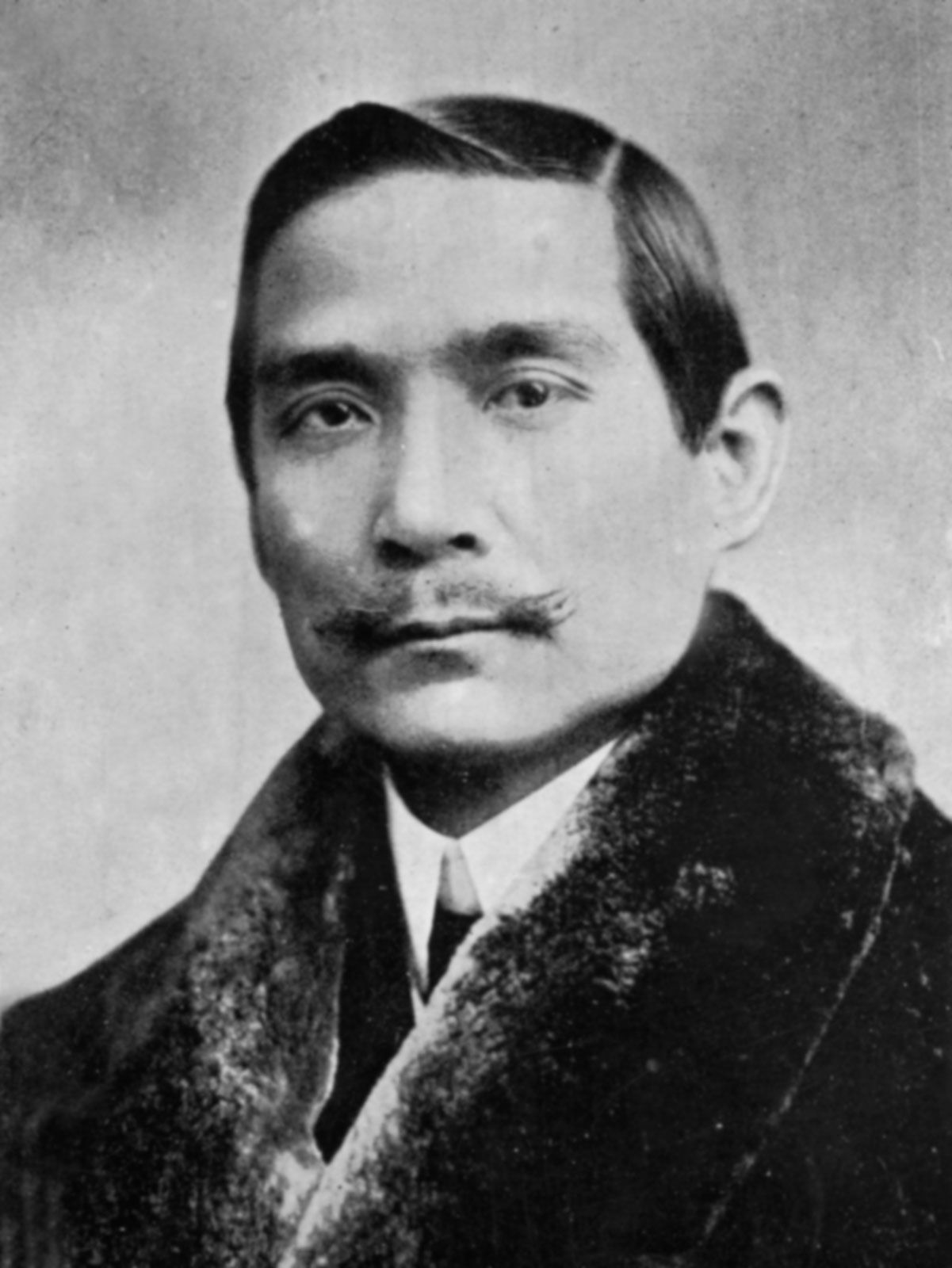
Sun Yat Sen famously declared that the overseas Chinese were the mother of the revolution which overturned the Qing dynasty in 1911 and replaced it with the Republic of China. Having seized power in 1644, by the late 19thC the Qing dynasty was collapsing from within due to official corruption, crushing famine, and public outrage over foreign imperialism. Sun had been exiled following a failed revolt. He made the claim about the overseas Chinese because, while local mutinies undoubtedly provided the spark, it was the Chinese diaspora in North America, Hawaii, southeast Asia and Japan[2] who provided the financial, logistical and ideological support that sustained the revolutionary movement’s long-term survival. By harnessing the critical support of the diaspora, Sun was able to transform a series of scattered, bankrupt insurrections into a well-funded political machine capable of effecting regime change.
Southeast Asia (Nanyang) served as Sun’s base of operations – the logistical, military and organisational hub – and the Chinese diaspora in Singapore and (British) Malaya provided large sums to directly support his many uprisings. In 1905 Sun formed the Tongmenghui (United League) by merging several anti-Qing[3] factions and the first overseas branch was established in Singapore in 1906. The League circulated uncensored, revolutionary newspapers throughout the Nanyang diaspora and smuggled propaganda and arms into China to incite uprisings. Proximity also enabled direct military assaults through today’s Vietnam.
The Americas were the essential capital provider. In the Americas, the diaspora provided the mass scale, long distance, financial capital needed to buy weapons and sustain the revolts. Sun toured North America extensively, leveraging Chinatowns, local clan associations and the Chinese Freemasons. Labourers, farmers and merchants gave generously and the result was massive, consistent funding.
Foreign private banks were problematic so, to ensure continuous backing, Sun utilized regional fundraising bureaus across the US. One such bureau, the American Chinese Revolutionary Army Fundraising Bureau, issuing revolutionary bonds that promised buyers a financial stake and political recognition in the post imperial government, raised $144,130 (today’s equivalent of $4 million) between June and September 1911 alone. This specific American injection of capital provided the immediate liquidity needed to sustain the Wuchang revolutionaries (see below).
America, or more specifically Hawaii (annexed by the United States in 1898), was also the place where Sun was first exposed during his teenage years to Western political theory. In his 1959 book Hawaii, author James Michener includes a scene in which Jack’s father, Alatau Tamchiboulac Atkinson, discusses his dynamic interpretation of the world with the young Sun Yat Sen. For four years Sun was a student at Iolani School, of which Atkinson was headmaster over various periods, so Michener’s statement, sourced from an unidentified Chinese informant, may very well be true. It is generally agreed that the four years Sun spent at the school exposed him to Western history and American political ideas that planted the early seeds for his revolutionary vision for China.
In October 1911, when the uprising in Wuchang broke out, Sun Yat Sen was actually fundraising in Denver, Colorado. Rather than rushing immediately to the battlefield, he spent critical weeks in the United States[4], London and Paris successfully lobbying Western governments and banks to block emergency loans to the Qing dynasty. This effectively starved the imperial court of the cash needed to fight back and confirmed its downfall. The Republic of China was established on 1 January 1912, with Sun Yat Sen as the first President. Sun subsequently became the leader of the Nationalist Party and went on to ally it with the then fledgling Chinese Communist Party (1921).
Today he is called “the father of the nation” in the Republic of China and “the forerunner of the revolution” in the People’s Republic of China. He is unique among 20th century Chinese leaders for being equally revered in both mainland China and Taiwan and his political philosophy, expressed in his Three Principles of the People (Nationalism, Democracy and People’s Livelihood), provides a powerful conceptual bridge in the event of Chinese reunification.
That Jack Atkinson strongly supported Sun Yat Sen and the republican aspirations he entertained for Imperial China is not surprising. As the Hawaiian monarchy slowly collapsed, the Atkinson family had formed part of a narrow circle of Honolulu-based Europeans and Americans who were actively committed to the cause of uniting Hawaii’s fortunes to the United States of America. Indeed, in 1897 Jack’s father, Alatau, had become editor of the Hawaiian Star Bulletin, an unashamedly pro-American, pro-annexation newspaper. Why did Jack issue the certificate? Quite simply, he would have recognised in Sun Yat Sen a man possessed of qualities and abilities capable of both delivering China from a failed form of government and achieving the same republican transformation as had taken place in Hawaii.
- “Jack” Atkinson and Theodore Roosevelt
Theodore Roosevelt (1858-1919), a Republican, became president of the United States in 1901 following the assassination of the incumbent, the well-liked William McKinley. Roosevelt remained in the White House until 1909 and is today considered one of the five most effective US presidents.
Jack Atkinson left his legal practice to become Secretary of the Territory of Hawaii in 1903. He served under his close friend, Governor George Carter. Carter was absent from his post on several occasions due to illness, during which time Jack served as the acting governor, wielding full executive authority over the territory during critical periods of legislative development.
Several items of correspondence have now found their way onto the Internet from the Roosevelt electronic archive which throw light on the nature of some of the communications between Jack, Carter and the President. This newly available information, together with other information derived from press reports and the record of the President’s daughter, Alice Roosevelt, is set out below in chronological order.
- On 8 November 1904 Governor Carter wrote to the President: “Owing to information received from New York relating to unfavourable sale of our bonds, I have concluded to dispatch Mr Atkinson at once to follow the matter up through the Interior Department; secure your approval as required by the Organic Act; then take up with Secretary Shaw the necessity of his again allowing them to be used as security for National deposits; afterwards going to New York to arrange the details of engraving and sale. Mr. Atkinson, you will remember from his friendship with me and devotion to his country, gave up his law practice and accepted the position of Secretary. He is a graduate of the University of Michigan and possesses my confidence to a marked degree.”
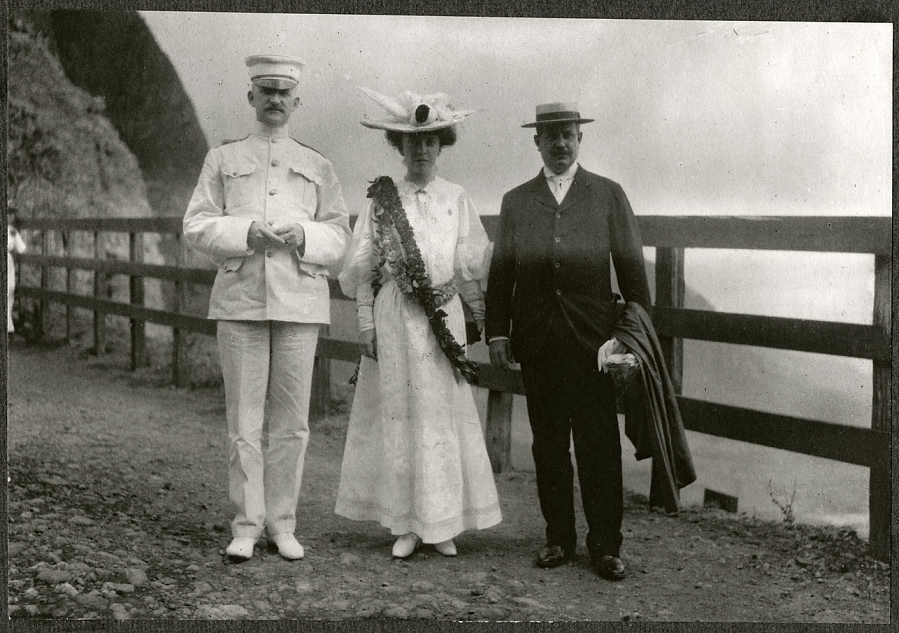
- In 1905 Alice Roosevelt, daughter of Theodore Roosevelt and 21 years of age, was one of a large American mission to Asia headed by the Minister for War (later President) William Howard Taft. This mission, which took in the Philippines, Japan, China and Korea, reflected America’s growing influence in Pacific affairs and generated massive media attention. On their way to Asia the party spent a day in Honolulu where they were welcomed by a committee headed by Acting Governor Jack Atkinson. Jack’s passion for outdoor sports, including surfing, is well attested[5] and he is famously known to have introduced Alice to surfing and canoeing as part of the day’s programme.
- On 17 May 1906 Roosevelt wrote to Acting Governor Atkinson: “I have your letter of the 11th instant. I will help you in every way in your purpose to secure a white population of actual land tillers who are small landowners…Now will you tell me how I can help in having the land laws of Hawaii changed so as to further this purpose?” The background to this was that the Acting Governor opposed the powerful sugar planters lobbying for cheap Asian labour[6] and instead partnered with labour unions who feared low wage competition. He did this because he sought to limit what he feared would be Asian domination of Hawaii. The bitter labour struggles ultimately fractured the political alliance between the planters and figures like Jack.
- On 17 May 1906, Governor Carter wrote to the President from his hotel in San Francisco, as follows: “This is simply to inform you that Mrs Carter and I leave San Francisco for Honolulu on the 25th. The effects of typhoid have disappeared, the long rest has done me good in every way and I shall take up my official duties feeling fine…Secretary Atkinson writes that he may be obliged to resign, that is that it may be the best thing for his future. His father‘s death[7] makes it no longer advisable for him to try to keep up their home as he can also help his married sister by paying her in the case of his mother and this he can best do by accepting an offer from New York of a salary larger than that paid the Governor and just twice his salary as Secretary.”
- In 1907 both Jack and George Carter prepared to leave office. The question arose as to whom Roosevelt should appoint as the next governor. On 25 March 1907 Carter wrote as follows: “ I think his (Atkinson’s) giving up his law practice and taking the Secretaryship is a very great sacrifice on his part and, as he refuses to consider the question of taking my place, I wonder sometimes if he could not be of service to you in some position other than in Hawaii. His home is now broken up and his mother is living with one of her daughters, so he is, in a measure, footloose and free. And after the training he has had here in executive work, and studying different political problems, his experience, particularly in committees of mixed-race, ought to be an asset of value to those in authority and it appears to me to suggest to you that if opportunity offers, he would be available for active service at any post particularly where he could increase his salary (which is now $250 a month) and thus be enabled to remit to his mother a larger sum. In this suggestion there is a motive which is in the interest of Hawaii’s future in that such a plan would enable us to give whoever you may choose to be my successor an opportunity from, say, July to November, of serving as Secretary and becoming familiar with the duties of my office. After the loyalty which Atkinson has shown to me and the service he has rendered to the Territory and in consideration of his own private affairs, it would not be right to expect him to resign prior to the end of his term. He is exceedingly interested in immigration work of all kinds…and I think has no idea as to what to do after November.In other words, don’t bother about me. I am not the kind of public man that wants you to give me another job. But I believe Mr. Atkinson would like to be promoted and go on in public service. He is exceedingly loyal to you, and I have not a doubt but that he could serve you well in many capacities, particularly in view of his legal training and the active experience he has gained here in the last three years.”
- On 9 April 1907 the President replied: “I have your letter of the 15th instant and I’m very sorry at what you write me. Of course, if you feel that you ought to go out, that is all there is to it. Under such circumstances, don’t you think Atkinson would be willing to take your place? I haven’t an idea whom else to put in. Outside places are not common and I simply do not know whether a chance for a vacancy which would appeal to him will occur. With all good wishes, believe me, sincerely yours, Theodore Roosevelt.”
- On 15 June 1907, the President wrote directly to Jack from his Oyster Bay home as follows: “My dear Mr Atkinson, The enclosed telegrams rather puzzle me. When I saw you last you told me you could not stay much longer in office and gave the impression that you could not afford it and that you were going into business. Governor Carter told us in effect the same thing. I had all along intended to appoint you governor, but in view of these facts I offered the appointment to Judge Freer. I take it for granted that Judge Freer sympathises with your policy. Otherwise, of course, he neither would nor could hold my commission. Will you trust this as confidential? With regard, sincerely yours, Theodore Roosevelt.” The telegrams referred to do not appear to have been uploaded onto the Internet so their content is unknown.
- On 25 February 1909, the Honolulu Evening Bulletin ran as its front-page headline “ATKINSON GETS IT. A. L. C. Atkinson has been appointed United States District Attorney to succeed Robert W. Breckons. This is the substance of a cable message received today in Honolulu…Mr Breckons is even more astonished than anybody else – nobody appears to have even dreamed of Atkinson receiving the appointment. [Breckons said] “The last word I had on the matter from Washington came a few days ago and stated that the matter had gone over until after the new Administration should have come in. So I don’t understand how all this came about”.”
- The newspaper commented: “Mr. Atkinson has to prove himself in this position. He has not hitherto made a leading feature of court work in his legal practice. He has not figured in the open as associated with any of the more important litigation of the Territory. Hence he has to make good along entirely new lines.”
- On 3 March 1909, the last day of his Presidency, Theodore Roosevelt received the following telegram from Hawaii: “Roosevelt, White House, Washington DC: We are with you still, aloha. Carter and Atkinson”. The President replied on the same day as follows: “I was very greatly touched by the telegram from you and Atkinson. Will you tell him so? With hearty good will and renewed thanks, believe me, faithfully yours, Theodore Roosevelt.”
- On 20 March 1909 the Pacific Commercial Advertiser ran the following article: “Breckons’ friends are fighting Atkinson and a mainland appointment is possible. The nomination of Mr A. L. C. Atkinson to be District Attorney failed of confirmation in the Senate. The cause was that President Roosevelt had singled him out in contravention of the rule he had laid down that he would make no nominations to office in the closing days of his administration but would leave such nominations to be made by his successor, President Taft. It is understood that there were no personal objections whatsoever on the part of Senators to Mr Atkinson…”.
Interestingly, Jack was appointed Deputy Attorney General in 1921.[8]
Comment:
What could speak more convincingly of the high regard in which Jack was held by the President? An AI overview contributes that, “Jack Atkinson had a close professional and personal relationship with Theodore Roosevelt… The President trusted Atkinson’s counsel, corresponding with him and territorial leadership regarding land use, the conservation of small islands to prevent deforestation, and regional geopolitical awareness.”
Apart from confirming the relationship, this comment points to an area in which the two men clearly shared a common bond. Theodore Roosevelt was passionately interested in the outdoor life and conservation and used his authority to create the United States Forestry Service, also establishing 150 national parks and 51 national bird preserves. Indeed, he is today remembered as the “conservationist president”. The Hawaiian Board of Agriculture and Forestry was established in May 1903 and Jack, also committed to the environment and outdoor life, was to hold the position of President of the Board from May 1920 to July 1925.[9]
THE PROGRESSIVE PARTY (ALSO KNOWN AS THE BULL MOOSE PARTY)[10]
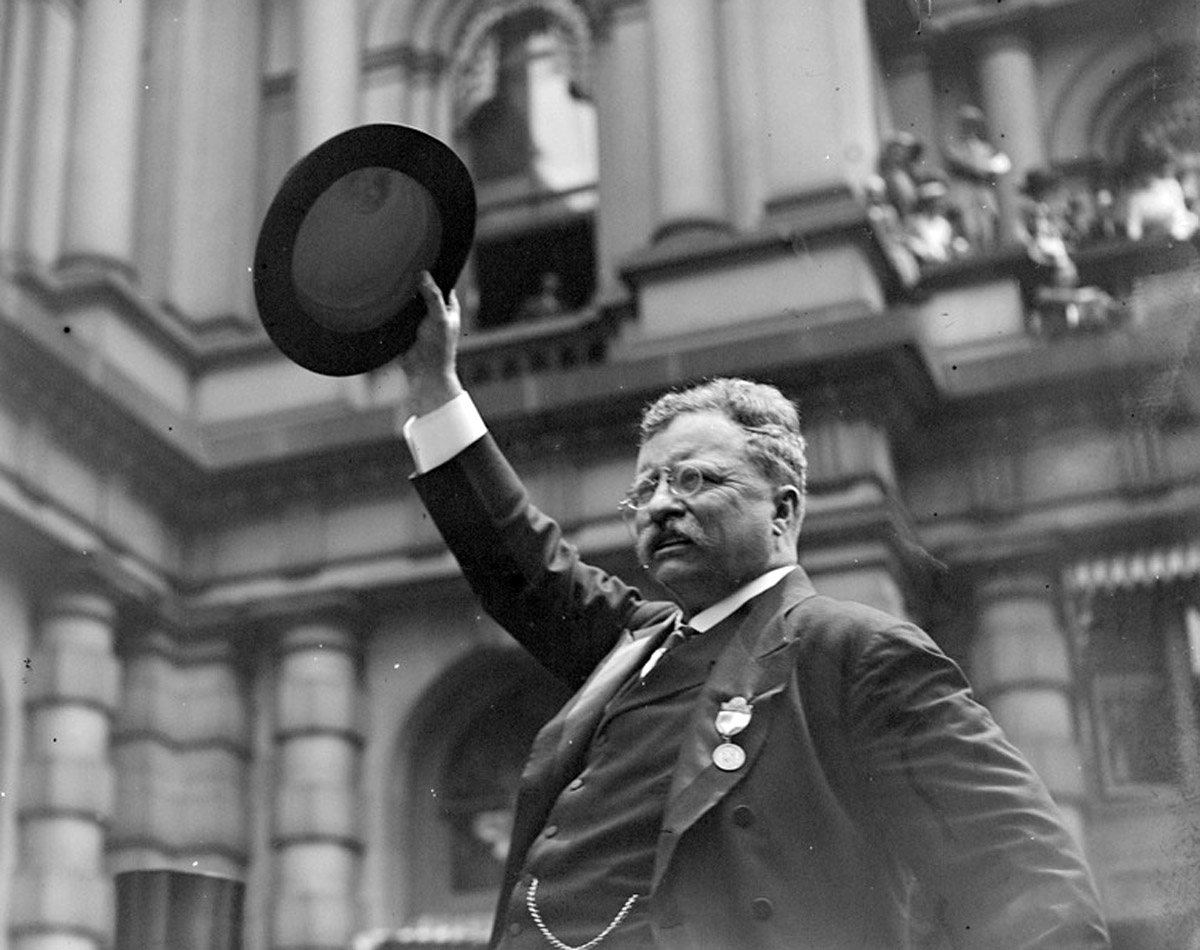
On 8 November 1904, immediately after winning his first full presidential term, Theodore Roosevelt announced that he would not run for another term. He later deeply regretted this pledge but honoured it in 1908 by stepping down and endorsing William Howard Taft, who went on to win the election. During his tenure, Taft drifted to the right which, along with Roosevelt’s increasingly progressive ideas, alienated Roosevelt with the result that he decided to make another attempt at the White House.
Roosevelt came extremely close to winning the June 1912 Republican nomination, actually securing the majority of the contested primary delegates. However, the incumbent president held control over the Republican National Committee[11] which ultimately disqualified enough of Roosevelt’s delegates to hand Taft the nomination. Roosevelt’s response was to leave the Republican Party and create a new Progressive Party.
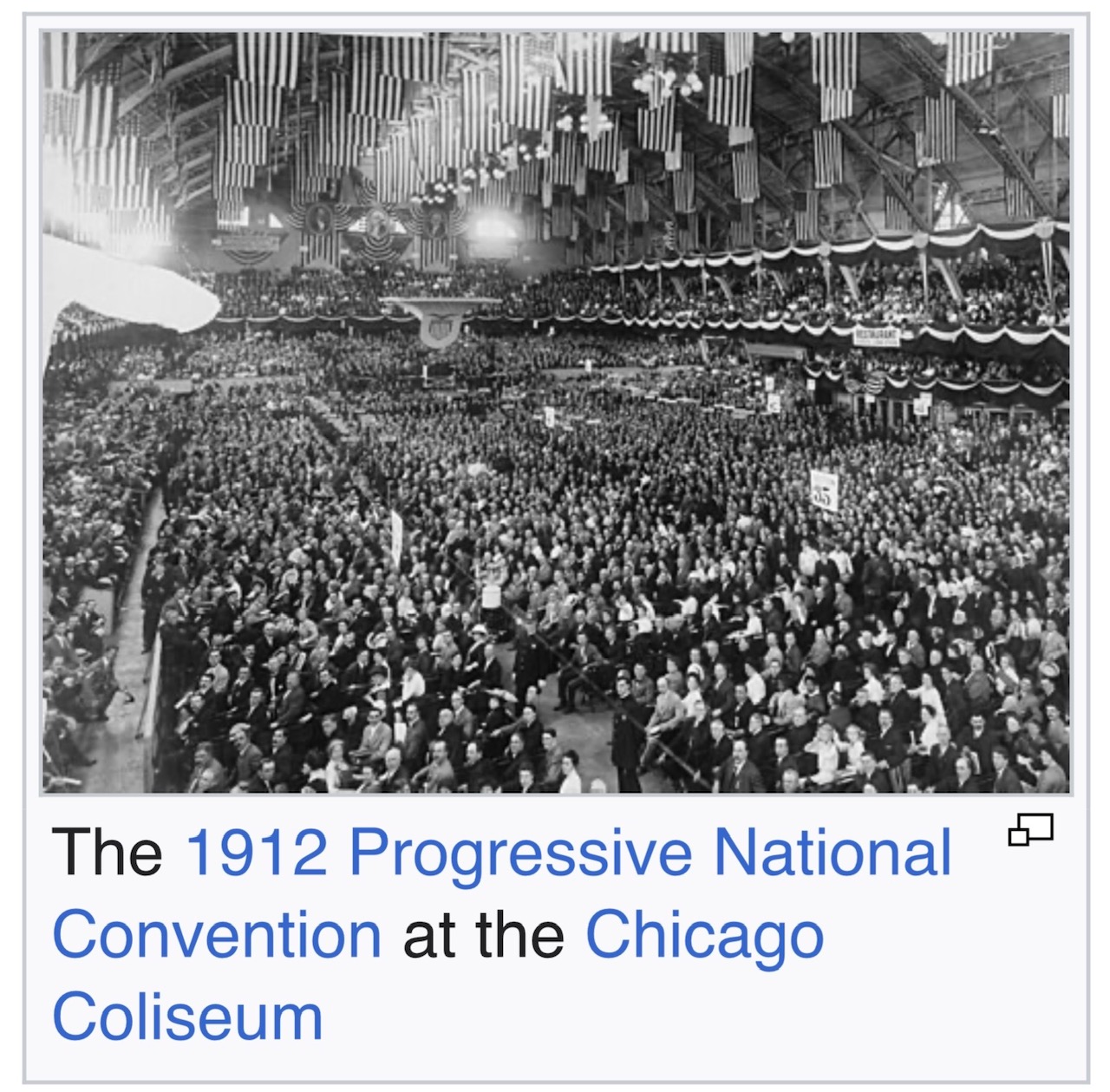
The platform of the Progressive Party aimed to reverse the domination of politics by business interests, which allegedly controlled the Republican and Democratic parties alike. The party’s platform asserted that: “to destroy the invisible government, to dissolve the unholy alliance between corrupt business and corrupt politics is the first task of the statesmanship of the day”.[12] To that end, the platform called for strict limits and disclosure requirements on political campaign contributions and registration of lobbyists.
The platform backed goals years ahead of that era’s mainstream politics. In the social sphere it called for a national health service, social insurance to provide for the elderly, the unemployed and the disabled, limiting the ability of judges to order injunctions to limit labour strikes, a minimum wage for women, an eight hour work day, workers’ compensation for work related injuries and an end to child labour. The platform also called for female suffrage.
On 12 July 1912 the Honolulu Star Bulletin reported the following: “Bringing back from Chicago, the Rooseveltian slogans that were sounded there against bossism, ex-Governor Carter and A. L. C. Atkinson yesterday received cable permission to organise Hawaii on “Progressive lines.” Carter and Atkinson take the attitude that there is no longer a national Republican party.”
This was followed by the following on 22 July: “PROGRESSIVES LAUNCH NEW PARTY IN HAWAII Fourteen attend meeting – Atkinson goes to Chicago – A Declaration of Faith is adopted The Progressive Party of Hawaii was formally launched today when Honolulu men held a meeting at noon at the offices of A. L. C. Atkinson and adopted a “declaration of faith”…The meeting decided that A. L. C. Atkinson should go to Chicago to secure representation, if possible, for Hawaii in the Progressive convention in August. Atkinson leaves on the Siberia this afternoon.”
The Bull Moose convention took place in Chicago between 5-7 August 1912.
On 20 August the Star Bulletin reported the following: “BULL MOOSE BUTT INTO HAWAII…How “Our Jack” fought for and won representation for Hawaii. ‘A. L. C. Atkinson, Hawaii Progressive’s delegate to the Bull Moose convention at Chicago, waged a vigorous “campaign of education” on the subject of territories in general and Hawaii in particular. He found most of the delegates bitterly opposed to giving Hawaii representation…Atkinson says, “The charge against us… was that we were not developing that country [sic] along traditional lines because of our cheap labour, using Japanese and Filipinos for development, and that only a few men owned everything. It did seem unjust that I, of all men, should have to bear the brunt of such charges, when I have been doing so much to remedy above conditions, constantly working along lines to correct our evils. However, I showed them how much advance we have made since annexation, what we developed from working through the Board of Immigration[13]… and [the] results obtained in assisting the white immigrant to develop and settle in Hawaii to take the place of Oriental cheap labour…But what a lot of educating I had to do…The members of the committee would insist on classifying us with the insular possessions.”
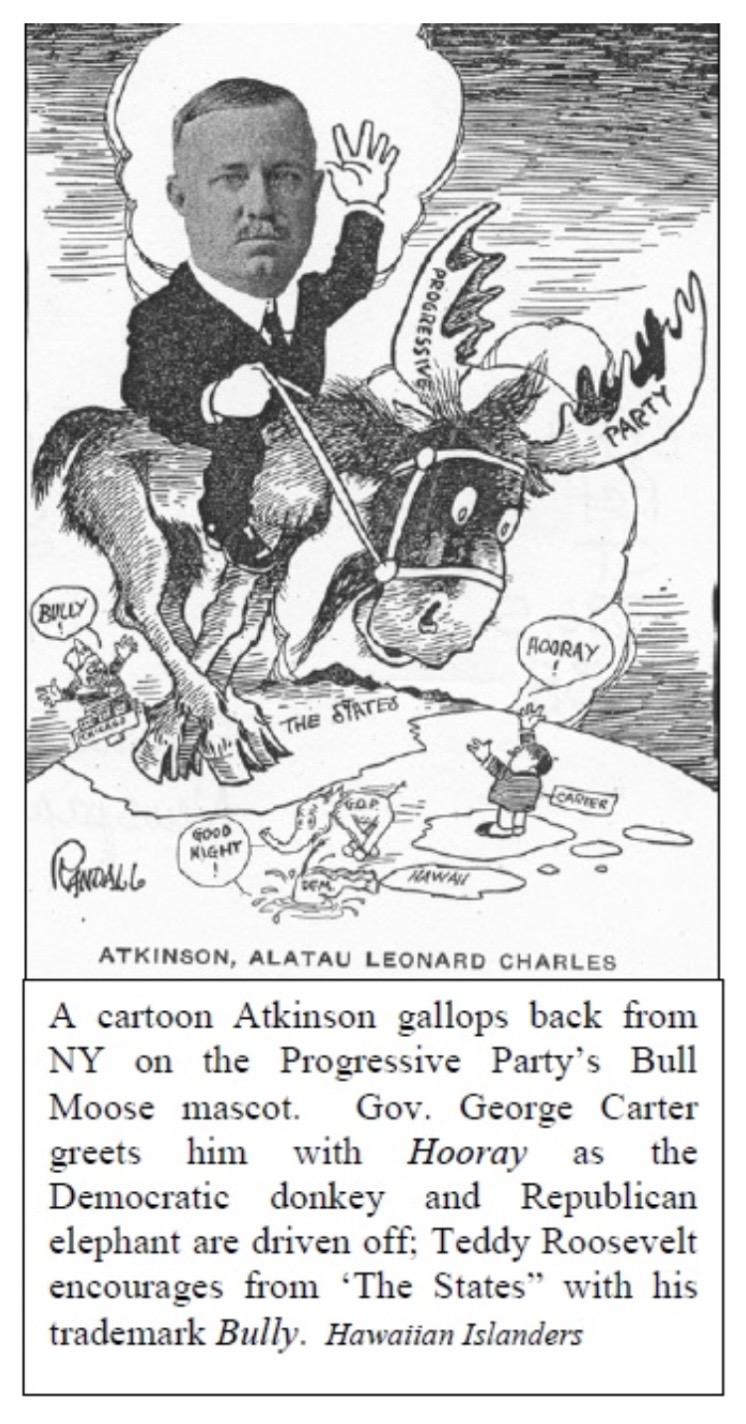
Jack’s argument, supported by representations direct from Hawaii, ultimately prevailed and the Territory received delegate status shortly after. After the convention, Jack became national committeeman for Hawaii and worked hard for the Party. On 20 September 1912 the Star Bulletin reported the following: ““Our Jack” Atkinson won’t return to Hawaii for at least two months, and perhaps longer…Jack Atkinson… has been placed at the head of the committee in charge of the collection of funds for the Bull Moose Party. Headquarters have been established on the eighth floor of the Manhattan Hotel, New York City, and Atkinson has generously consented to take charge of the supply of [funds] for the paltry sum of $1000 per month.”
On 5 November 1912 the Democratic candidate, Woodrow Wilson, was elected President of the United States. The strong Progressive showing, however, led to optimism that Progressives would supplant Republicans. The Hawaiian Gazette of 3 January 1913 reported the following: “TO PROGRESSIFY THIS TERRITORY. “Jack” Atkinson returns from running Bull Moose race with optimism. “The Republican Party will be absorbed by the Progressive Party” said A. L. C. Atkinson yesterday after leaving the Korea, on which he returned home after an absence of six or seven months, during which time he was one of the leaders of the office staff of the Bull Moose Party in New York, and a close friend of Colonel Roosevelt… Mr Atkinson has returned from the Chicago conference and is all enthusiasm as to the future of the organisation…”It was decided at the Chicago Convention to perfect the organisation,” said Mr. Atkinson. “I stayed back there to help them collect some money for the work. We had $50,000 pledged for this year‘s work and there are promises for more. We are not the third party anymore. It has taken the place of the Republican Party. In those states where we had no representatives on the ballots we are certain of representation now. The principal thing now is to perfect the organisation in every precinct in the country… Personally, I have never worked harder in my life than I did during the last campaign. It was a great experience, and it is a splendid thing to be able to rub elbows with men of national prominence.”[14] Atkinson states that while the work of the Bull Moose organisation was splendid during the past campaign, yet there was very little time in which to properly organise.”
An item in The Star Bulletin dated 16 January 1913, which reported on an informal talk subsequently given by Jack to University Club members stated that he had been assistant treasurer of the National Progressive Party. It also stated, “from his account [it had been] a tremendous job to tackle, with no regular Party lists of Party purses to tap. Progressive literature, stamps, hymn books and certificates netted as a whole a tremendous sum of money…”.
In her 1933 book Crowded Hours, Alice Roosevelt commented as follows: “Yet if a third-party ever had reasons to succeed – or, at least, after the great vote it had pulled, to establish itself – it was the Progressive Party. It had the clear-cut issue on which the split was based. It had a program, policies, ample financial backing, and a leader who inspired his followers. But it did not have the organisation – the plodding organisation in precinct, ward and county – that is on the job in season and out, and that seems to be essential to the existence of a political party. Without organisation, no party has a survival value.”[15]
In 1916, convinced that a divided Republican party would guarantee another Woodrow Wilson victory, Roosevelt effectively dissolved the Progressive Party to unite the conservative and progressive wings of the Republican Party. Around the same time the Star Bulletin ran a satirical article about Jack’s devotion to the Progressive Party. Perhaps Jack took comfort from Roosevelt’s famous 1910 “Citizenship in a republic” speech:
“The credit belongs to the man who is actually in the arena, whose face is marred by dust and sweat and blood; who strives valiantly; who errs and comes short again and again, because there is no effort without error and shortcoming; who does actually strive to do the deeds; who knows great enthusiasm, the great devotions; who spends himself in a worthy cause; who at the best knows in the end the triumph of high achievement, and who, at the worst, if he fails, at least fails while daring greatly, so that his place shall never be with those cold and timid souls who neither know victory nor defeat.”
It can be seen from the above that the contribution of the American Chinese diaspora was integral, and indeed it could be argued vital, to Sun Yat Sen’s ultimate success. Jack Atkinson was part of an Hawaiian ruling elite which had supported republicanism even before annexure. If he had not signed the false birth certificate, it is possible that someone else occupying his position may have done so. Be that as it may, it was the signature of Jack Atkinson that opened America to Sun Yat Sen, whose impact on Chinese history resonates down to this day.
Theodore Roosevelt’s life and presidency were driven by vigorous action, moral accountability and an intense dedication to public service. He believed that a life of ease was not worth remembering and actively pursued physical and mental challenges. As a domestic guiding principal, he believed in a “square deal” for all citizens. His goal was to combat special interests, treat labour and capital fairly and prevent the wealthy or powerful from exploiting everyday Americans. He also believed natural resources were not for unrestricted exploitation but belonged to all the people. That he held Jack Atkinson in high regard shows that he saw in Jack someone who shared his principles. Jack emerges from their relationship as a man of thought and conviction, keen to stand squarely alongside Roosevelt for the sake of those shared ideals that both agreed could only add benefit to the lives of millions. They were ahead of their time but that those reforms did eventually occur is a tribute to their vision and, ultimately, their memory.
Note: Information about the support of the Chinese diaspora for Sun Yat Sen has been largely gathered from Google AI searches.
[1] Sun Yat Sen was brought up and educated in Hawaii and in 1911 founded the Chinese Republic.
[2] In Japan, the Meiji Restoration of 1868 had ended 260 years of Tokugawa shogunate rule and established a centralised bureaucratic government and a western constitution. Following Japan’s victory in the first Sino Japanese war (1895) thousands of Chinese students flooded Japanese universities where they were exposed to western political philosophy, absorbed revolutionary ideas and provided intellectual recruitment for the revolution.
[3] Following the establishment of the Republic of China, Sun reorganised the Tongmenghui to form the nucleus of the Nationalist Party.
[4] Sun had earlier laid important groundwork with his English language pamphlet, published in New York in 1904, entitled The true solution of the Chinese problem. The pamphlet helped garner American sympathy for the republican movement by reframing the anti-Qing struggle as a modernisation effort that would ultimately benefit western commercial interests.
[5] In 1908 Jack was to head a list of charter members soliciting organisational support for a proposed Outrigger Canoe and Surfboard Club at Waikiki. Five years later he was part of a fundraising effort to support a young Duke Kahanamoku, who would go on to transform the obscure regional pastime of surfing into an internationally recognised sport.
[6] They were seeking exemptions from the 1882 Chinese Exclusion Act.
[7] Jack’s father, Alatau Tamchiboulac Atkinson, had died the previous month.
[8] The Maui News, 13 May 1921
[9] He left Hawaii for a new home in Chicago in May 1925.
[10] The “Bull Moose” nickname originated in 1912 when Theodore Roosevelt declared he felt “strong as a bull moose”. He used the phrase after losing the Republican presidential nomination to William Howard Taft, prompting him to adopt the animal as the symbol for the new party he established.
[11] The committee favoured Taft’s defence of traditional constitutional governance and institutional stability over Roosevelt’s increasingly radical progressive reforms.
[12]At the beginning of the 20thC, America was struggling with the effects of industrialisation, corporations wielded vast economic and political power and underpaid workers toiled in hazardous work conditions.
[13] Jack was president of the Board of Immigration from 1907 to 1913.
[14] A letter to Jack dated 9 July 1914 from New York (quoted in the Honolulu press) described the activity: “Colonel Roosevelt was here at the office all day yesterday… the office was crowded with people all day long – men of all political faiths from several parts of the state. There were a great many Democrats and some Republicans; of course, a great many Progressives… it was extremely interesting to hear the Republicans and Democrats from up the state tell him how thoroughly disgusted the voters are with both the Republican and Democratic machines in this state.”
[15] p224

