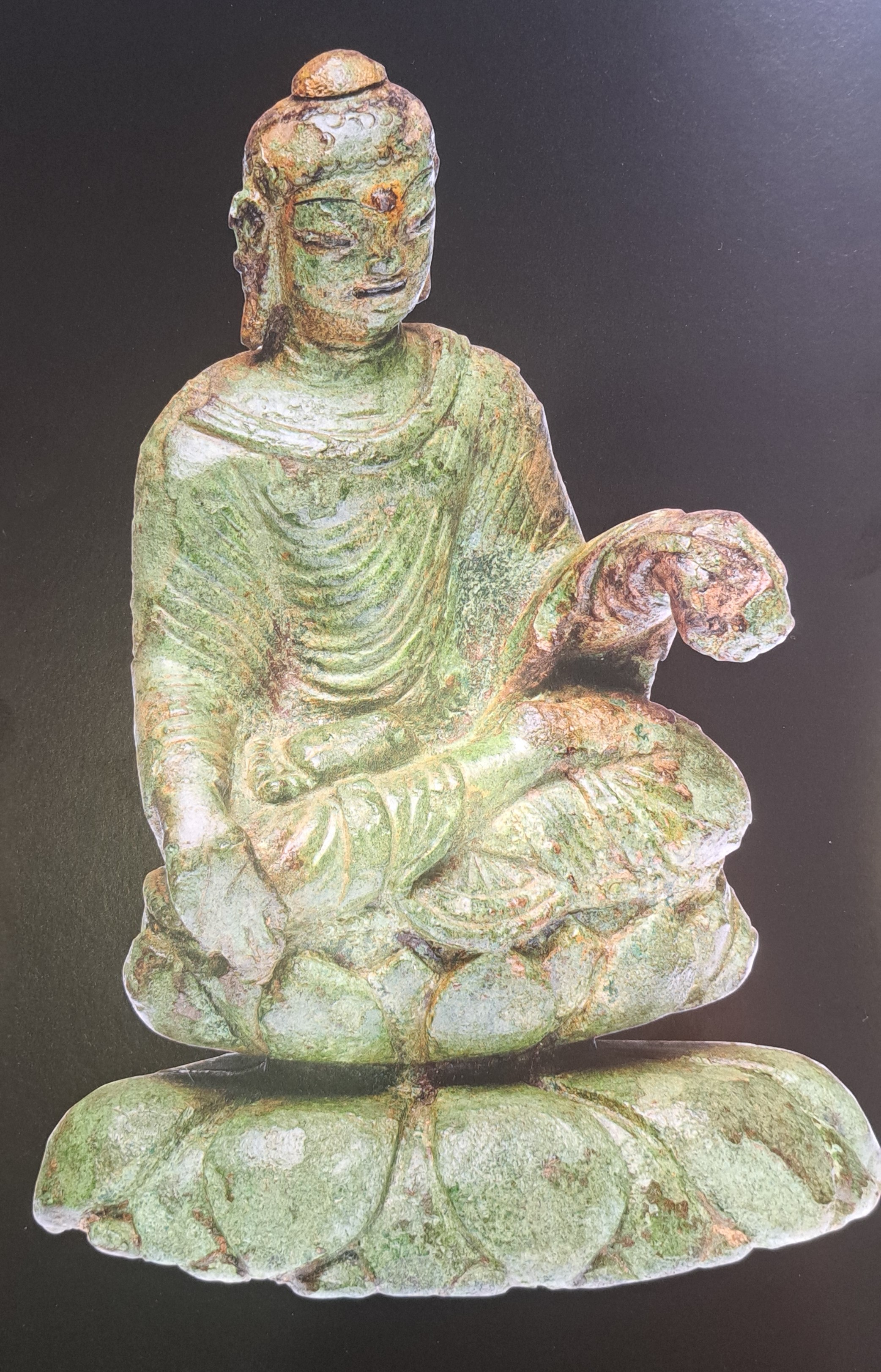
As you walk into the British Museum’s new Silk Roads exhibition the first thing that confronts you in in the otherwise empty entrance hall is a tiny copper alloy buddha only three inches high. The buddha dates from the 6th or 7th centuries CE and was probably made in the Swat Valley in what is now northern Pakistan. But what is remarkable about it is the fact that it was found on the small lake island of Helgö in Sweden from archaeological levels that date to around 800CE.
There in a nutshell is the intellectual proposition that lies beneath the exhibition – that the ‘Silk Roads’ were not simply about camel trains laden with precious consumer goods making their way westwards across the deserts and mountains between China and Europe. No, this is about the extraordinary level of connectedness that existed in ancient history and that trade goods travelled by both land and sea along transport links that spanned most of the known world.
Ever since the German geographer Ferdinand von Richtofen invented the term Seidenstrasse in 1877 the term has had a specific meaning – in part connected to the accounts left behind by travellers such as Marco Polo – of a number of trade routes that start in Western China and progress through the Taklamakan Desert in Xinjiang, across the Pamirs and Hindu Kush towards Iran and then on from there to the Mediterranean coast.
The late 19th– early 20th century discovery of huge numbers of remarkable artefacts at ancient buddhist sites in Xinjiang by such luminaries as Sir Aurel Stein and Albert von Le Coq only added to the attraction of this idea as a way of explaining the importance of international commerce in world history. But as Warwick Ball has pointed out, doubts over the use of this concept have been around since at least the 1940s, when Owen Lattimore refuted the idea that Xinjiang was deliberately opened up by the Chinese to export silk.[1] Hugh Pope called the idea “a Romantic Deception”, while Susan Whitfield, currently Professor of Silk Road Studies at the University of East Anglia, opened her 2020 book Silk Roads with the words “There was no ‘Silk Road’”.[2]
So anyone arriving at the exhibition and looking for vistas of Samarkand and Bokhara or pictures of caravanserai and shaggy Bactrian camels is in for some disappointment. And please note, almost everything on show dates from between the 5th and 10th centuries CE, a period in history about which very few people have a good grasp. Who was ruling China, Central Asia and the Middle East during these turbulent years? And even though the garnets in jewels recovered from Anglo-Saxon burials such as Sutton Hoo likely came from mines that were thousands of miles to the east, little is known about the nitty-gritty that underlay the trade in these kinds of luxury goods.
However, that being said, the curators of this exhibition have been able to give an indication of the extent of international trade during this period of history. They show that trade was not simply east-west, but that north-south interactions were equally important, as was Central Asia’s connection to India. Nor was it simply trade goods such as silk and jewels that were exchanged. War tactics, social customs, diplomacy, pilgrimage, literature and other cultural artefacts were also exchanged over vast distances. Maritime routes, such as those in the Baltic, the Red Sea and Indian Ocean were also central to this interchange of goods and ideas.
Great social transformations, including the expansion of Islam from the 7th Century, the growth of the Tang Dynasty in China, the end of the Roman Empire and the growth of Byzantium and the expansion in the Holy Roman Empire under Charlemagne were also important factors in determining trade routes and exchange objects. This was a time when Christianity, Islam and Buddhism were all expanding.

So it is hardly surprising that visitors to the exhibition will hear about places never before mentioned in relation to the Silk Road. Heijo-kyo in Japan, Silla in Korea and Chang’an in north-central China are placenames that are unlikely to be on the tip of one’s tongue. And yet the objects found in each of these places tell remarkable tales. Take the small blue glass cup found at Cheonmachong Tomb at Gyeongju in Korea. It dates from the early sixth century and has a honeycomb-patterned decoration produced using a mould-blowing technique. Such glasses can be found across Roman territory, but it was probably made at Alexandria in Egypt.
Items recovered from shipwrecks in the Indian Ocean also provide an insight into ancient trade. During the period in question ships sailed from northern China via the Indonesian islands to India, Persia, Arabia and the east coast of Africa. In 1998 the wreck of the Tang Dynasty ship now known as the Belitung was found near Sumatra, comprising more than 60,000 pieces of Tang ceramics and other objects that date to the 9th Century CE. It was probably on its way back to the Persian Gulf when it sank. Its cargo provides a great cross-section of commercial goods from the period.

The discovery in 1900 of the Dunhuang caves in the Tarim Basin of Xinjiang provides another great source of trade goods. In Cave 17 Aurel Stein found (and bought) 70,000 manuscripts, paintings and other objects, several wonderful examples of which are in the exhibition. These objects transformed the way in which the culture and history of this region was understood. The Miraculous Image of Liangzhou, more than 2.5 metres in height and embroidered with silk thread on silk and hemp, is one such item.
The exhibition never ceases to amaze the visitor as it demonstrates the extent to which our ancestors traded with one another. Khazars, Vikings, Alans, Eritreans, Sogdians and many other societies knew of each other and sent trade goods huge distances.
So at the end of the exhibition what can we say? The Silk Road is a misnomer? Yes! It was never a single road? Yes! Trade was in both directions, not to mention north and south and often by sea? Yes! In other words, we are talking about international trade and exchange of ideas. It was a phenomenon not restricted to one part of the globe – if we exclude South America – or one culture. But are we throwing the baby out with the bathwater? There is a danger that in generalising our understanding of the Silk Road to include just about all international trade we lose the very specificity that made it a powerful idea in the first place. More than likely that is what is happening. Scholarship on the Silk Road has now outgrown the original subject and awaits a new definition and focus. But for now, go along and see the incredible exhibits. It is crowded and you cannot easily move from one glass case to another, but it’s almost worth the entry just to see that tiny little buddha.
[1] Warwick Ball, The Eurasian Steppe: People, Movement, Ideas, Edinburgh University Press, Edinburgh, 2021.
[2] Susan Whitfield (ed.), Silk Roads: Peoples, Cultures, Landscapes, Thames & Hudson, London, 2021.
 Siberian Steppes
Fascinating! How I wish I could see the exhibit, but having to go almost half-way around the globe to get there means I have to depend on written accounts. Oh well.
LikeLike
What strikes me most is the determination to transport both mundane and very special items across the world when the methods of carrying them were so fraught with mishap. Also, there had to be an underlying bedrock of merchantilism to support such trade. But why? Who were the people rich enough to buy then send such items so far? And why? There had to be guaranteed purchasers, otherwise the goods would just not have been made then despatched by sea or by land.
The degree of trust and certainty shown by the senders is tremendous. But what was behind it all? Some of the items will have been taken along with those making these journeys, but not all of them. The numerous shipwrecks of cargo vessels laden with such artefacts show that there was established seaborne trade. This means large numbers of people in many lands wealthy enough to buy what was being transported. So high enough standards of living to have the spare money to pay for them. And what was bought would have had some special cultural importance to the purchasers, such as an original Constable being bought today by someone who appreciates good paintings.
Are we jealous that such cultures could have existed so long ago?
LikeLike
You make some good points about what was behind the trade routes across such huge distances. Part of the answer to that may be found in David Chaffetz’s new book, Raiders, Rulers and Traders: The Horse and the Rise of Empires (W W Norton & Co, £25). Chaffetz argues convincingly that the missing element in the puzzle is the massive trade in horses between the Central Asian steppes and the surrounding empires, including China, Persia and the Mughals of India. He maintains that this trade was huge and was the engine that drove the Silk Roads commerce. Steppe horse breeders supplying hundreds of thousands of horses every year received luxury goods in exchange which they then sought to pass on and thus further increase their fortunes. It even became a maritme trade, with the Portuguese, for example, shipping horses from Arabia to India by sea, 400 at a time. It is a pity that the organisers of the Silk Roads exhibition and Chaffetz did not spend a bit of time together. It may have led to a more coherent exhibition.
LikeLike