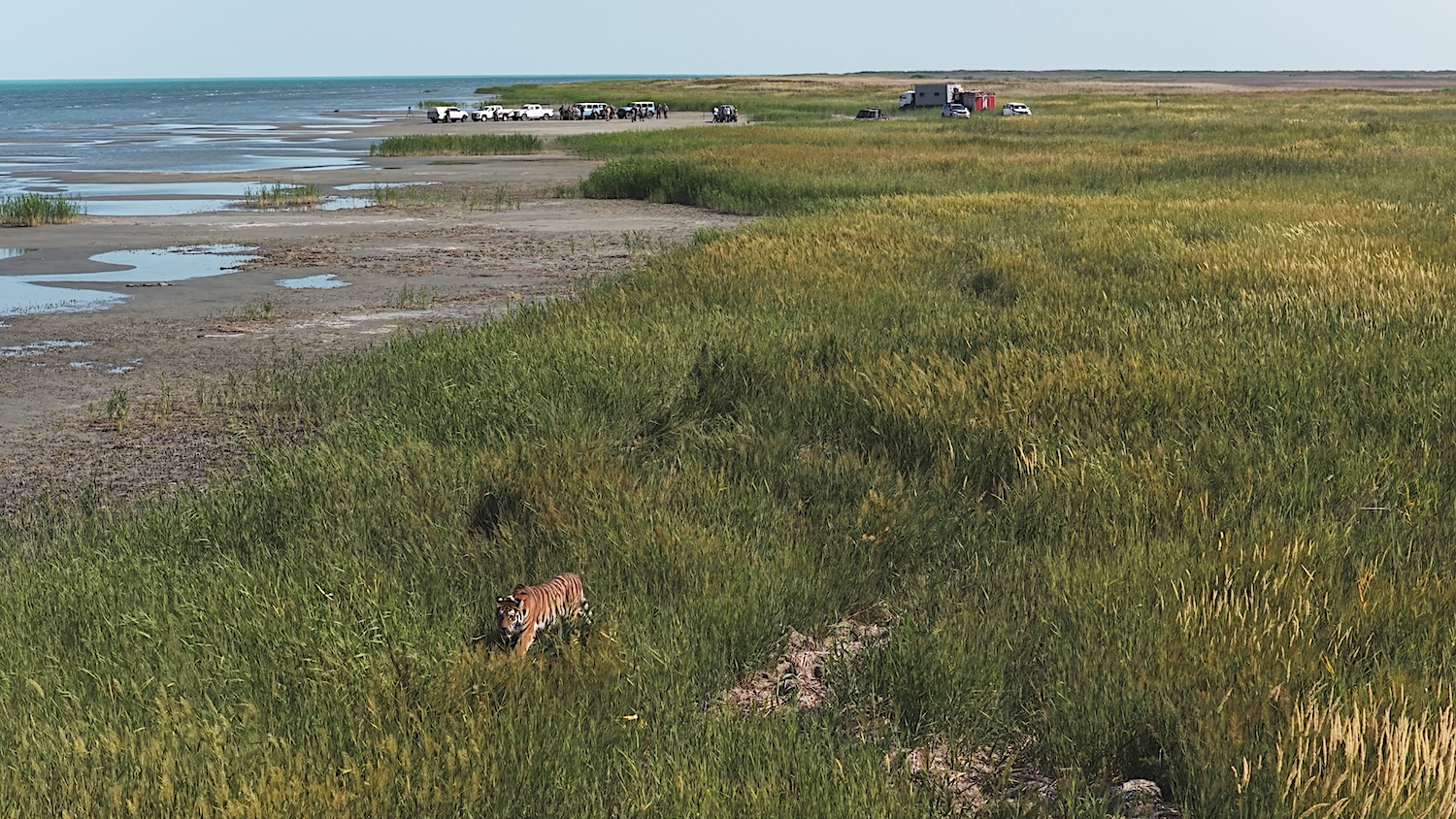
At last! The first wild tiger to be released in Kazakhstan bounded from a cage and disappeared into the long grass in a special reserve in the Ile-Balkhash State Nature Reserveon 31 July. Umit, an adult female Amur tiger whose name means Hope in Kazakh, was released at a remote site on the shores of the great lake and quickly disappeared. With a single leap she entered history as the first tiger ever released into a reintroduction programme.
“Today, we witnessed a truly historic event,” Minister of Ecology and Natural Resources Yerlan Nyssanbayev said at the release ceremony. “For the first time since the tiger disappeared from Kazakhstan more than 70 years ago, the first tiger has been released into its historical range. This is the result of many years of work by the state, our Russian colleagues, scientists and international partners,” he said.
Nyssanbayev added that the release was only the beginning of a much longer process. “A great deal of work lies ahead to monitor the tigers and establish a sustainable population, but today we have taken the first and very important step”.
Konstantin Chuychenko, Russia’s Justice Minister and chair of the supervisory board of the Amur Tiger Centre, noted that the tiger had become extinct in Kazakhstan in 1948,the same year that his own country signed the world’s first outright ban on tiger hunting in the Khabarovsk region. The ban saved Russia’s own Amur tiger from near-certain extinction but was too late to save its almost genetically identical cousin in Kazakhstan, sometimes referred to as the Turanian tiger. Most were shot by hunters before the ban was introduced.
Nearly 80 years later, animals from the Khabarovsk region are now helping restore the tiger population in Kazakhstan. “This historical parallel underscores the depth and significance of cooperation between Russia and Kazakhstan,” said Chuychenko. He noted that the tiger stands at the top of the food chain. Its presence depends on healthy forests, reliable water resources, sufficient populations of wild ungulates and effective protection against poaching.
Returning tigers required Kazakhstan to restore much of the natural ecosystem that once supported it. That preparation took more than 10 years and involved the reintroduction of Bokhara deer and kulan wild horses as prey animals for the tigers. Wild boar, which have always existed close to Balkhash, will form another source of food for the tigers.
There are presently six tigers in Kazakhstan. The first two, which arrived a year ago, came from European zoos and had spent their entire lives in captivity. They will never be released, but it is hoped that the female will become pregnant and that any cubs will be reared in large fenced enclosures before being released. They will have minimal contact with humans.
Four other tigers arrived earlier this year – two males and two females. Umit is one of these. The others will be released when they are ready for life in their new home range.

Government officials have sought to satisfy the concerns of locals in this sparsely-populated region of more than 500,000 hectares that they will be safe. The tigers are fitted with tracking collars and will be closely monitored. A compensation scheme for local farmers whose animals are attacked by a tiger has also been put in place. Eventually, it is hoped that a breeding population of 30-50 animals will be established, which could take 10-15 years.