In May I wrote about the fact that the explorer Samuel Turner had claimed to be the first person to climb in the Altai Mountains in southern Siberia. His book Siberia: a record of Travel, climbing and Exploration (1905) contains breathless accounts of his exploits in the region. However, Thomas Atkinson was there more than 50 years before him, having made two attempts to climb the tallest peak, Mount Belukha. Not surprisingly, without the benefit of modern climbing equipment, crampons, ropes, etc, Atkinson and his companions were turned back by the atrocious weather conditions.
I thought I was correcting an historical injustice and that no-one had spoken up for Atkinson when Turner’s book was published. I am therefore very grateful to Sally Hayles, who has just sent me a link to a letter published in the Scottish Geographical Magazine in 1906. The letter was written by William Graham of Edinburgh, who states that Atkinson “visited and climbed to the foot of one of the twin peaks of Bieloukha, the Belukha of Mr Turner, and gives a graphic account of its dangers and of the storm which drove him downwards with his two Kalmuck companions. The whole Altai region was explored by Atkinson at that time and his descriptions convey vividly to the imagination the grandeur in form and colour of its scenery.”
How delightful to find that not everyone had forgotten Atkinson’s achievements.
The Atkinsons went to remarkable lengths to make sure they could always travel with their child, Alatau, even in the most remote of places. During their journey to the Eastern Sayan Mountains and the Jombolok Volcano field in the summer of 1851 the two-year-old Alatau had been ill when they started off and after a few weeks travelling had not improved. Eventually they had to get him to a doctor at one of the goldmines scattered across the vast territory. After that he improved.
This week, while transcribing Thomas Atkinson’s diary for 1851 in the library of the Royal Geographical Society, I came across his accounts for this journey. The couple spent a total of about 170 roubles, including two roubles for the doctor at the goldmine. Listed separately is “Reindeer for Alatau, including saddle” which cost the couple 21 roubles – by far, the largest single item of expenditure.
Reindeer photographed in the Oka region
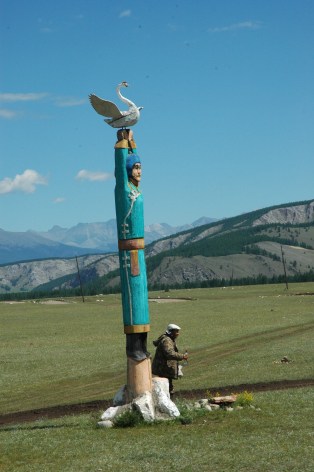
Where did they manage to find reindeer? The answer is intriguing. As they made there way from one Cossack frontier post to another, they began to come across people who were different to the Buriats they had come across regularly ever since leaving Irkutsk. These were Soyots, a reindeer-herding Turkic people closely related to the Tofalars of Irkutsk region, the Tozhu Tuvans in the nearby republic of Tuva and also the Dukha people of Hovsgol Province, just to the south of the Sayan Mountains – all of whom herd reindeer. You can read more about the Soyots here. Today they number about 3,500, many of whom live in the small town of Orlik. Atkinson notes in his diary that he paid one Soyot to guide him and his Cossacks across a particularly remote mountain.
A Soyot monument in the Eastern Sayan Mountains that I photographed this summer
It must have been from one of these groups of Soyots – soyot means swan in Turkic – that the Atkinsons decided to buy some reindeer. Lucy referred to them as Samoyeds, of which they are a sub-branch. As she noted in her book, Recollections of Tartar Steppes (1863):
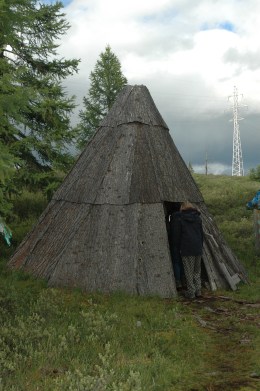
“We had some difficulty with Alatau over the morass, so resolved to invest a little money in the purchase of a pair of reindeer from a Samoiyede family, the only one said to be existing in these regions. They live in tents like the Tartars, conical and covered with skin; their dress also consists of skins. However, we found it a useless investment. The saddle was continually getting twisted, and I learned from our men that it required great tact for even a grown person to sit comfortably. So after the first day’s riding, we were obliged to abandon the use of them, and seat the boy on a horse, where he rode very comfortably. The delays in arranging his saddle on the reindeer impeded our progress greatly. He was obliged to be strapped on his horse; and it was rather fatiguing for him to be seated so many hours as he sometimes was. When sleep overtook him, we were obliged to carry him, which we did in turns.”
A Soyot ‘chum‘ made from tree bark that I photographed in the Sayan Mountains this summer.
So despite the large expenditure, the investment was not particularly successful. Worse was to come, as noted by Thomas on 21 July 1851 in his diary: “One of our reindeer fell ill on the road. This delayed us very much and caused us to remain the night at Tabitteiskaia, 36 versts from Koultouck.”
Thomas Atkinson’s disappearance from England in the 1840s was so sudden and unannounced and there was so little news about him that some of his peers clearly thought he had died abroad. I have located an entry for Atkinson in the The Dictionary of Architecture, issued by the Architectural Publication Society, the first volume of which appeared in 1853. At this time, he was travelling with Lucy and Alatau from Barnaul in Western Siberia back to St Petersburg.
The Dictionary entry, while short, is complimentary to Atkinson:
“In 1841 he was erecting some villas in the Italian style in the neighbourhood of Cheadle, and had previously enriched the suburbs of Manchester with some of its best buildings. The Church of S. Luke at Cheetham Hill, 1840, and that at Openshaw, 1840, both near that city, were from his designs. In 1842 he exhibited drawings of the palace at Moorshedabad, designed by Major-General MacLeod, a fine model of which is in Hampton Court palace.”
However, the final line shows just how comprehensively Atkinson had disappeared: “On leaving Manchester he went to Hamburgh, and thence to S. Petersburgh, in which country it is presumed that he died.” In fact, he did not die until 1861, three years after he returned to England from Russia.
This was not the only occasion on which Atkinson was presumed dead. At a meeting of the Royal Geographical Society held on 28 February 1859 there was a discussion about the fate of the German explorer, Adolf von Schlagintweit, who had disappeared while crossing from India into Tibet and was presumed dead. Atkinson took part in the discussion, counselling caution in presuming the German dead and telling the audience about a previous occasion on which he himself had been reported missing – he was referring to his and Lucy’s journey to Semirechye in what is now Eastern Kazakhstan in 1848-9:
“While I was absent I was lost for near eighteen months, and my friends in Siberia gave me up for dead. The gentleman with whom I had left what little property I had there, was about to make application to our minister in St. Petersburg, to know how it was to be disposed of. Fortunately, I returned and claimed it; and so, I think, Schlagintweit may turn up yet.”
Adolf von Schlagintweit
Sadly, Schlagintweit was already dead, having been beheaded by Wali Khan, the emir of Kashgar, in August 1857 on suspicion that he was a Chinese spy. His fate was not discovered until Chokan Valikhanov, the Kazakh/Russian traveller and ethnologist, visited Kashgar disguised as a merchant in 1859. He was able to return to Russia with Schlagintweit’s head, which was sent to his family for burial. The return of the head eventually provided a plot element in Rudyard Kipling’s wonderful novel, The Man who would be King.
St Luke’s Church in Cheetham Hill, Manchester – now, sadly, mostly demolished – has always been regarded as one of Thomas Atkinson’s best church designs. I have just located a glowing appraisal of the church, written by architect Frank Taylor Bellhouse and published in 1841 by The Civil Engineer and Architects Journal that completely justifies this description.
St Luke’s before it was mostly demolished (from a postcard)
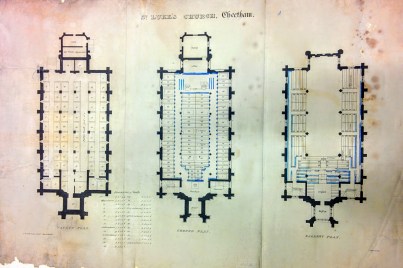
Like so many of Atkinson’s other ecclesiastical buildings, it was what is referred to as a Commissioner’s Church, completed in 1839 with money received from the French as reparations for the Napoleonic Wars and designed to accommodate the growing number of worshippers to be found in the rapidly expanding industrial towns of the north. It was built of ashlar (finely worked masonry) in the Gothic Perpendicular style that Atkinson helped to popularise and originally it could accommodate a congregation of more than 1500.
One of Atkinson’s original drawings for the church (courtesy of Manchester City archives)
Bellhouse, who is known to have designed parts of the Manchester New Workhouse and who was a member of the Ecclesiological Society, is fulsome in his praise of Atkinson’s building. “I consider the design and execution of the edifice alluded to be of such high excellence, that it is only doing a bare act of justice to the architect to whose genius we are indebted for this beautiful work of art, and also to the admirers of modern ecclesiastical architecture, to give a greater publicity to it than it has yet received”, he writes, adding, “Not having observed anything more than a casual notice of this edifice in your publication, I think a few descriptive remarks, even from an incompetent person, if given in sincerity, and with an eye to the advantage and improvement of the profession, would not be misapplied.”
Bellhouse goes on to give a detailed description of the new church, pointing out that it cost around £14,000 to build and also noting that it contained an organ designed by the well-known company of William Hill and Sons of London – on which the composer Mendelsohn is known to have performed during a visit to the city in April 1847. You can read a review of that concert here.
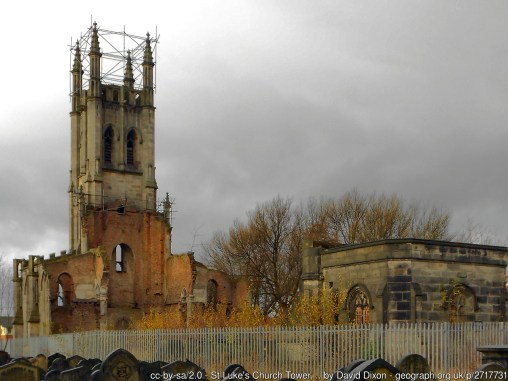
Most of the church was demolished in the late 1980s after it ‘fell into disuse’. Today only the church tower – minus its spire – remains, although it is Grade II listed. We can only imagine the interior, as described by Bellhouse:
“I am happy in being able to state that the finishing and painting of this beautiful church was intrusted to the care of Mr. Atkinson, who seems to have spared no pains or trouble in fulfilling the arduous task imposed on him. The whole of the walls are tinted of a warm stone colour, the mouldings left white, and the most prominent members of them gilt, which gives it a most rich and mellow appearance. The ceiling over the nave is divided by the roof principals, and moulded ribs into square compartments, and these again painted in imitation of oak tracery and panels. The pews are painted to imitate grained oak, and lined with crimson moreen.”
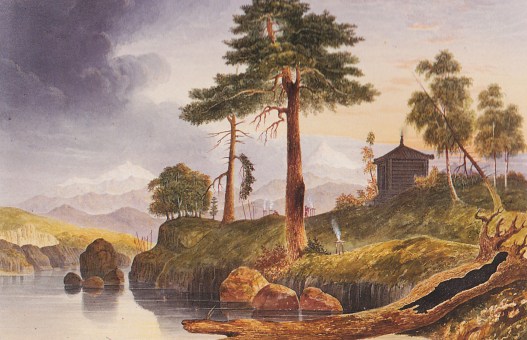
Atkinson’s painting of a “Buriat Temple, Lake Ikeougoune”
For some time I have been puzzling over the location of the little temple portrayed in the picture above by Thomas Atkinson. It clearly states that it is a painting of a Buriat temple, so the likelihood is that it was painted during the Atkinsons’ journey in the summer of 1851. Now I think I have been able to ascertain the exact location.
According to both Thomas and Lucy, the River Ikeougoune was not far from the Bishop’s house they stayed in, both on their way to the Jombolok Volcano Field and on their way back to Irkutsk. They both describe the hot springs close to the Bishop’s house.
The bishop in question was Bishop Nil Isakovich, bishop of the Irkutsk and Nerchinsk eparchy from 1838 to 1853, who spent many years attempting to convert Buriats to Orthodoxy. As a Christian missionary, he tried to find out the reasons why lamaism spread so easily amongst the Buriats. He even completed a major work on Tibetan Buddhism – Buddizm, razsmatrivaemyi v otnoshenii k posledovateliam ego, obitaiushchim v Sibiri (Buddhism, examined in relation to its Siberian followers) – which was published in St. Petersburg in 1858. It was a thorough description of Buddhist doctrine, rites, and organizational structures in the Transbaikal. The bishop observed the rapid spread of Buddhism in this area and tried to work out the best ways in which they could be persuaded to convert to Christianity. He was the inspiration for Nikolai Leskov’s character of the Bishop in his novel On the Edge of the World , who learns through example and suffering that in indigenous peoples of all cultures there is dignity that must be recognized and built upon as a foundation for Christian conversion.
I am grateful to my good friend Vladimir Chernikov for pointing out that the Bishop’s house was located in a place now called Nilova Pustyn (named after him), north of Turan, on the road that runs from Lake Baikal to Mondy, on the Mongolian border. Close to the Bishop’s house are mineral springs that have been in use for many years. Some of the Decembrists exiled to Irkutsk used to come here to ‘take the waters’, including the Bestuzhev brothers, Trubetskoi, Rayevsky, and Prince Volkonsky – all of whom were known to the Atkinsons and perhaps recommended this place to them.
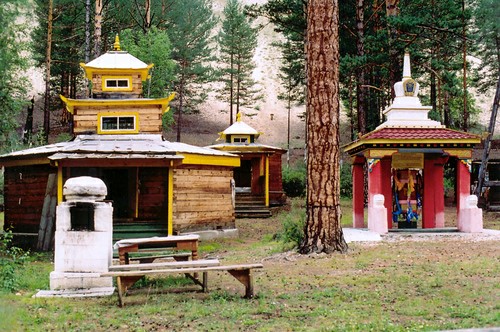
The River Ike-Uhgun (Ikeougoune, as Atkinson wrote it) passes through Nilova and we know from Thomas Atkinson’s diary that he reached the bishop’s house on 24th July 1851. Leaving Lucy and Alatau to bathe in the springs, he set off on horseback up the river valley. Vladimir Chernikov points out that some miles upstream from Nilova is an important Buriat holy site called Burhan Baabai, where there are a number of Buddhist temples located in woods above a bend in the river. Here are some photos from Google Earth:
Incidentally, this painting was bought from Atkinson in a sale at Christies in 1858 by the Duke of Cleveland. In October 1994 it was sold as part of the contents of Raby Castle in Co. Durham, along with 11 other pictures by Thomas Atkinson. Sadly, the dealers who bought the pictures say they can no longer remember to whom they sold them. Seven of the paintings were of scenes Thomas recorded during this trip to Buryatia in the summer of 1851. Very sad that we have lost sight – for the moment at least – of this important collection of paintings.
I have come across a wonderful film about Bolat Khan, a resident of Kapal in Eastern Kazakhstan – the town lying in the shadow of the Djungar Alatau mountains in which Thomas and Lucy Atkinson spent almost a year in 1848-9 and where their son, Alatau Tamchiboulac Atkinson was born.
Bolat Khan
The film tells the fascinating story of a local farmer and hunter, Bolat Khan, how his parents were killed by Stalin’s secret police during the purges and about his own career as the director of collective farms in the Kapal-Arasan region during the Soviet period. It shows that there is a darker history to this region that only now is beginning to surface. You can find the film here.
The film was written, filmed, edited, programmed and compiled in SMX, PHP, Java and Flash by Mitch Collins and translated and adapted to Russian and Kazakh by Lena Leneshmidt of Almaty, Kazakhstan.
I have now transcribed most of Thomas Atkinson’s diary that covers the long journey he made with Lucy and their son Alatau in the summer of 1851 into the mountains of Buryatia and Northern Mongolia, including the area around the Jombolok Volcano Field in the Eastern Sayan Mountains – the area I visited in July along with four of Thomas’ and Lucy’s descendants.
The diary contains much that is new and not included in either of his published books. He reveals, for example, that he drew a plan of the volcanoes in the Jombolok Volcano Field. Sadly, like most of the hundreds of sketches he drew, there is now no trace of it. More surprisingly, reading the diaries shows just how much Lucy relied on them in writing her own account of their travels together.
Their journey started on 23 May – as soon as the roads were open following the spring thaw. Almost exactly three months later they arrived back at the Archbishop’s house with its hot springs, near Kultuk on Lake Baikal. They were exhausted, but had seen some amazing sights, including the Jombolok volcanoes, Kara Noor Lake, the twin lakes that are the source of the Oka and Irkout Rivers, Mongu Seran Xardick – the tallest mountain in the region – and even Lake Khovsgul in northern Mongolia, about which Thomas wrote in his diary: “This lake is truly beautiful. I have seen nothing finer in the whole of my travels,” (emphasis in original).
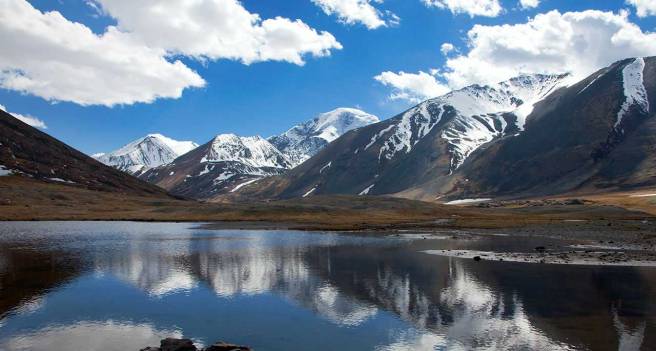
Lake Khovsgol in northern Mongolia: “This lake is truly beautiful”
They had endured a soaking wet summer that had seen the River Oka rise 31 feet in a night and had often left them drenched to the skin. On other days it had snowed heavily. They had put up with endless bogs, clouds of very unpleasant mosquitoes and a very basic diet that often consisted of what they could shoot and little else. It was, yet again, another epic journey, carried out with a less-than-three-year-old baby in tow.
The extent to which Lucy’s book, Recollections of Tartar Steppes (1863), relies on Thomas’ diaries is indisputable. It is unlikely that Lucy ever intended to write a book, but was persuaded to do so by the publisher John Murray, who mentored her and suggested she should write it in the form of a series of long letters to a friend. The book provided her with an income following Thomas’s death in 1861, when she had no other source of money.
Examples of the closeness with which Lucy’s book follows Thomas’ diaries abound. Here is one clear example taken from the entry for 13th July in Thomas’ 1851 diary, where he writes about a visit to the yurt of a Buriat family on the Oka River:
“Lucy, Alatau and I, with one Cossack as talmash (translator-ed), went to visit the Bouriats. We found a very pretty woman at one of the yourts and were much interested with the picture of their god, very well printed on silk. They have in each yourt an altar on which is placed many brass cups and a brass ornament. The cups are often filled with the articles offered up to the Deity, for instance wine (which they make from milk, a very strong spirit), butter, milk, tea, coffee and sugar. At the bottom of the altar they frequently burn their offerings on little wooden blocks. The master of the yourt gave us a cup of the wine, very little of which we drank, but they old man soon became quite tipsy. They drink a great deal. We paid another visit and was treated in a similar manner. We then bade adieu to them and started on our way.”
Here is Lucy’s account of the same event, as published in her book:
“We entered their yourts, in one of which we found a very pretty black-eyed young woman, with cheeks like roses, not ruddy like a milkmaid’s, but of a delicate tint; she wore a closely fitting black velvet jacket, which became her amazingly; and her head was adorned with the usual ornaments. Saluting me after the fashion of the country, she asked us to enter.
“We were much interested with the picture of their Deity, very nicely painted on silk. In each yourt we found an altar, on which is placed a number of brass cups or small basins, filled with the articles offered up to the Deity. For instance, wine (or rather a strong spirit made from milk), butter, tea, coffee, milk, and sugar. At the bottom of the altar they frequently burn their offerings on little wooden blocks. The master of the yourt handed us a cup of the wine, which I declined, and passed it to Mr. Atkinson, who merely tasted it, but the old man soon became quite tipsy. I think he had a little before we entered. They drink it in large quantities. In each dwelling we were treated in a similar manner. Having bid adieu to the good people, we were once more on our way.”
The similarity is clear. Lucy’s reliance on Thomas’ unpublished diaries in no way detracts from her book, which is a remarkable achievement. It is quite possibly the earliest serious travel book written by a woman in the English – or for that matter, any other – language. It is also extremely good, a forgotten classic. The Cambridge academic Anthony Cross, who wrote an introduction to a new edition (1972) of Lucy’s book, says both of Thomas’ books “pale before the fresh and unpretentious work of his wife”, little realising just how much of it was based on Thomas’ words.
Thomas’ diaries are an indispensible guide to understanding his itineraries, timescales and, most importantly, his relationship with his wife and son, which his bigamous marriage prevented him from mentioning in his books. More’s the pity, as the unexpurgated versions of events found in the diaries are often far more dramatic than those contained in his published books.
Thomas Atkinson’s account of his visit to the volcanoes in the Jombolok Valley in Eastern Siberia makes up the final chapter of his first book, Oriental and Western Siberia. It is the only chapter in this book that refers to his travels in Eastern Siberia and seems strangely disconnected from the rest of the narrative. As with the rest of his published writing, it makes no reference to the fact that he was accompanied by Lucy and his son Alatau.
Not only is this chapter disconnected from the rest of the book, it is also very difficult to follow his route, something I found out when trying to trace his journey in preparation for this summer’s expedition to the same region. Even with the help of Lucy’s book, Recollections of Tartar Steppes, which at least gives some dates, it was not easy. Now, having transcribed the relevant sections of Thomas Atkinson’s diary for 1851, I can understand why; for some strange reason, the order in which he visited places as set out in his book differs from that set out in his diary.
Thomas’ 1851 diary, which like four other diaries is held in the library of the Royal Geographical Society in London, is written in pencil in tiny lettering. As the RGS will not allow the pages to be photographed or copied, the only way to investigate their contents is to copy them by hand. This is a long and laborious process, that requires me to travel up to London and spend the day with a magnifying glass untangling the feint script I find on the pages. I have already spent weeks transcribing other parts of the diaries, but anticipate that it will take more than a year at the present rate to finish this project.
However, it is worth the effort. Unlike Thomas’ books, which contain few dates, are not written in date order and make no mention of Lucy or his son Alatau, the diaries are set out in clear date order. And Thomas regularly refers to Lucy and Alatau and how they are coping with the difficulties of the journey. Describing how he crossed the deep, broad and fast-flowing Oka River on horseback, with the baby Alatau held in front of him, Thomas writes in the diary: “Alatau was delighted at the rushing and foaming of the water around us, as well as with the plunging of our horses.” Later he describes the worsening conditions as they rode during a torrential downpour: “It was almost impossible to get the horses through the deep morass which was made worse by large stones and roots of trees, which our horses stumbled over continuously. This delayed us greatly. I was surprised that Lucy kept her saddle over much of this track.”
So, from the diary we now know that the Atkinsons left Irkutsk on 23rd May 1851. By 28th May they had reached Koultouck on the western shore of Lake Baikal, from where they followed the River Irkout westwards in to Buryatia and towards the Saian Mountains, stopping in at the Cossack guardposts (karaoul) on their way. By 1st June they had reached the point where the White Irkout and Black Irkout merge. Today this point is on the track that leads from Mondy to Orlik and is about 450 kms from Irkutsk.
During our visit to these regions this summer we were remarkably lucky with the weather, experiencing only a couple of days of rain and the occasional morning frost. However, the Atkinsons appear to have travelled during one of the wettest summers on record. Day after day Thomas records in his diary that they faced torrential downpours and even snow: “A soaking day obliged us to sit all day in the tent and watch our cooking operations”; and “Our path was now over a dreary waste without either tree or shrub, but plenty of snow, both old and fresh, which had fallen on the previous day and night”; and “On turning out this morning I found the ground was covered with snow and the rain pouring down in torrents. What a night for our men! On waking up they found themselves covered with snow and thoroughly soaked. It was even difficult to make a fire”, and so on, day after day.
It was still raining hard when the Atkinson’s reached Monsieur Alibert’s graphite mine at Batagol (see blog entry for 12th August) on 17th June. Thomas and Lucy spent at least four days here, examining the mine and the surrounding area. Thomas comments on how well M. Alibert treated his workers and also on the quality of the graphite: “The road which Mr A has made to descend to the river and his farmhouse has been a work of great labour and expense, which proves he is no mean engineer. All the works which he has executed are far superior to anything I have seen in Siberia….Should this lead prove of a good quality, what an immense property Mr A will have. He may supply the pencils for the whole world for ages to come.” Which is, of course, exactly what happened!
Monsieur Alibert’s graphite mine at Batagol in 1856
Thomas and Lucy arrived at the Oka Guardpost on Friday 29th June at 2pm, to find the Cossacks celebrating an Orthodox festival. They left early in the morning of Monday 2nd July and by Thursday 5th July Thomas had come across – and been intrigued by – the massive lava trail in the valley of the Jombolok River – which he called the Djem-a-Louk. Having set up camp and left Lucy and Alatau in the care of two Cossacks, he tried to follow the trail of lava from this valley into the main Khi-Gol volcanic crater on horseback, but the lava was too sharp. He decided to continue on foot, although his men were not happy at first. But he was determined: “I soon convinced them to the contrary by taking off my coat, strapping it up and fixing it on my shoulders. Having slung on my rifle, I ordered a Bouriat to take the horses to the tent and then started to cross the lava, which is not more than a verst and a half wide.”
Their leather boots were cut at every step by the sharp lava and very soon their feet were aching, but before long they reached the volcano valley: “On turning a point of some high rocks, I saw to my infinite delight a cone formed in the crater and at 10 minutes past six o’clock we stood on its apex and looked down into its deep abyss.” This must have been the Peretolchin Volcano.
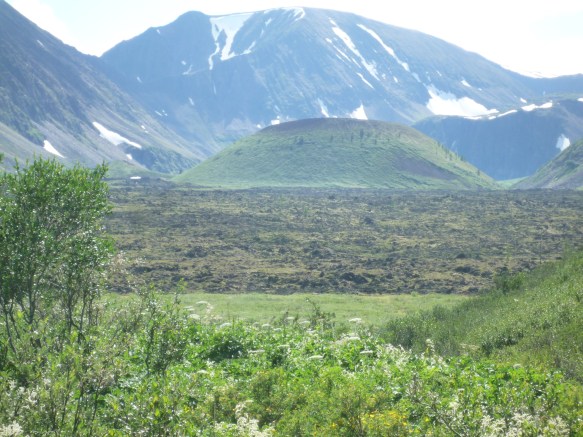
This is the first view that Thomas Atkinson would have had of the Peretolchin cone as he entered the volcano valley
They next day he crossed the main crater to visit the cone of what is now called the Kropotkin Volcano. There can be no doubt that Thomas Atkinson was the first outsider ever to visit this valley and climb the volcanic cones. He says he made many sketches and even a series of plans of the crater itself. Sadly, their present location is unknown.
The view from the Peretolchin cone towards the Kropotkin cone, with a lava field in between.
On Saturday 7th July Thomas and his Cossack and Bouriat companions returned to the camp where he had left Lucy and Alatau in the company of two Cossacks, only to find that they had already left camp and retreated down the valley. They found them a few miles down the valley and the next day made it back to the Oka Guardpost, where once again the rain began to fall. Thomas says that he and his men had to move his tent twice, as the River Oka rose 31 feet during the night: “When we got up in the morning the water had again risen and to add to our happiness, we were told that the other boat had been carried away, along with the tree to which it had been tied. The watchman had seen it and called the Cossacks, who followed it along the bank for some distance, but without being able to get near it.”
From here the Atkinsons travelled south to Lake Kovsgol in present-day Mongolia, which will be the subject of a future posting.
All of this story is told in reverse order in Atkinson’s book, with his visit to M Alibert’s mine occurring after he had visited the Jombolok Volcano Valley, as well as many other incidents. Just why this was the case I cannot fathom, but thankfully the diaries have helped sort out what was a very confusing narrative.
Today I am publishing a wonderful essay by Marianne Simpson about her ancestor Joseph Sherrard. Marianne is a direct descendant of Lucy Atkinson’s brother and has written previously for Siberian Steppes about the early history of Lucy and her family. Joseph Sherrard, in whose memory Lucy received her middle name, was her great uncle and played an important role in the early history of Australia. Below you will find a short summary of Marianne’s article which connects directly to the full essay.
Marianne Simpson writes:
“Joseph Sherrard first came to my notice as I was exploring the remarkable life of his great niece, Lucy Sherrard Finley (Mrs. Atkinson). I discovered that not only was Lucy an intrepid traveller and explorer but that her great uncle had also travelled far beyond English shores, indeed into the Pacific Ocean. In Joseph’s case, his adventures were undertaken as a member of His Majesty’s Navy but what makes his story so compelling for us today is that his voyages were undertaken when the Pacific was just opening up to European exploration and the settlement of New South Wales had only just begun. He sailed and rubbed shoulders with men whose names are both legends in the history of exploration and, also, famous in the history of colonial Australia. It is for this reason that, while not known to history himself, it has been possible to reconstruct so much of his fascinating story.
Joseph Sherrard began his seafaring career as Captain’s Clerk in 1791 on H.M.S. Assistant which accompanied H.M.S. Providence under the captaincy of William Bligh on Bligh’s second breadfruit expedition to Tahiti. En route to Tahiti, the two ships anchored at Adventure Bay, Tasmania in 1792 for the purpose of procuring wood and water as well as exploring the adjacent area.
The Providence and Assistant at anchor in Adventure Bay, 1792 (George Tobin) (Mitchell Library, Sydney)
On arriving in Tahiti where they stayed three months, the two ships’ companies witnessed what was virtually a final look at the Tahitian world before it was changed forever by almost immediate subsequent contact with whalers and missionaries. On the return journey, they successfully navigated the treacherous waters of the Torres Strait, a feat for which Bligh is still acclaimed today.
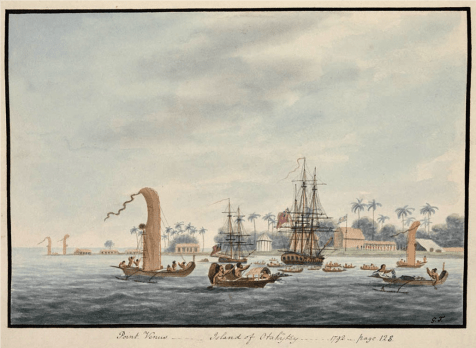
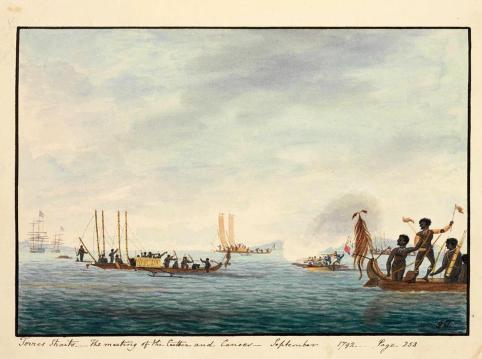
(above) Point Venus, Island of Tahiti 1792 (below) The two ships open fire on native vessels in the Torres Strait (George Tobin, Mitchell Library, Sydney)
After returning to England, Joseph joined H.M.S. Reliance, again as Captain’s Clerk. The Reliance left Plymouth in February 1795, bearing several names famous in Australia’s history: Lieutenant Matthew Flinders, Surgeon George Bass, incoming Governor John Hunter and the Aboriginal Bennelong. Matthew Flinders subsequently achieved lasting fame by leading the first circumnavigation of Australia, identifying it as a continent and giving Australia its name. The Reliance was only 27 metres long and, during a journey lasting seven months, these men, including Joseph Sherrard stationed on the quarterdeck just forward of the Captain’s cabin, would have got to know each other very well.
In 1797 Joseph was part of the ship’s complement when, battling tumultuous seas and leaking badly, the Reliance brought back from Cape Town the first merino sheep to be imported into Australia. Joseph Sherrard and Matthew Flinders remained part of the ship’s complement until the arrival of the Reliance back in Plymouth in 1800.
In 1802 Joseph Sherrard was appointed Purser of H.M.S. Buffalo. In 1803 the Buffalo under Commander William Kent explored New Caledonia, the Solomon Islands and parts of Indonesia with a view to establishing whether they could provide a source of cattle. Not only was Joseph part of this expedition but he was also accompanied by his new wife, Lucy, after whom Lucy Sherrard Finley was subsequently to derive her name. In 1804 the Buffalo was the principal of four ships which, under Lieutenant Colonel William Paterson, took possession of the northern territory of Van Diemen’s Land in the name of King George III. In a letter held by the Mitchell Library, Sydney, Joseph describes the new settlement.
View of Sydney 1804 (Edward Dayles, Mitchell Library, Sydney) There is evidence to suggest that Joseph Sherrard made his home in one of the two cottages to the left of the tower (right).
In 1807, shortly before the Buffalo left for England, William Bligh, now Governor of New South Wales, granted Joseph 100 acres in the coveted Cowpastures district. Although there is no evidence that Joseph returned to Australia after 1807, he was to retain this land – where the Australian agricultural and pastoral industries began – until 1832. After returning to England, Joseph was subsequently Purser on H.M.S. Creole which spent five years in Latin American waters as the countries of that continent started to open up to British trade. Joseph Sherrard died in Walmer, Kent, England in 1835.
Joseph Sherrard was a forerunner for his great niece Lucy and great great nephew Alatau. Each accepted life as they found it and, within those constraints, each chose their own path and pursued it with purpose, intelligence and vigour. They were not daunted by the unknown but, rather, intrigued by it so that foreign travel and far flung lands were embraced as opportunities, even when they involved danger and separation from loved ones. In the case of Lucy, her life was further impacted by the substantial legacy left to her by her great uncle which gave her a measure of independence and the backing to undertake the journey to Russia which changed her life forever.”
Marianne Simpson’s full essay on Joseph Sherrard – well worth reading – can be found here: Joseph Sherrard-3
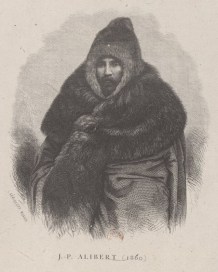
On their journey to the Jombolok Volcano Field in the Eastern Sayan Mountains of Buryatia in the summer of 1851 the Atkinsons decided to visit a remarkable mine run by a remarkable Frenchman – Jean Pierre Alibert. Lucy describes the visit to the Batagol Mine, the ruins of which still lie in the mountains to the east of the town of Orlik, thus:
“From this place we visited a lead mine belonging to a Frenchman. On the road to it we passed many Bouriat winter dwellings, sheltered in a pretty well-wooded valley, with a broad and rapid stream running through it. These people differ from the Kirghis in having fixed abodes. They are exceedingly aristocratic, possessing both summer and winter dwellings. Farther on we found them in their summer habitations, surrounded by numbers of horses and cattle, but few sheep. The men are more industrious than the Kirghis, though not so gentlemanly-looking; whereas the women, some of them, were really pretty, which is probably owing to their not being so hard worked.
Jean-Pierre Alibert
“To reach Mr. Alibere’s mine we had a mountain to ascend from the valley of the Oka, which led us into a region of lakes, near which the road was very bad, caused by the deep morass, where we were floundering about in mud and water at every step we took. Unpleasant though it was, we had crossed worse places; and we rather astonished our host when we told him so. Once arrived, we found everything we could desire except cleanliness, and this it was impossible to have, the black lead penetrating everything. Our host had wisely built a bath, a very necessary precaution. He has a farm some ten versts distant, so that his table was supplied with butter, cream, and vegetables, fresh daily; this was more than we expected to find, I never thought to have even a potato.
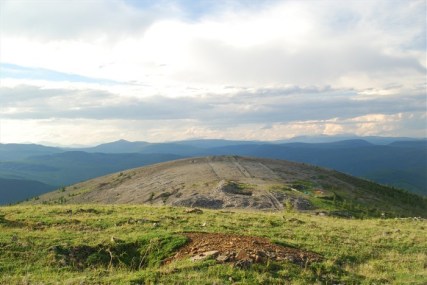
The site of the mine today (photo Bernard Grua)
“From this mountain, which is dome-shaped, I saw what to me was a wonderful sight, and the effect of which was beautiful, viz. a rainbow beneath, not above us; I never saw such a thing before, nor have I seen it since.
“We had some difficulty with Alatau over the morass, so resolved to invest a little money in the purchase of a pair of reindeer from a Samoiyede family, the only one said to be existing in these regions. They live in tents like the Tartars, conical and covered with skin; their dress also consists of skins. However, we found it a useless investment. The saddle was continually getting twisted, and I learned from our men that it required great tact for even a grown person to sit comfortably. So after the first day’s riding, we were obliged to abandon the use of them, and seat the boy on a horse, where he rode very comfortably. The delays in arranging his saddle on the reindeer impeded our progress greatly. He was obliged to be strapped on his horse; and it was rather fatiguing for him to be seated so many hours as he sometimes was. When sleep overtook him, we were obliged to carry him, which we did in turns.”
Alibert had arrived in the Sayan Mountains in 1847. He had been prospecting for gold in a river near Irkutsk when he came across lumps of graphite in his pan and decided to follow the stream to find the source, which turned out to be more than 300kms away in the Sayan Mountains. At that time, high quality graphite for use in lead pencils was in short supply, the important mine in Borrowdale, Cumbria, having closed down. Despite the remoteness of this location, Albert realised he could turn a profit by mining the mineral and therefore set about building workings on top of a hill at a place called Batagol.
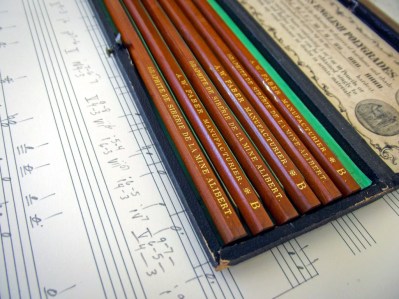
Alibert’s graphite was used in Faber’s pencils
When the Atkinson’s visited it was still being developed, but by the mid-1850s production was beginning in earnest. Alibert struck an exclusive deal with the German pencil maker Faber and managed to export his graphite on the backs of reindeers – still found in the area – and then down the rivers to the Pacific coast, where it was loaded onto ships bound for Europe. The mine became the main source of graphite for the world and Alibert was later awarded numerous medals and honours across Europe. Pencils made from Alibert’s graphite by Faber became the standard.
In the extract above Lucy mentions a reindeer they tried to use to carry Alatau, but found it too difficult. Today these deer are still herded by the local Soyot people – Lucy called them Samoyeds – a distinct ethnic minority, about 3500 of whom live in the region. They are very similar in culture to the neighbouring Tuvans and until recently still lived part of the year in birch-bark ‘chums’ – conical structures similar to native North American wig-wams. They also spoke a Turkic language similar to the Tuvans, but this has largely disappeared, although some attempts are being made to revive it. I now realise that our local guides to Jombolok were Soyots, almost all of whom are believers in shamanism.
Soyot chum in the Sayan Mountains
The Batagol Mine continued to produce very high-quality graphite until it closed in the 1950s, although it is still remembered locally, as is Monsieur Alibert, who had a reputation for treating his workers very well. During our trip we passed within a few miles of the mine, but it was not until I returned to England that I was able to find out more about it. You can watch a slide-show here about a trip to visit the site of the mine made almost a decade ago:










 Siberian Steppes