At last! The first wild tiger to be released in Kazakhstan bounded from a cage and disappeared into the long grass in a special reserve in the Ile-Balkhash State Nature Reserveon 31 July. Umit, an adult female Amur tiger whose name means Hope in Kazakh, was released at a remote site on the shores of the great lake and quickly disappeared. With a single leap she entered history as the first tiger ever released into a reintroduction programme.
“Today, we witnessed a truly historic event,” Minister of Ecology and Natural Resources Yerlan Nyssanbayev said at the release ceremony. “For the first time since the tiger disappeared from Kazakhstan more than 70 years ago, the first tiger has been released into its historical range. This is the result of many years of work by the state, our Russian colleagues, scientists and international partners,” he said.
Nyssanbayev added that the release was only the beginning of a much longer process. “A great deal of work lies ahead to monitor the tigers and establish a sustainable population, but today we have taken the first and very important step”.
Konstantin Chuychenko, Russia’s Justice Minister and chair of the supervisory board of the Amur Tiger Centre, noted that the tiger had become extinct in Kazakhstan in 1948,the same year that his own country signed the world’s first outright ban on tiger hunting in the Khabarovsk region. The ban saved Russia’s own Amur tiger from near-certain extinction but was too late to save its almost genetically identical cousin in Kazakhstan, sometimes referred to as the Turanian tiger. Most were shot by hunters before the ban was introduced.
Nearly 80 years later, animals from the Khabarovsk region are now helping restore the tiger population in Kazakhstan. “This historical parallel underscores the depth and significance of cooperation between Russia and Kazakhstan,” said Chuychenko. He noted that the tiger stands at the top of the food chain. Its presence depends on healthy forests, reliable water resources, sufficient populations of wild ungulates and effective protection against poaching.
Returning tigers required Kazakhstan to restore much of the natural ecosystem that once supported it. That preparation took more than 10 years and involved the reintroduction of Bokhara deer and kulan wild horses as prey animals for the tigers. Wild boar, which have always existed close to Balkhash, will form another source of food for the tigers.
There are presently six tigers in Kazakhstan. The first two, which arrived a year ago, came from European zoos and had spent their entire lives in captivity. They will never be released, but it is hoped that the female will become pregnant and that any cubs will be reared in large fenced enclosures before being released. They will have minimal contact with humans.
Four other tigers arrived earlier this year – two males and two females. Umit is one of these. The others will be released when they are ready for life in their new home range.

Government officials have sought to satisfy the concerns of locals in this sparsely-populated region of more than 500,000 hectares that they will be safe. The tigers are fitted with tracking collars and will be closely monitored. A compensation scheme for local farmers whose animals are attacked by a tiger has also been put in place. Eventually, it is hoped that a breeding population of 30-50 animals will be established, which could take 10-15 years.
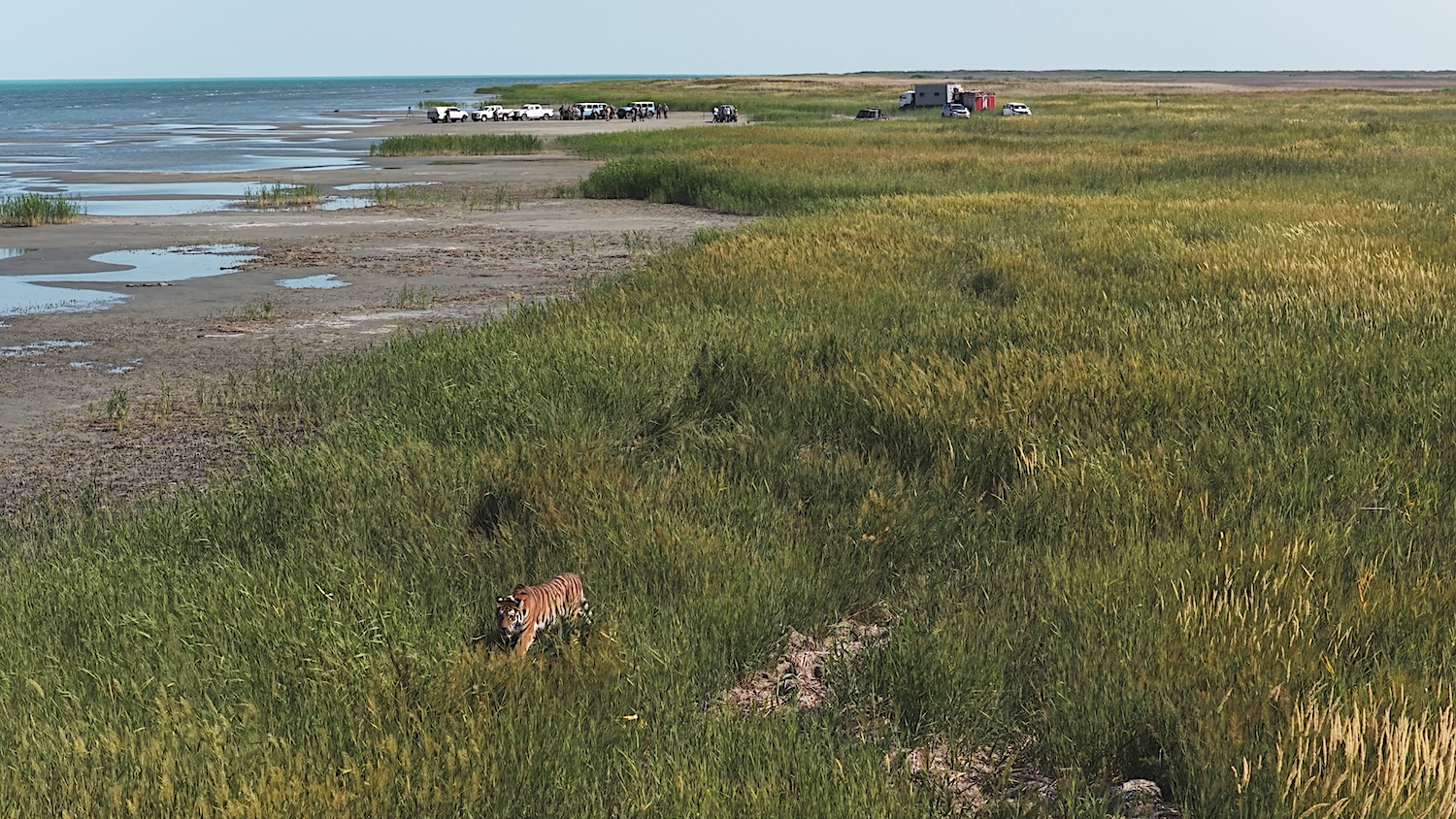


“At last! The first wild tiger to be released in Kazakhstan bounded from a cage and disappeared into the long grass in a special reserve in the Ile-Balkhash State Nature Reserveon 31 July.”
Another attempt to recreate the world of decades ago. Why not bring back slavery? Putin is trying to bring back the USSR. Why not bring back Nazism? In the UK birds of prey are being brought back where there are large flocks of sheep. And, of course, large numbers of small birds – all food for these eagles.
If the tigers had not been there before there WOULD NOT be this scheme to bring them back. What is so MAGICAL, so PERFECT about particular times in history? We now have over 8 BILLION people on Earth. Not the 2 BILLION of 1927, just a century ago.
Forget NOSTALGIA. Think COMMON SENSE.
Who is going to see this tiger? Almost NO ONE.
LikeLike
Hmmm.Bit of a defeatist attitude, if you dont mind me saying. Eagles, of course, don’t eat small birds. Nor do they generally eat adult sheep. but even if they do, isn’t it a price worth paying to see these magnificent creatures? Tigers are an iconic species, hunted to extinction in many parts of the world. This tiger’s name, Umit, which means Hope, says it all. Let’s hope we can live alongside other creatures. What this has got to do with Nazism, I have no idea. I think you are a bit confused on this point. Lighten up a bit and look for the positive in the world instead of the negative. There is nothing nostalgic in making space for nature. It is the only way we will survive as humans on this planet.
LikeLike
“Defeatist”? That depends on what the aim is. With reintroducing wolves, bears, eagles, etc, comes the inevitable clash with humans, domestic animals and other wild animals. As I said, if these animals had not been there before they would not be being reintroduced now; as if there was some nirvana time when the world was perfect.
You say “tigers are an iconic species”. People make them “iconic”. And people are speciesist; defining some animals as good, some as bad. I have yet to hear rats or mosquitoes being called good.
By quoting slavery and Nazism, I was showing how in the past some things were seen as normal (to some people). Reintroduction is seen by some people as trying to normalise the planet.
“According to the RSPB, species like the White-tailed Eagle naturally hunt and consume other birds such as gulls and ducks, alongside mammals and fish. Eagles are opportunistic hunters and will take avian prey or scavenge carrion when the opportunity arises.” Who is right?
You say “Nor do they generally eat adult sheep, but even if they do, isn’t it a price worth paying to see these magnificent creatures?” You need to ask the lambs and sheep, not me.
Calling white eagles “magnificent” is just a human attitude; speciesism. The animals they kill would have a different attitude.
As for “making a space for nature”, humans are part of “nature”; just one natural species.
Yes, some animals do look “magnificent”; in the true meaning of the word, “awesome”. Having lived and worked in Africa, I have been thrilled at the sight of coming across lions by a waterhole at dawn, meerkats by a dirt road in the Namib Desert, hippo just yards away in the Okavango Swamp at dusk. But I am not an African villager, a Scottish sheep farmer, nor a Kazakhstani.
LikeLike
You make some good points, but allowing humanity to destroy so many other species is not an option. As the example of reintroducing wolves into Yellowstone has shown, top predators can make a massive difference to ecosystems. Indeed, some would argue that their loss is the most destabilising event in a particular ecosystem. The widespread and ongoing mass killing of sharks is another good illustration. Farmers can be compensated for losses at a fraction of the cost of losing the environments on which animals, birds, insects, etc depend. I have nothing against either mosquitoes or rats or any other creature. All deserve our support. Insecticide is not just a product, it is a description of what these products do.
LikeLike
Thank you Nick for the rational, fact based, and non-emotive response:)
LikeLike