Thomas Atkinson’s contribution to the architecture of Manchester is finally beginning to get some of the attention it deserves. From his yard, first in Piccadilly and then around the corner in Store Street, he took on several substantial projects in the mid-1830s, although ultimately, the city was to be instrumental in his downfall as an architect.
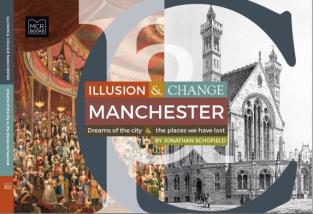
Recognition for his work can be found in a newly published book by Manchester author and tour guide Jonathan Schofield. Illusion & Change: Manchester – Dreams of the city and the city we have lost by Jonathan Schofield devotes several pages to Thomas’ architectural work in the city, including the villas he designed for the hillside above St Luke’s Church in Cheetham Hill.
Jonathan Schofield’s book on Manchester
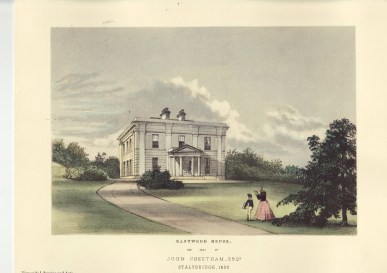
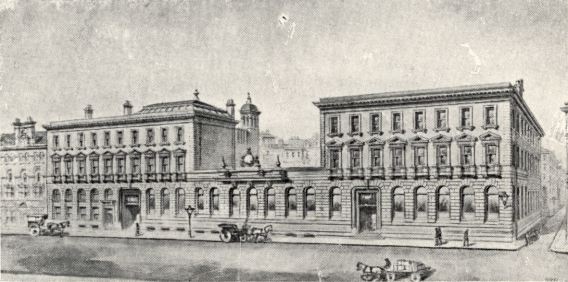
The church was built – and the tower survives to this day – but the villas, alas, were never completed. Also mentioned in the book are the headquarters for the Manchester and Liverpool District Bank, the observatory planned for Kersal Moor, his proposal for a Unitarian Church in Upper Brook Street and the church he built at Openshaw. We could also mention the superb houses he designed for John Cheetham and his brother in Stalybridge – both now sadly demolished.
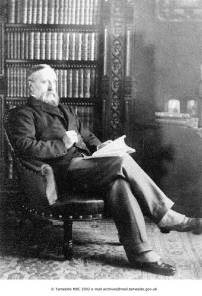
Eastwood House, Stalybridge, designed and built by Thomas Atkinson for John Cheetham MPJohn Cheetham sitting in the library at Eastwood House, also designed by Atkinson
Mr Schofield casts Thomas as a Cassandra, a man who made many plans for the city, but who was ignored by the establishment. This is slightly harsh, although understandable. I have previously noted the fact that he lost out on several commissions to the architect Charles Barry and it is certainly true that it was the Manchester and Liverpool District Bank building that finally sent him into bankruptcy in 1838. But The Builder magazine, in its obituary of him, published on 31 August 1861, was full of praise for his work:
“The building of the District Bank was as important an event in the architectural history of Manchester as that of the Travellers’ Club was in London since it showed the local public that effect was not dependent on mere “orders”, that there was something more than these in the matter of architecture. The epoch of the acquirement of this insight by the public cannot be too highly estimated. Subsequently the same architect opened out in like manner another avenue to taste, by the adaptation of the central lantern-lighted staircase hall, for which Barry is to be credited as regards the Royal Institution, but which with the surrounding arcades which Atkinson added, was a novelty in private houses.
The Manchester and Liverpool District Bank head office in Spring Gardens
During the few years in which Atkinson practised in Manchester, taste certainly improved by his example. In his Italian villas, bold cantilever cornices, and more effective porches and chimneys; and in his Gothic designs, the features which are now well known, but were then habitually caricatured, were introduced. Indeed, his Gothic was considerably in advance of that practised by London architects.”
Nor was it just his designs that were impressive. He also had an impact on the other architects in the City:
“To show the change that has taken place, it may be well to mention, that at Atkinson’s arrival in Manchester, the architects of the town had their assistants for nearly everything beyond surveying, from London. Most of these assistants had been indebted for what they could do, to one master, the now deceased too-much-forgotten George Maddox, of Furnival’s Inn: they had not rested long enough in his school to acquire his unquestionable taste; and they were generally deficient in such matters as Gothic mouldings and tracery, to an extent which now seems a deficiency in the power to produce no matter what character of good architecture. By all these gentlemen, some of whom have since deservedly attained a good position, and were then sufficiently qualified to judge, Atkinson was pointed to as a rare bird, a man veritably who made his own designs and was an artist.”
Anyone who wants to find out more about Thomas’s work in Manchester should join one of Mr Schofield’s tours of the city, several of which cover developments in the city in the nineteenth century. There is a further opportunity to hear more about Thomas’ work in the city on 16th November at the Victorian Society, when writer John Massey Stewart is due to give a talk on ‘Thomas Witlam Atkinson (1799-1861): a forgotten Victorian architect and artist’. Details can be found here.
Yet again, I have been delighted to find another substantial reference to the work of Thomas Atkinson, this time evidence given by Thomas to a select Parliamentary Committee. The evidence is fascinating because it was taken down verbatim by shorthand writers and every now and then something of Thomas the man comes across as he gives evidence. His performance was very impressive. He exhibited a detailed knowledge of the facts and delivered new and interesting information to the committee members, who questioned him at length.
The first I knew of this evidence to Parliament was last year in Hawaii, when I came across original letters between Thomas and William Ewart MP among the papers belonging to Thomas’ descendant Paul Dahlquist. In one letter, dated February 1859, William Ewart MP, chairman of the Parliamentary Select Committee on the Colonization and Settlement of India, wrote to Thomas Atkinson asking him if he would be willing to give evidence on his experiences in Central Asia, and in particular on the possibility of increasing trade.
Thomas replied on 11 February, stating that he would have “much pleasure in attending your committee…when I shall endeavour to answer such questions about the regions I have travelled through as they desired to be informed upon.”
Three days later, on Monday 14th February, Thomas made his way to the Houses of Parliament to appear before the committee. It was only last week that I finally found time to search the Parliamentary archives, where Rhiannon Compton was kind enough to locate the records. This is what they show.
The Select Committee report to which Thomas gave evidence
Thomas was the committee’s second witness, preceded only by Sir Joseph Dalton Hooker, the founder of Kew Gardens and a great expert on northern India and the Himalayas. Dalton and Hooker later became great friends and it is interesting to speculate that this was where they first met each other. Thomas was first asked about the extent of his travels. He revealed that he had been as far east in Siberia as the source of the Lena river in the Baikal Mountains, west of Lake Baikal; as far south as latitude 42 degrees, and to within 70-80 miles of Kashgar in what is now Xinjiang, western China, to the sources of the Syr Darya (Jaxartes).
He was closely examined on what he had heard about Russian trade with Central Asia and gave well informed answers, noting that British calicoes were being brought from India to Khokan (Kokand) in the Ferghana Valley. The MPs were particularly keen to know if there were good prospects for opening up trade between Britain and Central Asia and Thomas replied in the affirmative. He said woollen clothes would be bought, but “they must be of particular colours; dark colours would not sell, but vivid colours, red, crimson, yellow, green or light blue are much admired; dark blue would not sell.” He said he had had several local costumes, but had to leave them behind in Russia: “I found things accumulated so fast that having to travel on camel and horseback it was impossible to bring as many things as I desired.”
Thomas noted that the Russians were trying to increase their trade with Central Asia and that they sold calicoes, leather, copper, iron and hardware. They banned gunpowder and the Chinese had a monopoly on the supply of brick tea, about which there was a long discussion, including its use as currency: “I have had as many as 100 of those bricks to travel with; it was the only money,” he told the committee. He also described how it is brewed and said he “very often found it an excellent supper.”
The MPs asked him about the wealth of the tribes on the steppes; and Thomas recounted how he had often come across chiefs who owned 10,000 horses and 50,000 oxen. The MPs seemed bemused when he explained that there was no agriculture and that the nomads lived simply on the products of their animals. Their income came from selling livestock, particularly oxen, to the Russians. “They grow no corn,” he explains, “they eat animal food, horse flesh and mutton and drink koumis, made from mare’s milk. They have hyran (cheese), made from the milk of cows and sheep, which is dried in the sun till it becomes as hard and very like limestone; when used it is broken into small pieces and then softened in water. I have sat down at a brook and made an excellent meal of it.”
Thomas was then questioned about gold production, noting it was mostly found in the small mountain ranges south of the Altai mountains, where it is washed from river gravels. Asked what size nuggets he has seen he replied: “the largest I have seen was about 84lbs in weight; it was considered the largest nugget in the world for a long time; 10lb is quite common in some of the mines.”
Thomas gives his evidence
Asked about the dress of the locals, Thomas stated that they wear costume and were “well dressed, frequently in silk…they wear garments of most vivid colours; and when seen together they made the most picturesque groups of people it is possible to imagine.”
Thomas was asked in detail about the danger of travelling in Central Asia. He said that the caravans were well protected and that Europeans would be able to get to Khokan, although the caravan trade would have to be in the hands of local Tartars. He was protected by the Cossacks provided to him by the Russian Tsar, although in more remote areas “they were obliged to put off their uniform. It would have been dangerous for them to wear it.” As for himself: “I never changed my costume, although I was advised to do so and put on that of an Asiatic, which it was said would afford me more security. I found myself favourably received in my own costume and I should recommend others to adopt this course.”
He continued: “I had a passport from the Emperor himself, which enabled me to leave his empire and re-enter it wherever I chose; otherwise upon the frontier they would not have permitted me to leave.” He always had three Cossacks selected for their language skills. “I could speak Russian with the Cossacks and then they acted as interpreters for me.” He said he spoke Russian “sufficient to travel”. In fact, we know that Lucy often translated for him as her language skills were better than his.
He was never plundered except in Siberia, where he was robbed by convicts. “I believe a man may travel by the caravan routes through these regions with perfect security, if he has firmness and deals honestly with the tribes. Other areas were more dangerous, he admitted, but added “I was well armed and I showed them that I could use those arms if it was necessary…I had the Cossacks and if I had ordered them to shoot a man they would have done it in a moment.”
Thomas also gave a good account of his first meeting with Tsar Nicholas I: “He asked me to state distinctly what my object was, and I did so. I had found great difficulty with the government, when I made an application to be allowed to travel and then I came to the determination that I would apply to the Emperor for his permission. I made an application through Mr Buchanan, our minister in St Petersburgh, and in three days I had the Emperor’s order to travel.”
Asked whether the Tsar had questioned him over his purpose in travelling, he replied: “He desired to know my object in travelling and I told him it was to sketch the scenery of the country and make notes of anything I thought valuable.”
Thomas’s information on the attitude of the Central Asian tribes to the Russians is of great interest to the committee. He said they “know very well that Russia is surrounding them with forts and that the time is not very far distant when she will say ‘You must pay tribute, and not only pay tribute, but become soldiers when it is necessary’.” He thinks they would respond favourably to an approach from the British and adds that “England lost a favourable opportunity of making acquaintance with them a few years ago.”
Here he was referring to the fate of Lt Col Charles Stoddart and Capt. Arthur Conolly, two British army officers who were beheaded by the Emir of Bokhara in 1842. “I was not there,” he added, “but my impression is, from what I could gather, that the death of our two officers, Messrs Conolly and Stoddart, was solely their own fault.”
This was controversial, as the Revd Joseph Wolff’s account of his attempted rescue of the two men, first published in 1845, had lauded them as heroes. Thomas was undeterred: “Several Russian officers and merchants of my acquaintance who have visited Khiva do not agree with Dr Wolff. They believe that these officers were sacrificed by their overbearing conduct, believing they could command the Khan of Bokhara as they would a regiment on parade at the Horse Guards.” Asked how it was their own fault, Thomas replied brusquely: “From being somewhat insolent.”
Stoddart and Connolly – executed by the Emir of Bokhara
After further extensive questioning, Thomas was thanked and left the committee meeting. Two days later, on 16 February, William Ewart wrote to Thomas again: “In consequence of the interesting evidence you gave us on Monday I am led, on behalf of the Committee, to ask whether you could give us a summary of the most obvious measures adopted of late years by Russia for developing the trade of Central Asia. We would not ask you for more than the aforesaid views. The committee could receive you tomorrow at 2 o’clock.”
So on 17th February Thomas returned to Westminster to continue giving evidence. In answer to the question of how Russia was extending its trade into Central Asia he talked of the three Kazakh hordes (jus in Kazakh) and explained that two – the middle and small hordes – were now under the complete control of the Russians, allowing caravans to pass in complete security and that the third horde, the Great Horde, was partially under Russian control. Tartars from Russia controlled the caravans, which were now widely accepted by the khans and sultans.
Thomas also talked about the steamer traffic on the great Central Asian rivers, including the Syr Darya – then called the Jaxartes or Sihon. He pointed out that they could steam up above Khokan and that there were six steamers of up to 1,000 tons on the Aral Sea in 1856, but that there were now more. However, they were not used for trade, but solely to resupply the forts and military camps of the Russians. He said that the tribes had tried to resist the Russians: “Even during the years I spent with them there was a great commotion and if the Kazakhs had had a leader, Russia would have been driven out of the Great Horde, undoubtedly.” Russia had expanded its forts so extensively that they now stretched well beyond the Chinese border – “50 miles beyond in some parts, 300 miles in others.” He had little doubt that Russia would be successful in Central Asia: “The Kazakhs have been completely asleep and Russia has gradually gone on from one point to another and erected forts, so that the time will come when she will say to the sultans and chiefs, ‘You must pay us tribute’. In fact, they are hemmed in.”
Overall, Thomas’ evidence is impressive. It is both precise and accurate. He spoke from knowledge and at that point was surely more knowledgeable than any living Englishman on the Russian progress in Central Asia. He said that British trade could make headway in Central Asia, but that the Russians had pretty much got things sown up. And that was precisely the case. The Central Asians, he said, recognise the quality of British goods, but could not easily obtain them. The Russians were even falsely printing ‘Made in Manchester’ on their cottons in order to dupe traders into buying their inferior goods.
Despite the very interesting material that was uncovered by this select committee, its final deliberations were never fully published, although the verbatim evidence was. On 7th April 1859 an election was called by Lord Palmerston’s government and the committee, along with Parliament, was dissolved. The recommendation was that another similar committee should be formed in the following Parliament, but I have not been able to find out if this occurred.
Thomas kept in touch with Ewart, accepting invitations to dinner at his house in Cambridge Square and agreeing to show Ewart’s daughters his paintings. Whether they bought any is not recorded. In March 1860, just over a year after he had given his evidence Ewart wrote to Thomas to tell him that he was going to make a few remarks about Central Asia during a debate in the House of Commons, basing his comments on Thomas’ evidence.
Where did Lucy Atkinson live after her husband, Thomas, died in August 1861? Until that point they had been living at Hawk Cottage on the Old Brompton Road, although for the last months of his life, when he knew he was dying, Thomas lived in Lower Walmer in Kent, presumably in order to take advantage of the sea air.
Hawk Cottage no longer exists, but we know what it looked like from a watercolour that has survived – not by Thomas, but by the artist William Cowen.
Hawk Cottage on the Brompton Road in West London, from a watercolour by William Cowen
The modest house had a walled garden which offered a degree of privacy. Outside was little more than a country lane that led out towards Earl’s Court and the edge of town. It would probably have been described as a ‘genteel’ area, well away from the hustle and bustle of the City of London and the docks. The location of the house can be seen in the map below to the right. Today The Boltons nearby is one of the most exclusive streets in London, with houses changing hands for tens of millions of pounds. Cresswell Lodge, the property that backed onto Hawk Cottage, was until the 1860s at least a boarding school for young ladies.
Map showing Hawk Cottage and the Old Brompton Road
Thomas, Lucy and Alatau are shown living at Hawk Cottage in the 1861 Census, where he is described as an ‘Author of Travels’. Alatau is described as a scholar, although I have yet to find out where he was attending school. The great Victorian scientist, Sir Francis Galton, mentioned the Atkinsons and the cottage in his autobiography. Referring to their return to England he notes: “They took a picturesque but ramshackle small house and garden, called Hawk Cottage, that stood on the old Brompton Road, nearly opposite to where Bina Gardens are now, on a spot that had not then passed into the hands of the builders of streets. They were much visited by members of the highest Russian nobility and by many English friends.” (from ‘Memories of my Life’).
When Thomas died his estate went to his first wife, Rebecca Atkinson, who was living in Beaufort Street in Chelsea. Lucy was soon in financial difficulties (see articles below) and six months later, in March 1862, she made an application to the Royal Literary Fund for a grant. Her application was successful and she was awarded £80, to be followed in 1863 by the award of a Civil List pension of £100. But what is noticeable is that the address she gives for her application to the RLF was No 9 Lilly Terrace, New Road, Hammersmith. Did she have to move because she could no longer afford the rent for Hawk Cottage? I think that is very likely.
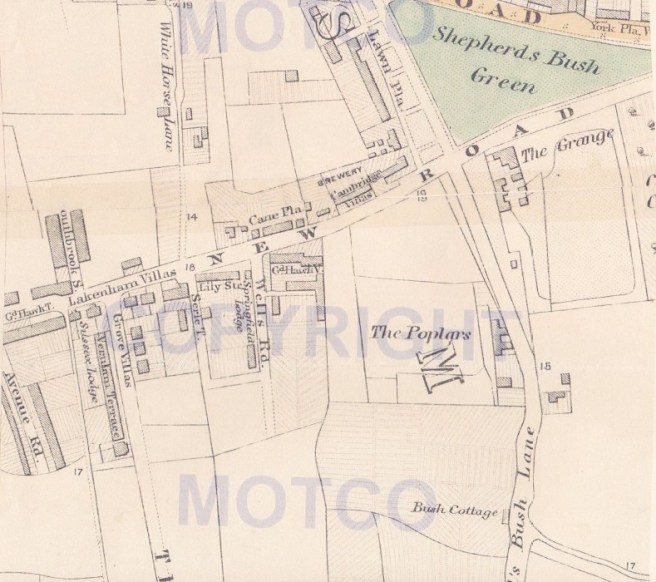
New Road was renamed Goldhawk Road in the 1890s, but of Lilly Terrace there is no trace. However, a clue to the location of Lilly Terrace can be found in a map of the area dated 1862. This shows that between Wells Road and Serle Terrace there was a ‘Lily Street’. It doesn’t quite make sense that a terrace on New Road should be called Lily Street, so my guess is that this was actually Lilly Terrace. The houses were newly built at this time and it may be that the mapmaker was using a temporary name. Either way, this is the most likely location of the terrace, which you can see on the map below just below the N in New Road.
Map of New Road (now Goldhawk Road) close to Shepherds Bush
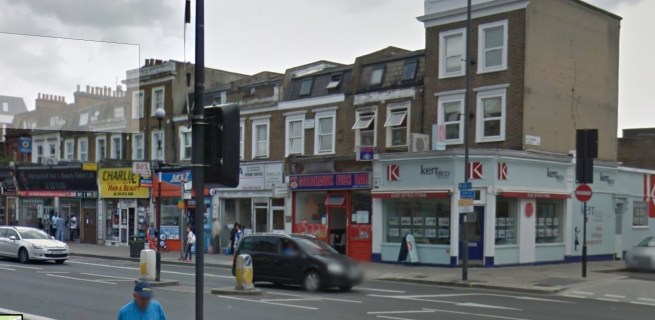
Today, it is not easy to see the old houses, as shopfronts have been built along most of the road. But by standing back you can still see the old terrace quite clearly.
Part of Goldhawk Road showing the terrace that was once lived in by Lucy Atkinson
Lucy stayed here for a few years before she disappeared from view for some time. It is likely that some time before the end of the 1860s she returned to Russia for a while, perhaps working in her old profession as a governess. By 1881 she was back in London, living in Mecklenburg Square, close to Kings Cross. She was to stay there for the rest of her life.
My last posting looked at what happened to Lucy Atkinson following the death of her husband, Thomas Atkinson, in August 1861. This posting tries to piece together the story of Thomas’ first wife, Rebecca, and the children of that marriage – Martha, John and Emma. I am grateful to Sally Hayles and Marianne Simpson for their help with both postings.
Thomas Atkinson’s decision not to tell Lucy Sherrard Finley, the woman he married in Moscow in February 1848, that his first wife was still alive – he is described as a widower in the marriage record – was to have enormous repercussions for both of them.
Extract from Thomas and Lucy’s marriage record that clearly states he is a widower.
He had been living apart from his first wife, Rebecca, for six or seven years by the time he married Lucy, most of that time abroad. Considering the difficulties and expense of obtaining a divorce in mid-Victorian England, it is perhaps understandable that he chose to obscure the issue. However, once he had married Lucy, fear of being accused of bigamy meant he could never fully explain to anyone, in Britain at least, the full story of his and Lucy’s 40,000-mile journey through Siberia, Central Asia and Mongolia. For much of that journey they were accompanied by Alatau, the son born to the couple during the winter of 1848 in the town of Kapal in what is now eastern Kazakhstan. But at no point in either of Atkinson’s two books on his travels does he mention either Lucy or Alatau and he chooses instead to write as if he had been travelling alone or only with guides.
Their absence from his published narrative is huge, as we learn both from his diaries – where they are mentioned extensively – and from Lucy’s own book, Recollections of Tartar Steppes, published in 1863, two years after Thomas’ death. Even though it is partly based on Thomas’ diaries, the book contains much that is new and casts a much more intimate light on their travels as a family group through these remote regions. The drama of Lucy’s several scrapes with death, the almost unattended birth of Alatau, the occasions on which she raised a gun to protect her husband from attackers – she was a crack shot – and many other dramatic moments are set out in scintillating detail.
Lucy only found out about the existence of Rebecca, Thomas’ first wife, following his death in August 1861, barely three years after their return from Russia. We don’t know precisely when she found out, but only weeks after Thomas’ death, Rebecca was granted letters of administration over Thomas’ estate, effectively making her his heir. This must have come as a deep shock to Lucy, who had always believed that Thomas was a widower. No doubt she was also expecting to inherit his (comparatively meagre) estate.
Instead, she had to face the humiliation of explaining to various grandees and acquaintances that she was indeed married to her husband and was not a disreputable woman who had travelled with a married man and had a bastard son. In stuffy mid-Victorian England it was indeed a remarkable achievement that Lucy – who had been out of England for a total of 18 years – was able to retain her dignity and even continue to express her affection for her husband.
But what about Rebecca Atkinson? What do we know about her, and about the three children born to her and Thomas? There are gaps, but the narrative is beginning to unfold. The couple must have met in 1818-19 when Thomas, still learning his trade, worked at the sandstone quarries in Halifax, Yorkshire, which specialised in flagstones for floors and provided cut stone for housing and public buildings.
Rebecca’s father, John (b1760), was a cordwainer or shoemaker. He and his wife Jane had at least five children, of whom Rebecca was the second oldest, born in 1792. All the children were christened at St John the Baptist Church in Halifax, the same church in which Thomas and Rebecca were married on 1 April 1819, when Thomas was just 20 and Rebecca was 27. As their first child, Martha, was born in Halifax on 9th November the same year, it is reasonable to assume that Rebecca was pregnant when they married.
The family’s movements in the first half of the 1820s are hazy, to say the least, but we know that Thomas was moving around the country quite a lot at this time, from Yorkshire, to London, to Kent, working on contracts as he progressed from mason to clerk of works until he was finally able to set himself up as an architect. He learned his skills on the job, taking on more and more responsibility as he progressed from carving stone to gradually producing drawings for architectural work. Already, whilst he was living in Ashton-under-Lyne in the early 1820s, he was teaching art as he worked on a local church. It is also possible he was allowed to take part in art classes at Cannon Hall as he was growing up, where he would have been instructed by one of several art teachers that passed through the house.
In the early 1820s Thomas and Rebecca must have moved back to Cawthorne for a while, as he worked on St George’s church in Barnsley for some time, walking the five miles to the town and back every day. He was also given work by the Spencer Stanhopes, who eventually persuaded him to go the Manchester and may have helped to set him up in business. Throughout this time, he was beginning to develop his interest in architecture and was already building a collection of castes of sculptures he came across in his travels. He seems to have made a particular study of the rural churches of Lincolnshire, but his first publication, Gothic Ornaments Selected from the different Cathedrals and Churches of England, published in 1829, shows that he travelled widely in order to sketch.
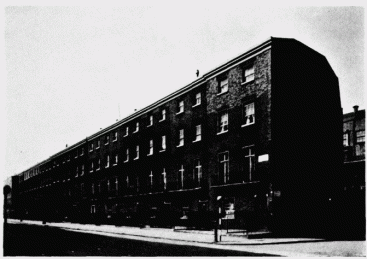
Two further children followed Martha – John William, born in 1824 in Yorkshire, and Emma born in 1829 in Lambeth, South London, after the family had moved there (I have not been able to find birth records for either). We don’t know exactly where they lived, but Thomas’s architectural business was located at 8 Upper Stamford Street (now demolished, but the street still exists, renamed Stamford Street) in Southwark, on what is now the South Bank, and it is likely he lived there too. From 1825-28, just overlapping with the Atkinsons, the architect Charles Hollis, who build All Saints Church in Poplar and Windsor Bridge and the Church of John the Baptist also in Windsor, lived next door at No 10.
The terrace in Upper Stamford Street, now demolished, in which Thomas’ business was located. He worked at No 8, on the extreme left of the picture.
The family stayed in London for four or five years, with Thomas working on villas in Central London and South London, on St Nicholas’ Church in Tooting and various other architectural projects. However, by 1834 they had returned back north to Manchester, moving into a property in Chorlton cum Hardy, to the south of the city centre, where Thomas’ building business, based first in Piccadilly in the city centre and then in nearby Store Street, initially flourished. However, within three years his business was in trouble and early in 1838 he was declared bankrupt.
It seems likely that Thomas spent some time in debtors’ prison, if only for a short while, as the discharge book for the Fleet Prison in London shows Thomas being released in February 1841, on sureties from William Richardson and John Skerette Stubbs, a well-known milliner in Manchester. He was certainly not in prison for his daughter Martha’s wedding in July 1840 to James Wheeler, an up-and-coming solicitor from Manchester. Thomas is described as a ‘gentleman’ on the wedding record, as is Wheeler’s father, John Wheeler.
In fact, James Wheeler was quite a catch for Martha Atkinson. He belonged to a large, prosperous and well-known Manchester family connected to publishing and journalism. His grandfather, Charles Wheeler, founded the Manchester Chronicle in in June 1781 and his father John also edited the paper. Of his nine siblings, his brother John was also a journalist and colleague of Charles Dickens on the Morning Chronicle in London. His eldest brother, Charles Henry Wheeler, became part of the Winchester elite as a well-known publisher and writer. James’ elder sister, Elizabeth Wheeler Stone, was a social novelist, amongst the first to expose the distress of the manufacturing districts of Lancashire in the first half of the nineteenth century in such novels as William Langshawe, the Cotton Lord (1842). Another brother, Thomas Wheeler, after Cambridge and the bar, became a county court judge in St Marylebone, London.
James himself seems to have dabbled in journalism before turning to law, taking the helm at the Manchester Chronicle before it was sold off in 1834 and then writing several books including Manchester: its political, social, and commercial history, ancient and modern (1836) and the anthology Manchester Poetry (1838). Soon after becoming a lawyer he was acting for several large railway companies, which at that time were expanding rapidly across Britain, including several that were associated with George Stephenson (1781-1848), the designer of The Rocket and the first inter-city public railway line at Stockton and Darlington in 1825. During the late 1830s and afterwards he was appointed solicitor for numerous railway stock companies.
James Wheeler’s book on the history of Manchester
So when Martha married James at St Clement’s in Chorlton cum Hardy on 11 July 1840, Thomas must have been very proud. Despite his recent financial difficulties, he was marrying his daughter into a well-to-do, well-connected dynasty. And so it proved to be. James’ practice grew and by the mid-to-late 1840s he had moved with his family from Manchester to a new office in Victoria Street, Westminster in London, next to the building that would eventually become the headquarters of the Institute of Civil Engineers.
I have not been able to find James and Martha Wheeler in the 1851 Census, although we know their third child, Edith, was born in Pimlico in 1847. Their youngest child, Gertrude, was born in Kingston, Surrey in 1856. Two older children, Godfrey and Marian, had been born in Chorlton cum Hardy in 1843 and 1845 respectively. By 1861 the Wheelers were living at the newly-built 4 Ladbroke Gardens, in Notting Hill, with their four children, Martha’s sister Emma and James’ sister Anne and her husband (and James’ business partner) William Yates Caistor, also a solicitor. The extent of their social advance is shown by the fact that they had four servants living in the house.
Ladbroke Gardens in Notting Hill
By 1871 the Wheelers were living at 22 Great Cumberland Place (now demolished), close to Marble Arch in Marylebone, London. Now they had six servants including a butler, footman, lady’s maid, cook and two housemaids. The three girls and Martha’s younger sister Emma were still living at home.
The following year, in May 1872, Rebecca Atkinson died at home in Beaufort Street, Chelsea, aged 77. Her death certificate states she was “widow of Thomas Witlam Atkinson, Architect.” A nurse, Jane Day living in Cheyne Row West, Chelsea, was present at her death.
Prior to her death she had lived in Beaufort Street for more than 20 years. She first appeared there, in the house of a widow, Mrs Mary Ann Palmer and her two unmarried daughters, in 1851, when she is described as a visitor. She is still there in 1861 and 1871, although Mrs Palmer had presumably died by 1871. All the other residents of the house were women annuitants.
James Wheeler died in August 1875. His will was proved by his son Godfrey and daughter Edith who were his executors. He left effects of no more than £60,000 – a massive fortune at the time.
By 1881 his widow Martha was living at 32 Hyde Park Gardens, along with her youngest daughter Gertrude – now 35 – a cook, a butler and a footman. Martha was still there in 1891, along with her grandson, Frank G W Bliss, (aged 5 and born in India) and seven staff. She died in 1899 and was buried next to her husband at St Michael and All Angels Church in Cuxton, near Rochester, Kent.
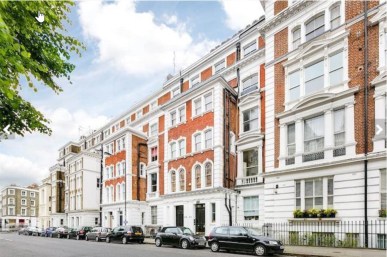
Hyde Park Gardens, where Martha was living in 1881
Martha was predeceased by two of her daughters. In June 1886 Gertrude, the youngest and last to leave home, had married Irishman William Alexander Willock, who worked for the Madras Civil Service as Collector and Agent at Vizagapatam in India. They had travelled out to India, but less than two years later, in February 1888, Gertrude died during childbirth at the English hill station of Trichinopoly in Tamil Nadu. She and the baby were brought back to England and buried at the church in Cuxton.
Gertrude’s sister Edith also married a colonial officer, although of a somewhat grander station. Her new husband was Henry William Bliss – in 1889 he was knighted and became Sir Henry William Bliss KCIE – who after receiving his degree at Merton College, Oxford, in 1863 joined the Madras provincial civil service. He served as Commissioner of Salt and Revenue from 1878 to 1886 and as a member of the Finance Committee of India from 1886 to 1887 and member of the Board of Revenue from 1887 to 1889. He then served as a member of the Imperial Legislative Council of India from 1890 to 1892 and Madras Legislative Council from 1893 to 1898.
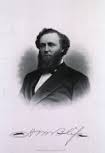
Sir Henry Bliss
The marriage took place in November 1879 at Christ Church in Bombay. It was Bliss’ second marriage, following the death of his first wife, which has resulted in the birth of a son, Charles Bliss. Edith and Henry had three sons, the second of whom was born in ‘Ooty’ (Ootacamunde), a well-known hill station to the north of Coimbatore in Tamil Nadu. And that is also where Edith died in May 1898. She is buried there, but a memorial tablet at Cuxton Church in Kent records her passing and gives her name and title as Dame Edith Bliss.
Her husband, Sir Henry, retired from the Indian Civil Service almost immediately after her death and moved to London, where in 1900 he married for a third time and became a Moderate Party member of the London County Council. Later he retired to Abbey House in Abingdon, Berks where he died in 1919.
As for Marian Wheeler, the eldest daughter, she married a military man, John Rudge, in February 1878. In 1881 he was living in Portsea, Hants, with Marian and their newly-born daughter, Amy. He was an infantry major in the 1/10 Regiment and on the Active list. A decade later he was a colonel and living in Lincoln with Marian and Amy. By 1901 he was on the retired list, living at Millbrooke, Topsham, Countess Weir in Devon, with Marian and their nephew, Godfrey Bliss (15), son of Marian’s sister Edith, together with four servants. I have not been able to trace Amy any further.
Martha and James’ only son, Godfrey the eldest child, studied law at Magdalen College, Cambridge, graduating in 1866. He was called to the bar in 1869, but by 1881 he was a non-practising barrister, living at 21 Harbour Terrace, St Austell, Cornwall with his American-born wife Mary and a servant. Presumably, having inherited a considerable sum from his father, he had decided not to work. Two children born to the couple died soon after birth.
Soon after this Godfrey migrated to Aiken, South Carolina, in America, where he became a successful businessman. By 1902 he was President of the Sterling Kaolin Company and a keen golfer.
He died without children in 1933 and letters of administration were granted to his cousin, Philip Wheeler Bliss. According to the Aiken Journal and Review of 30 August 1933: “The Will of Mr. Godfrey Wheeler, who died in Aiken on Aug. 19th, has been filed at the office of the Probate Judge. Professor Otis L. Courtney, with whom Mr. Wheeler resided was willed the sum of $10,000, and the balance of the estate was left to his nephew, Colonel Philip Bliss, of England. The residue is to be divided with another nephew, Harry Bliss, if he survived at the time of Mr. Wheeler’s death. The Will is dated Dec. 21st, 1931. and witnessed by R. L. Gunter, H. H. Raynham and L. R. Weeks. The estate has not been appraised, but it is estimated at about $40,000.”
Godfrey owned over 200 acres at the time of his death and was thus a wealthy man. Philip and Harry Bliss, to whom he left the majority of his estate, were both sons of Godfrey’s sister Edith.
The only line that seems to have continued from James and Martha was via Edith Bliss’ children – Henry, Godfrey (known as Harry) and Philip. All carried the name Wheeler as part of their name.
After Balliol and the army, Henry became a research chemist for the British Research Association for the Woollen and Worsted Industries. He had a son who died at birth and he himself died in 1964 in Hampshire.
Harry I have no further details for, except that in 1911 he was living with an aunt and uncle in Devon.
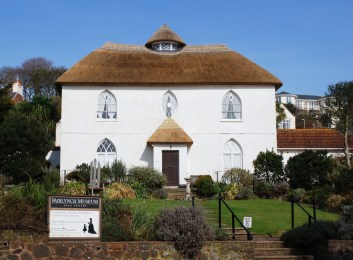
As for Philip Wheeler Bliss, he went to Eton and then became an officer in the Royal Engineers, rising to the rank of Brigadier. At the beginning of the Second World War, having become an expert on reinforced concrete, he was appointed Director of Fortifications and Works at the War Office before retiring in 1943. He bought a house in Budleigh Salterton with his wife Monica and died in 1966. His son, Captain Philip Bliss, sold the house the same year and the following year it reopened as the Fairlynch Museum, a local history museum and one of the only thatched museums in Britain.
The Fairlynch Museum in Budleigh Salterton, once home to the Bliss family.
I have not been able to locate any further family members, although I believe that two of Brigadier Bliss’ grandsons emigrated to Australia. Any further information would be much appreciated.
Thus we return to Thomas and Rebecca Atkinson’s two other children, about which little is known. We know that John William Atkinson was born in Yorkshire in 1824 and that he died in Hamburg on 3rd April 1846, aged 22, probably from TB. The Manchester Courier and Lancashire General Advertiser for 11 April 1846 noted that he was a marine artist: “His talents were various: as a marine artist they would have been great, as shewn by his sketches, one of which, The Phantom Ships, is of a very high order.” The lack of information about this critical period in Thomas’ life prevents us being too specific, but it seems likely that John’s death had a significant impact on him. John was living with Thomas in Hamburg at the time he died.
It cannot be a coincidence that Thomas chose to give up architecture at this point and head for some of the most remote places on earth, in the wilds of Siberia and Central Asia. A failed business, a broken marriage and then the death of his only son would have been a considerable burden for anyone.
Thomas and Rebecca’s youngest daughter, Emma, is even more of an enigma. Born in Pimlico in 1827, she can be found living with Thomas in 1841 in Chorlton, but without either her mother or brother. I cannot find a trace of her (or, for that matter, Martha and her husband) in the 1851 Census records and there is a trace of a possibility that all three were living in Madrid, Spain. In 1861 she was still unmarried, living with her sister Martha and James Wheeler in Ladbroke Gardens, Kensington. She was still with them in 1871 in Gt Cumberland Place, Marylebone, still unmarried. In both the 1861 and 1871 Census her birthplace is given as Lambeth, rather than Pimlico. After that the trail goes cold.
Several sources say that she is Emma Willsher Atkinson, author of Memoirs of the Queens of Prussia (London 1858). This is not correct, as this author can be traced from childhood and has no connection with Thomas and Rebecca. Memoirs… contains a dedication on the frontispiece to ‘A much-beloved invalid sister’, which does not square with the Atkinson family. I have not been able to find out where or when Emma (daughter of Thomas) died.
The overall picture is that Thomas’ first family did pretty well for themselves. When the family broke apart at the beginning of the 1840s Thomas was bankrupt, with few prospects of getting back into business. His daughter Martha’s marriage to James Wheeler turned out to be fortuitous – and prosperous. And their children also prospered.
Thomas’ son John did not live long, but his father stayed with him until the end. And Emma, his youngest daughter, although she appears not to have married, lived well in her sister’s houses for many years. Rebecca herself lived quietly in a respectable part of London as an annuitant, with her two daughters only a short cab ride away. Of course, we don’t know how Rebecca and her daughters felt about their father and whether or not he ever saw any of them again after he returned to London from his travels. Perhaps one day some information will emerge.
For the last 14 months of his life Thomas Atkinson was seriously ill and almost unable to work. He continued as best he could to complete his final book, Travels in the Regions of the Upper and Lower Amoor, but to all intents and purposes he was housebound, unable to travel much. A final visit to his birthplace at Cawthorne in Yorkshire in the autumn of 1860 was one of the last journeys he made. He spoke about his travels at a meeting in the village on the 1st November, where no doubt he took the time to visit his mother’s grave in the churchyard, the headstone of which he had carved himself many years before.
The gravestone at Cawthorne carved by Thomas for his mother
He also met up again with the Spencer Stanhope family and stayed for a few days at Cannon Hall from where he visited Sprotborough, the home of Sir Joseph Copley and also Wentworth House, where he was guest of Earl Fitzwilliam, and says Lucy in a letter, “the lion of the evening”. The Reverend Charles Spencer Stanhope, who was a particular friend and had encouraged and supported Thomas in the early days when he was starting out on the road to becoming an architect, was also present.
But what happened after Thomas died in August 1861 at Walmer in Kent? What became of Lucy and their son Alatau? The full story is not yet clear, but there are a few clues. This article will explain Lucy’s predicament and how she survived the various storms that broke over her during those first few years following her husband’s death.
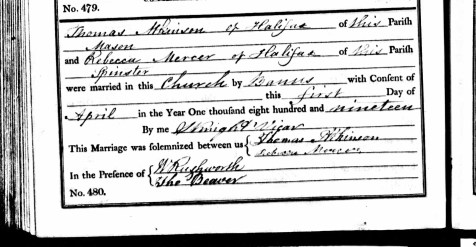
The first – and most profound – shock for Lucy following Thomas’ death came when she was informed that her husband already had a wife who was alive and well in Chelsea, London and seeking his estate. So shocked was Lucy that at first she could not believe it was true. In fact, Thomas had married Rebecca Mercer, from Halifax, in April 1819 whilst he worked at the quarries in the town. They had three children – Martha, John and Emma – and lived together until the late 1830s.
Thomas’ marriage to Rebecca Mercer in 1819
Details of the circumstances leading to their separation are unknown, but it is possible that she and Thomas parted following Thomas’s bankruptcy in the late 1830s. According to an entry in the 1901 Dictionary of National Biography: “He remained at Manchester until 1840, after experiencing some reverses, owing probably to a too liberal expenditure on works of art.”
Evidence for their separation is limited, but the 1841 Census shows Thomas living in Chorlton cum Hardy, Manchester with his daughter Emma, but provides no clear evidence of his wife Rebecca or their son John. Their other daughter, Martha, had married the previous year and was living locally with her new husband James Wheeler. There is a ‘Mrs Atkinson’ living nearby in Chorlton on Medlock. Her occupation is given as washerwoman, but although she is the right age, we cannot be sure it is Thomas’ wife. If it is, she had clearly fallen on hard times. For some of his bankruptcy hearings and as correspondence addresses for his watercolour exhibition entries to the Royal Academy and elsewhere in the period 1839-40, Thomas gives locations in London.
At some point in the 1840s Rebecca moved to Chelsea, possibly after Thomas had set out for India in the early 1840s. She is recorded there in the 1851 Census, living as an annuitant, along with several other women, in a boarding house in Beaufort Street run by a Mrs Palmer and her two spinster daughters. In fact, she stayed there until she died in 1872. She may have been following her daughter, Martha, who had married solicitor James Wheeler in July 1840 and moved to London from Chorlton sometime before 1847, when her third child had been born in Pimlico, London. Wheeler’s business – he became a leading lawyer specialising in railway company law – took off and he was soon a very rich man.
On his return from his Indian trip, in 1842 or 1843, Thomas moved to Hamburg to work as a jobbing architect, taking with him their son, John, who was probably suffering from TB. They stayed in Hamburg until John died on 3rd April 1846 at the young age of 22. His death was noted by the Manchester press, which stated he had died after a four-year illness and that he has shown promise as an artist: “His talents were various: as a marine painter they would have been great, as shewn by his sketches, one of which, the Phantom Ships, is of a very high order.” Sadly, the sketches are lost.
Soon after, having decided to give up his work as an architect and become an artist, Thomas left Hamburg for good, first for Berlin and then for Russia, where he stayed for the following 12 years. It seems reasonable to assume that his marriage to Rebecca had effectively ended some years before. Rebecca’s annuity may be evidence that he set up a fund for her, although evidence is scant. In his diary for 1847 there is a note that states “Ordered Mr Wheeler to pay £24 into Coutts Bank for Mr Drury”. The diary also lists the business address for James Wheeler. Of course, such payments could have been a leftover from his bankruptcy, but there is just a chance that they were connected to Rebecca’s annuity. Either way it shows that he was in touch with Wheeler, even when he was in Russia.
We don’t know if there was any direct contact between Rebecca and Thomas in the intervening years. They never divorced and so when in 1848 Thomas married Lucy, in strictly legal terms it was a bigamous marriage. However, he had been living abroad by this point for at least six or seven years and bearing in mind the extraordinary difficulties of obtaining a divorce in Victorian England, it does not, in my consideration at least, appear to be such a serious crime. That, of course, is not the way it would have seemed at the time, when bigamy was punishable by up to five years in prison.
Thomas’ failure to tell Lucy about the marriage was more serious. It certainly affected the way he wrote his books, as he could hardly mention the fact that he was accompanied by a new wife – and child – for most of his travels. Only when Lucy published her own account of their travels, in 1863, do we hear anything about her part in their remarkable six-year journey. Nor could Thomas travel with Lucy without marrying her, even in Russia. In the circumstances, he chose to marry Lucy and tell her nothing, a secret he kept until he died. Hence Lucy’s disbelief when confronted by Rebecca’s claims for Thomas’ estate after he died.
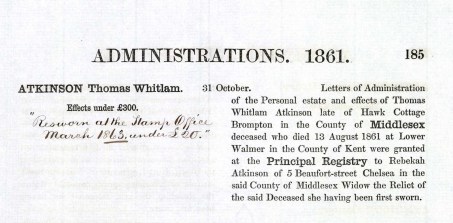
Although there was not much in Thomas’ estate – it was listed at “under £300” in October 1861 shortly after his death and then resworn as “under £20” in March 1863 – Rebecca successfully claimed it all, relying on the legal skills of her solicitor son-in-law James Wheeler, one of the most prominent lawyers in London and himself a very wealthy man by this time.
Listing of Thomas’ will
Wheeler was very diligent in seeking to obtain anything he thought was Thomas’ and appears to have launched a relentless campaign against Lucy, suggesting that she and Thomas had never married. In doing so, of course, he was also defending the reputation of his mother-in-law, who would have been scandalised by the fact that her husband was a bigamist.
We know about James Wheeler’s actions because in May 1862 Lucy replied to a letter written by Lord Ashburton – now lost – to explain what had been happening. Ashburton was president of the Royal Geographical Society from 1860-64 and had known Thomas and bought some of his paintings. She wrote:
“I am well aware and have also made acquainted those who had interested themselves in me, that the son-in-law of my husband had made statements to the effect that there is another wife, besides myself living, and further, he has taken out letters of administration – all my solicitor demands is proof that there is such a person existing, in the absence of which I am his legal wife and act as such. We are doing our utmost to bring this unfortunate affair to an issue. My friends, the gentlemen to whom we are indebted, are now going to sue Mr Wheeler. They are doing this not so much for their own benefit as to obtain justice for me.”
So even nine months after Thomas’ death Lucy still found it hard to believe that Thomas had a previous wife who was still alive. Her ‘friends’, by whom she meant the great geographer Sir Roderick Murchison, the publisher John Murray, Lord Ripon, the scientist Francis Galton and the scientist and publisher William Spottiswoode, were even considering suing Wheeler for libel.
As Lucy explained: “Mr Wheeler has written to all the principal persons at the Geographical and though not in direct terms still has worded his communications in many instances so as to lead them to conclude I had been living in an improper way with Mr Atkinson. Having done so, it is just possible he may have written to your Lordship. The way Mr Wheeler has attacked my character is the more despicable and cowardly as I told him whence he (my husband) had married me. The manly way would have been to attack the culprit if such there was, and not the poor victim.”
The reason that Lucy had written to Lord Ashburton was in reply to a query she had received from him in connection with the paintings he had bought from Thomas and which were hanging in his residence at Bath House, Piccadilly. Having no doubt heard from James Wheeler, he was unsure if he had title, as he had bought them from Lucy. She reassured him that the paintings had been given to her by Thomas “some years hence” and that therefore she had been entitled to sell them. It was not the only challenge concerning the ownership of Thomas’ paintings; a few weeks after Lucy wrote to Lord Ashburton a posthumous sale of Thomas’ paintings at Christie’s, due to be held on 16th June 1862, was cancelled on the morning of the sale, presumably because there was a dispute over ownership.
Lucy explained to Lord Ashburton that she had not benefited in any way from Thomas’ estate:
“All my husband’s property I have delivered over to the principal creditors, but as I fear those will not arise sufficient funds to liquidate the debts, I am endeavouring with my feeble efforts to make the wherewithal to do so, and if I am successful it will be the proudest day of my existence.”
Still sceptical about whether or not Rebecca was alive, Lucy was clearly loyal to her deceased husband’s memory, as this extract from the letter makes clear:
“Should this man (Wheeler-ed) be able to prove (which I doubt) that the first wife is living, still I look upon myself as the one entitled to pay my husband’s debts and clear his memory. In the sight of God I am his wife and I have to the best of my ability acted the part of one to him. I never deserted him for an instant either in sickness or in poverty, and I have followed him through danger which many a man would have shuddered to encounter, and he has ever been to me a good husband, during a period of 14 years that I have been married to him.”
Considering the circumstances, it is a remarkable letter. Hounded by creditors and a powerful solicitor acting for a former wife, she is strong and determined and still faithful to Thomas.
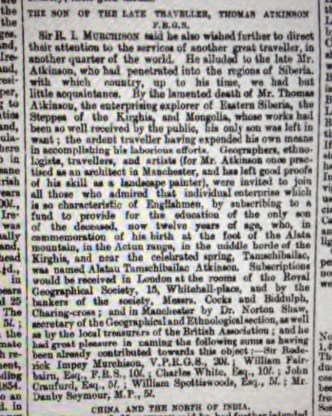
But the fact remains that Lucy was by this point almost destitute. The £500 she had inherited from her uncle, Joseph Sherrard, in 1837 (see previous blog below), appears to have gone by this point, and she had no other source of income. An appeal to members of the Royal Geographical Society, launched by Sir Roderick Murchison in September 1861, had raised several hundred pounds to pay for Thomas and Lucy’s son, Alatau Tamchiboulac Atkinson, to be educated at Rugby School, although he did not actually attend the school until August 1864.
Newspaper report of the public appeal to raise funds to educate Alatau Atkinson
Lucy had also started work on her book, Recollections of Tartar Steppes. Although not published until 1863, a letter she wrote to her publisher John Murray and dated 23rd January 1862 survives in the Scottish National Archives. We don’t know when a contract was agreed, but the letter makes clear that she had already sent him some draft chapters, written in the form of letters to a friend. She had waited anxiously for a reply: “To speak frankly, your letter lay some short time on my table ere I dared to open it, to know my fate. In the style I have sent you I can write more letters, equally, if not more interesting. I so feared you would say they were trash.”
Murray had asked her specifically to write more about the Siberian exiles, those men who had been banished to Siberia following the unsuccessful Decembrist Uprising against Tsar Nicholas I in 1825: “As regards the Exiles I presume you would like me just to tell how I found them. You must know I was received by them all as a sister, I having lived in the Mouravioff family during eight years. When I entered the houses of Mouravioff and Iakooshkin (Mattvei Muravyev and Ivan Yakushkin, two of the exiles-ed) and mentioned my maiden name, I was immediately recognised. I was always considered part of the family. Others of the exiles with whom I had no acquaintance received me with open arms so soon as I said where I had been living. The name acted as a talisman.”
The Decembrist Mattvei Muravyev-Apostol, after he had been pardoned from Siberian exile.
But a small book advance, whenever it arrived, was not going to be enough to keep her and Alatau. Lucy therefore decided to seek funding from various other institutions. In March 1862 she approached the Royal Literary Fund for help. Founded in 1790 and supported entirely by donations, over the years the Fund has helped thousands of writers and their dependants who have fallen on hard times, including such prominent names as Samuel Taylor Coleridge, Thomas Love Peacock, James Hogg, Leigh Hunt, Thomas Hood, Richard Jefferies, Joseph Conrad, D. H. Lawrence, James Joyce, Ivy Compton-Burnett, Mervyn Peake and Dylan Thomas.
Lucy’s application letter, preserved in the archives of the Fund at the British Library, is both fascinating and very moving. Fascinating because it settles once and for all the birth date for Thomas – in her own hand she writes 6th March 1799 – and moving because it also reveals the extent of Thomas’ illness in the last year or so of his life. “My Lords and Gentlemen”, she began:
“I should not have applied for relief from this fund but for the death of my husband, the late Thomas Witlam Atkinson, owing to which circumstances I am left with an only son, totally unprovided for, he having expended the whole of his own means during his researches in Siberia, Mongolia and Chinese Tartary, whither, after our marriage in Moscow in 1848, I accompanied him over a period of six years. It was during our wanderings in Chinese Tartary that our only son was born under peculiarly difficult and trying circumstances.
This journey was performed without the aid of any society whatever and entirely at his own cost.
For fourteen months before his death my husband was quite incapable of undertaking any kind of occupation owing to illness brought on from over-working himself and taxing his strength beyond its endurance.
I am now reduced to the necessity of disposing of any wardrobe and a few little valuables I possessed for our maintenance. And moreover I may add even before my husband’s death we have commenced doing so – always hoping he might recover and be able to resume his labours.”
Lucy’s application to the Royal Literary Fund
Her application included supporting letters from Murchison, Murray, Lord Ripon, Spottiswoode and Francis Galton. Galton’s letter revealed that Thomas was planning further journeys until his illness stopped him in his tracks: “She was her husband’s devoted companion and helpmate in all his Asiatic wanderings (which I need not dwell upon here, as they are well known to the public). She was, as I can testify from direct personal knowledge, the supporter and encourager of his artistic and literary labour and she is now by his premature death – I say premature for he was planning new journeys as an artist-traveller when his illness commenced – reduced to the greatest financial embarrassment.”
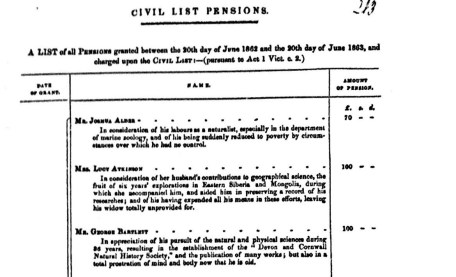
The result was an award of £80, no mean sum in 1862, which was enough at least to tide her over. The following year she also made an application to the Civil List for a pension. These pensions were given to people who had made a contribution to science and literature. Lucy was awarded £100 a year and her citation says: “In consideration of her husband’s contributions to geographical science, the fruit of six years’ exploration in Eastern Siberia and Mongolia, during which she accompanied him, and aided him in preserving a record of his researches; and of his having expended all his means in these efforts, leaving his widow totally unprovided for.”
Lucy’s award from the Civil List, 1863
What is interesting about this citation, which must have given Lucy great pleasure, was the fact that it named her as Mrs Lucy Atkinson and made clear that she was Thomas’ widow, despite the fact that Rebecca Atkinson was still alive at this time. (In 1870 Lucy, listed as Mrs Lucy Finley, was to receive another pension from the Civil List, this time for £50 “in consideration for her services to literature”.)
So by 1863 Lucy had at least kept the wolf from the door. She had enough to pay her rent at 9 Lilly Terrace – now part of Goldhawk Road – in Hammersmith, which allowed her to finish her book. And whatever the legal situation, in some quarters at least she had been officially acknowledged as the widow of her husband, despite the fact that his first wife – and two of his children from that marriage – were still alive. Her son Alatau was soon to be sent to Rugby School, where he would stay for two years. And then what? That will be the subject of further postings.
I have now completed a detailed report (Return to the Great Steppe) about the recent trip of the Atkinson descendants to Kazakhstan. If you would like a copy in pdf format, just click on the link.
You may be interested to look at some of the press coverage arising from the visit. Articles include this piece from a Kazakh news organisation; this report in Kazakh from Kazakhstan’s Ministry of Education; this report in English from kazinform; this report from the website of Kazakhstan’s National Academic Library; this report in the Western Gazette about Pippa Smith’s experience in Kazakhstan; and here on the BBC’s Uzbek service. And this is from the Astana Times.
The ten Atkinson relatives, myself and photographer David O’Neill flew back to London from Almaty on Tuesday after a hugely successful visit to Kazakhstan. None of us could have imagined the reception that we would receive, both in the capital, Astana, and in Almaty region in the south.
It will take a while for the full impact of the trip to sink in, but for now I think we can say that the significance of the journeys undertaken by Thomas and Lucy Atkinson in the territory of what is now Kazakhstan has been recognised in that country. The most eloquent expression of that came in the speech from Professor Myrzatay Zholdasbekov, at the National Academic Library, who said that South to the Great Steppe should be translated into Kazakh and Russian, so that it can be more widely known.
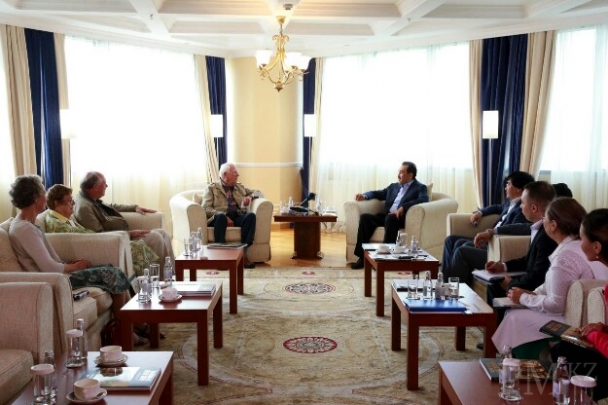
The prime minister, Mr Karim Massimov, personally met representatives from the family, as did Almaty governor Mr Amadyk Batalov.
Pippa Smith, Belinda Brown, Paul Dahlquist and Nick Fielding meet with Kazakhstan’s prime minister, Mr Karim Massimov
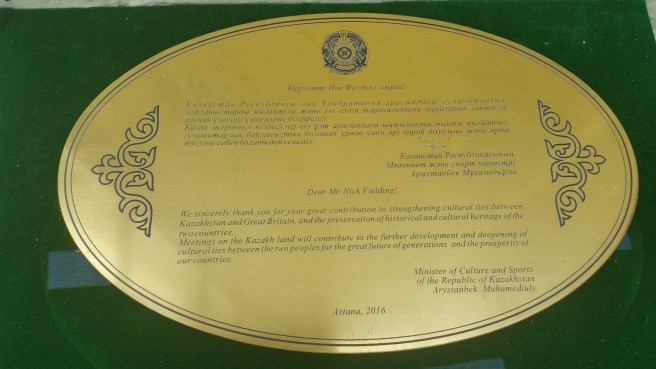
Wherever we travelled, people came up to us, having seen coverage of our journey in the newspapers and on television. The government expressed its support for our programme by presenting wonderful plaques to myself and Paul Dahlquist, on behalf of all the descendants.
Plaque presented to Nick Fielding by Culture & Sports Minister Arystanbek Muhamediuly
Thomas and Lucy, through their writings, have left us with a unique picture of life on the steppes 168 years ago. They met many of the leading khans, sultans and bis (judges) during their travels – not to mention humble shepherds and their womenfolk – and as well as writing about them, Thomas also produced numerous landscape paintings and portraits. There are few, if any, other representations of these places and characters from Kazakhstan’s distant past.
The warmth felt by the Kazakhs towards the Atkinsons was most clearly felt in the little town of Kapal in the Djungar Alatau region, where in November 1848 Lucy gave birth to her son, Alatau Tamchiboulac Atkinson. Kazakhs are deeply touched that they chose this name for him and that even when he had settled far away in Hawaii many years later, he refused to shorten or change it, but stuck to the original. The pageant – known in Kazakh as a shildekhana and held in honour of a newborn child – presented by the residents of Kapal will long live in the memory of all who were there. It was followed by a magnificent feast accompanied by local musicians and singers.
The shildekhana performed in Kapal for the Atkinson relatives (image: David O’Neill)
We were also able to visit the foothills and stunning river valleys of the Djungar Alatau region, following closely in the footsteps of Thomas and Lucy. This, more than anything else, brought home to everyone the full extent of the couple’s achievements. We could see for ourselves the distances they travelled, the imposing heights of the mountains they crossed and the open emptiness of the steppes themselves.
Of course, this trip will not be the end of the matter. There will be further events and more connections to make. We want to find the descendants of the people the Atkinsons met on the steppe and to introduce them to each other once again. This is only the beginning….
We arrived at Lake Alakol late on Saturday evening. The following morning, as the bad weather set in, with constant rain and cloud, we headed for the beach.
On the beach at Lake Alakol (all images: David O’Neill)
Alakol was an important place for Thomas and Lucy. They arrived there after spending around three months exploring the valleys of the seven rivers of the Semirechye region in the summer of 1849. It was the last point at which they would have been able to see the Djungar Alatau mountains before they made their way north towards Barnaul in the Altai region. The German nineteenth century geologist and explorer Alexander von Humboldt had always believed that an island in the middle of the 1,020 square-mile lake, Ul’kun-Aral-Tyube, suggested the lake’s origins had been volcanic. Thomas was able to show that this was not the case.
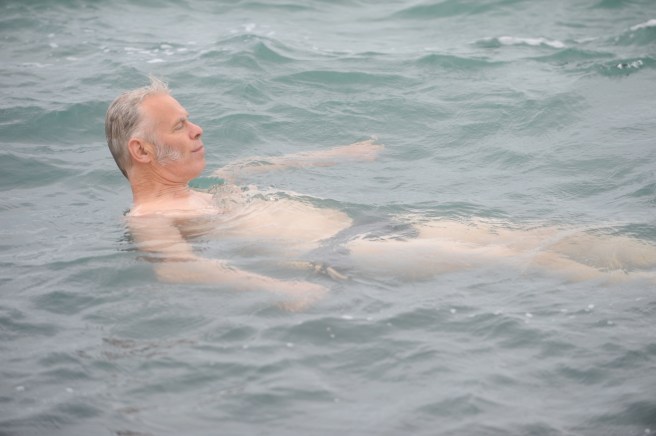
Pippa Smith on the beach at Lake AlakolSteve Brown takes to the water at Lake Alakol
With little prospect of the weather lifting, the decision was taken to return south to Taldykorgan that evening. The Atkinson descendants had now seen most of the range visited by Thomas and Lucy, and although they had not been able to get high into the mountains, they had at least got a flavour of the terrain and the beauty of this remarkable area.
After the exhilaration of yesterday’s events in Kapal, the 10-strong group of descendants of Thomas and Lucy Atkinson moved on to Sarcand, just outside the Djungar Alatau National Park. The route took them over unmade roads across the Hasford Pass from Arasan to Zhansugarov – a spectacular journey from which they could see the vast extent of the Djungar Alatau chain of mountains. It was exactly the route taken by Thomas and Lucy, along with their six-month-old baby Alatau in the late spring of 1849.
Looking back from the Hasford Pass towards Arasan and the Djungar Alatau
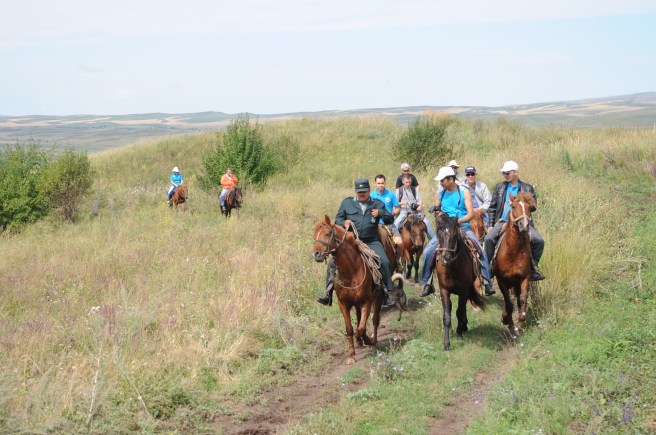
In Sarcand, officials from the national park led the party into the foothills of the mountains, and after crossing the Great and Little Bascan Rivers, they divided into a horseriding group and another group of non-riders who travelled over the rough tracks in vehicles. Their starting point was a section of the Terekte River – known in Thomas and Lucy’s day as the Terric Sou. A picture of this river, painted by Thomas, now hangs in the dining room at the Royal Geographical Society in London.
Thomas Atkinson’s painting of the source of the Terric Sou (courtesy of RGS)
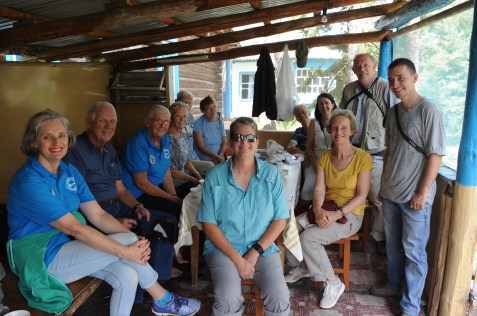
For those on horseback, a two-hour ride brought them to a cabin high in the apple forests that cover this part of the Djungar Alatau, including the famous wild Sivers apple (Malus siversii), from which all apples are believed to have descended.
On horseback in the Djungar Alatau (images below by David O’Neill)
In a cabin amongst the apple forests of the Djungar Alatau
Having returned to their starting point, the Atkinson descendants were taken first to an exhibition of local natural products from the park and then on to a celebratory meal. They then left Sarcand for the four-hour drive to Lake Alakool to the north.
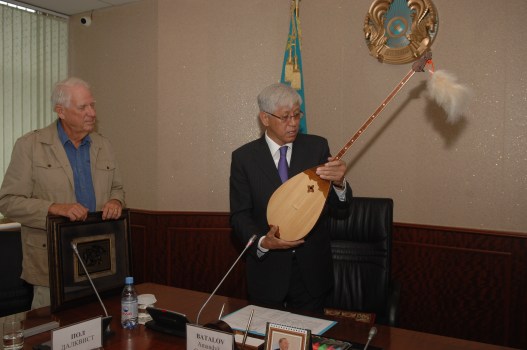
This very special day started with a meeting in Taldykorgan with the governor of Almaty region, Mr Amandyk Batalov, who presented the delegation with gifts including a dombra, Kazakhstan’s national musical instrument. Mr Batalov was remarkably well informed about Thomas and Lucy Atkinson and emphasised their importance to the history of Kazakhstan. He told the family members that Kazakhstan’s president, Nursultan Nazarbayev, had taken a personal interest in the story and asked rhetorically if it could be the case that the Atkinson family members were in fact Kazakh citizens, as their ancestor had been born in the country.
Almaty governor Amandyk Batalov presents the Atkinsons with a dombra (all images David O’Neill)
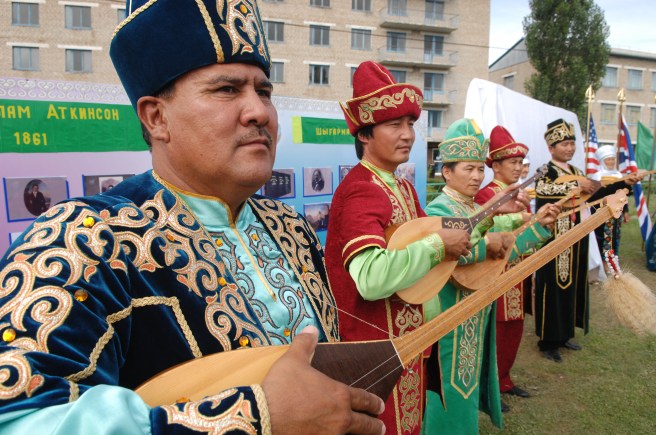
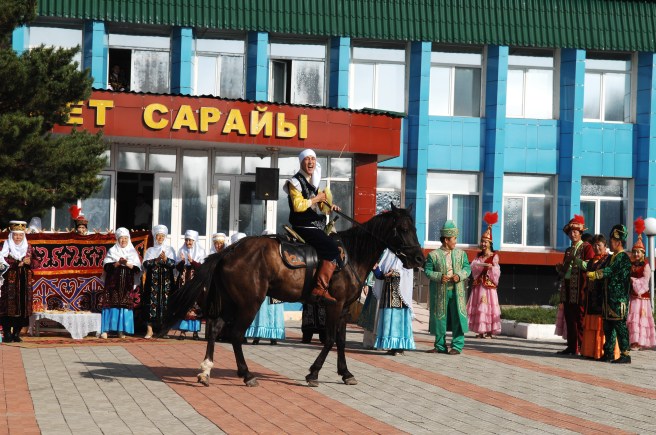
After another press conference, the delegation left for Kapal, the town where Alatau Tamchiboulac Atkinson was born on 4 November 1848. This was the culmination of this very special visit to Kazakhstan and it did not disappoint. The family members were greeted by musicians and singers dressed in national costume, before a magnificent 2-metre granite memorial was unveiled to much applause from the large crowd. After a visit to the Tamchiboulac Spring itself, a pageant recreating the events leading up to Alatau’s birth was enacted by a large number of actors, musicians and dancers. The pictures speak for themselves.
An orchestra of dombra players in KapalThe Kazakh hosts for the memorial unveilingSteve Brown dressed as Thomas Atkinson and Pippa Smith as Lucy Atkinson, together with the baby AlatauPaul Dahlquist unveils the memorial to the birth of Alatau Tamchiboulac Atkinson
The memorial states: “Alatau Tamchiboulac Atkinson, the son of Thomas and Lucy Atkinson, who were the first British explorers to come to Kazakhstan in the 19th century, was born here on 4th November 1848.”
The people of Kapal celebrate the new memorial stoneThe Atkinson descendants at the Tamchiboulac SpringThe residents of Kapal presented an extravaganza portraying the events leading to Alatau’s birth in their town, including this superb display of horsemanship
A great khan holds the baby Alatau and begs Thomas and Lucy to let him stay on the steppesA real baby played the part of Alatau
After the pageant, we were all invited to a special meal to celebrate the ‘birth’ of Alatau. It was exactly the kind of meal that Kazakh’s prepare for such a festive occasion.
The meal included sheep’s head and horse meat, along with quails, koumiss, laghman, caviar and dozens of specially prepared dishes. It was accompanied by songs and tunes from local musicians. This extraordinary day will long live in the memory of everyone who was there.
At the end of the day, as the Atkinson descendants prepared to make their way across the steppe to the town of Sarcand, there was a moment or two for them to reflect on a truly amazing experience.