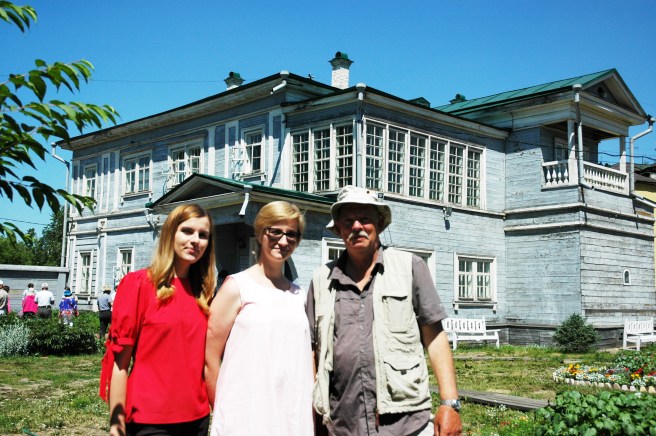
During our trip to Eastern Siberia we took the opportunity to visit the Decembrist Museum in Irkutsk, not least because Thomas Atkinson had planned to write a final book on the Decembrists, but died before it could be published. (For more background, see my blog post on the Atkinsons and the Decembrists of 2 March 2017). Located in the former home of Prince Sergei Volkonsky and his wife Maria, the museum has a wonderful collection of memorabilia associated with the Decembrists, many of whom were exiled to this region.
We were received with great hospitality by staff at the museum, including Anna Turevich, who has already published a short article on Thomas and Lucy Atkinson’s connections with the Decembrists. More work is planned and it is hoped at some point that research into the private correspondence of some of the Decembrists may reveal more about their meetings with the English travellers.
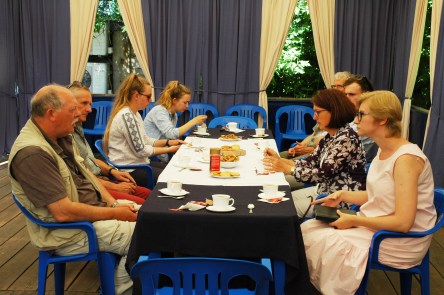
Nick Fielding with Anna Turevich (c) and a colleague in the gardens of the Decembrist MuseumTea and cakes with the staff from the museum
Just back from a quite extraordinary trip to the Jombolok Volcano Field in the Eastern Sayan mountains in the far West of Buryatia in Eastern Siberia to celebrate the visit there by Thomas Atkinson in 1851. The map below – in Russian – will give you some idea of the remoteness of this beautiful place.
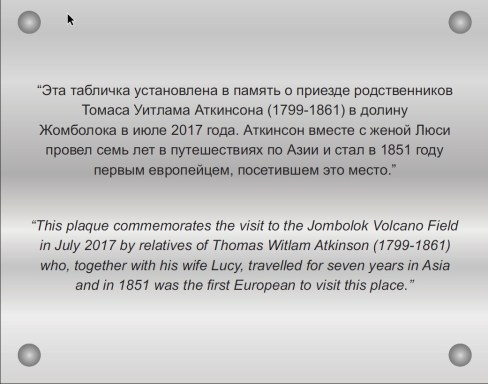
Our journey started in Irkutsk, close to Lake Baikal in the east of Siberia, and was followed by a 550-km road journey south and then north-west to the small village of Orlik in the Republic of Buryatia. This was followed by a 63-km journey through forests and bogs along the Oka River, before we arrived at the thermal springs at Hoi To Gol, at the foot of the Eastern Sayan Mountains, close to the border with Tuva. From here we crossed a pass at 2,400m, before descending on horses into the Valley, where one of the volcanoes is named after Thomas Atkinson. It was here that we fixed a plaque to commemorate the visit by the four descendants of Thomas Atkinson who came along on the trip – Steve and Gill Brown, their son David and daughter Catherine.
You can get an idea of our journey from this wonderful short film, shot by Anatoly Melnikov:
This is the plaque (in Russian and English) that we fixed at the foot of the Atkinson Volcano:
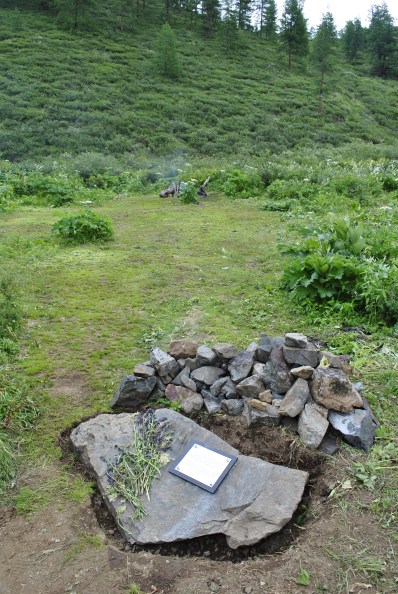
And here’s a picture of it fixed to a rock at the foot of the Atkinson Volcano. It’s fixing point has been turned into a cairn and we hope that people who visit will continue to add stones to it over the years.
This was a truly spectacular trip to an incredible place. Jombolok, which last erupted around 1200 years ago, is a giant volcanic crater, with a large number of volcanic cones strewn throughout the massive lava field. A huge lava trail extends down the Jombolok Valley and it was this that first caught Thomas Atkinson’s attention and convinced him to follow it to find its source.
As well as the volcano field, myself, photographer David O’Neill and Maddy Brown (no rel.) also travelled for 11 hours on horseback to visit the very remote and beautiful Kara Noor lake, which was painted by Thomas Atkinson. We found his old camp and our Buryat guide Rinchin told us we were certainly the first English people to visit this spot since Atkinson was there in 1851! A really incredible place which we will never forget.
Arriving at Thomas Atkinson’s camp on Kara Noor lake
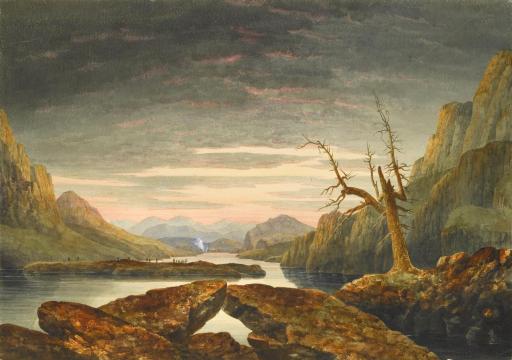
Here’s his painting of the lake. You can see smoke rising from the campsite on the left side of the lake in the distance.
Just back from a quick trip to Kazakhstan, where I was able to visit the World Ethnosport Confederation’s festival outside Almaty. Formed in 2015, the Confederation is made up of countries with a steppe tradition. On display in Almaty were riders from Mongolia, Kyrgyzstan, Kazakhstan, Hungary, Bulgaria, as well as singers and musical performers from Uzbekistan, Turkey, Buryatia and various other countries.
Traditional wrestling, archery and eagle-hunting displays were also featured in the festival, which took place in the countryside outside Almaty. The horse-riding skills on show were truly spectacular and much appreciated by the large crowds.
Traditional eagle-hunters and their dogs at the festivalArchers using traditional recurved bows take their aimWrestling action at the festivalTwo horses at the same time? No problem!Uzbek singers and musicians
In two weeks’ time, on 3 July, together with six others, I will be setting off for Eastern Siberia to visit yet more places associated with the Atkinsons. This time our goal will be the Jombolok (sometimes spelled Zhombolok) Volcano Field, in the Eastern Sayan Mountains some 500kms to the east of Irkutsk and Lake Baikal. I have written about this place before, and particularly about one of Thomas’ paintings, which illustrates the nearby Kara Noor Lake – see my posting of 23 June last year.
The Jombolok Volcano Field in Eastern Siberia, showing Volcano Atkinson to the right
Thomas and Lucy visited this region in the summer of 1851. As I wrote last June: “Now known as the Jom-Bolok volcanic field, it is actually located in Russia in the Eastern Sayan Mountains. In 2011 it was the subject of a major Russian study which you can read here. That article by Alexei V Ivanov et al notes: “Despite the fact that the Jom-Bolok volcanic field has been known for almost one and a half centuries , it is little studied and no geological information has yet been published in English.”
In an appendix to the article there is a historical note which states: “Initial information about the volcanoes in the East Sayan Mts. was published in a local Siberian newspaper in 1858 by an English architect, Thomas Witlam Atkinson. Later, he devoted a number of pages in his extensive travel book to the same volcanoes (Atkinson 1859). In 1852, Atkinson travelled from the inhabited Oka river area, along Jom-Bolok river (referred by him as Djem-a-look river) up to Haranur lake and the Hee-Gol valley. Apparently, he was among the first visitors to the volcanoes, because the local Bouriat people had great dread of that valley, and never ascended it except by compulsion. His report was used later by the Russian royal Peter Alekseevich Kropotkin, who was famous for both his anarchist philosophy and contributions to glaciology (see Ivanova and Markin 2008). He visited the volcanoes in 1865 and provided a geological description (Kropotkin 1867).””
I will be travelling with my good friend and photographer David O’Neill and with Steve and Gill Brown and their children David and Catherine, who are direct descendants of the Atkinsons. A friend of theirs, Maddy Brown, is the final member of the party.
This is going to be a testing journey. We will drive west from Irkutsk for about 500kms before completing the journey on horseback. It should take us nine days. When we arrive we plan to leave a memorial tablet on the top of Volcano Atkinson, one of four volcanic cones in the valley and named after Thomas in recognition of his role in discovering this important geological site.
Logo of the RSAA: the horns of the Marco Polo sheep
It must be the season for talks, as last night I was the guest speaker at the Royal Society for Asian Affairs in London where I delivered a talk on Pioneers of Central Asian Exploration: The Travels of Thomas and Lucy Atkinson to 20 or so members of the society.
The RSAA was initially formed in 1901 as the Central Asian Society, its founder members including Dr Cotterell Tupp, Captain Francis Younghusband, Colonel Algernon Durand, and General Sir Thomas Gordon – all names associated with the Great Game era of Anglo-Russian rivalry in the region. Its initial prospectus stated:
“At present there is in London no society or institution which is devoted entirely to the consideration of Central Asian questions from their political as well as from their geographical, commercial or scientific aspect, though Societies such as the Royal Geographical and Royal Asiatic Society discuss these subjects incidentally. It is therefore proposed to establish a society to be called the Central Asian Society, with rooms, where those who either have travelled in Central Asia, or are interested in Central Asian questions, could meet one another.”
Later, the organisation became the Royal Central Asian Society and then, in 1975, it adopted its present name. There can be no more appropriate place to have delivered a talk on the Atkinsons who, more than any other British citizens, before or since, explored Central Asia and wrote about its landscape and people.
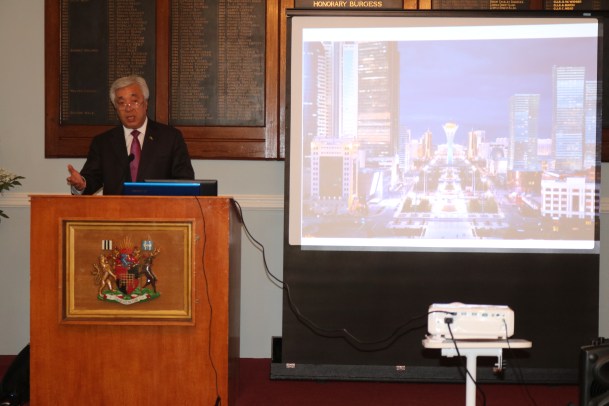
More than 150 people crowded into Romsey Town Hall in Hampshire last night for an event to celebrate the achievements of Thomas and Lucy Atkinson. Guests of honour included the Ambassador of Kazakhstan, HE Erlan Idrissov, the mayor of Romsey, Mr John Parker and Hampshire High Sheriff, the Hon. Mrs Mary Montagu-Scott. The meeting opened up with three songs from the Romsey Voices choir before Thomas and Lucy’s great, great great grandson Steve Brown introduced the ambassador, who spoke warmly about the Atkinsons and the contribution they had made to both Kazakh and British history.
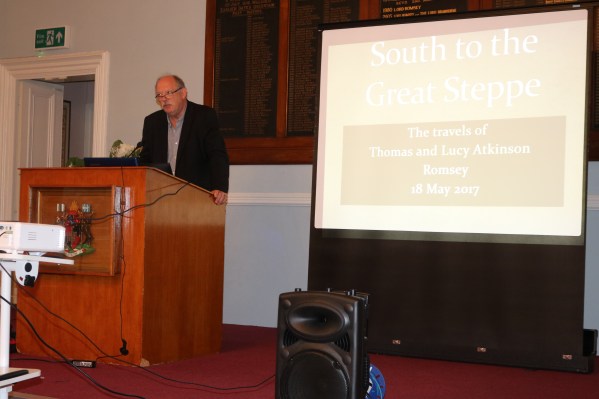
This was followed by a talk by me about the Atkinsons’ travels in Kazakhstan and then a talk from Steve about the history and geography of Kazakhstan. Finally, Steve’s wife, Gill spoke about the trip the Atkinson descendants made to Kazakhstan last summer to visit the birthplace of their ancestor Alatau Tamchiboulac Atkinson at Kapal in November 1848.
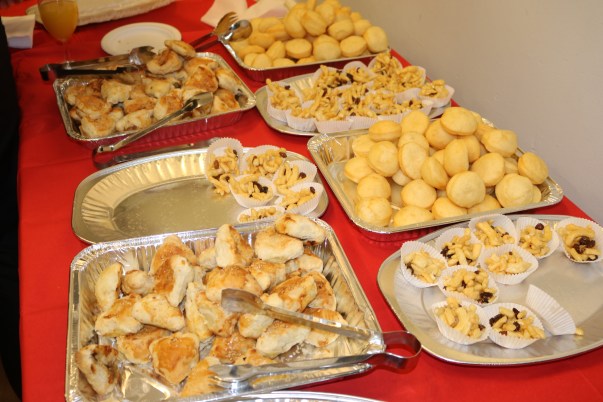
Afterwards guests were treated to a wonderful selection of Kazakh foods and pastries.
I have now given more than 20 talks about the Atkinsons and this was definitely the biggest one so far. Many thanks to everyone who attended and to Steve and Gill for organising it so brilliantly.
Atkinson descendants (l to r) Pippa Smith, Steve Brown, Helen Brown, Cat Brown and Gill Brown, Romsey mayor John Parker, Kazakh ambassador HE Erlan Idrissov, David Brown and yours truly.
Another surprise from the archives! As Sally Hayles was looking into the background of architect Alfred Bower Clayton, who was in partnership with Thomas Atkinson during the mid-1830s, she came across a reference to a ‘Thomas Atkinson’ who was awarded a ‘large silver medal’ by what was then known as the Society for the Encouragement of Arts, Manufactures and Commerce and is today known as the Royal Society of Arts.
A silver Isis Medal similar to the one awarded to Thomas Atkinson
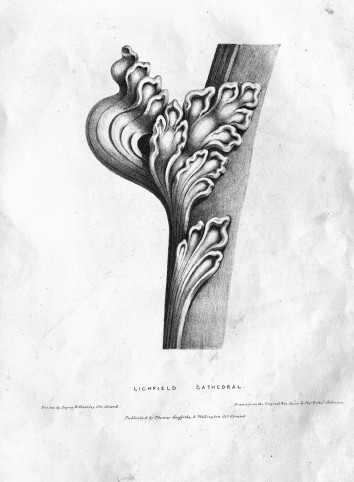
On checking with the RSA it turns out that this was indeed Thomas Witlam Atkinson. He was awarded the society’s prestigious silver Isis Medal in 1827 for “an original composition of architectural ornaments”. The RSA still has his drawing which I reproduce below.
The drawings for which Thomas won a silver medal (courtesy of RSA London)
The award of the medal would have been a great fillip for Thomas, who had only recently set up in practice as an architect in Stamford Street, just across the River Thames from the Society’s headquarters in John Adam Street. The following year he would begin publishing his folio book Gothic Ornaments selected from the Cathedrals and Churches of England, and the medal no doubt increased his prestige.
Interestingly, the design he sent in was very similar to the first plate of his book, which shows a detail from Lichfield Cathedral.
The first page of Gothic Ornament, published in 1828
Did the medal survive? It would have been engraved with a citation and his name. It is not in the possession of the family, so if anyone comes across it, please let me know. And once again, many thanks to Sally for spotting this.
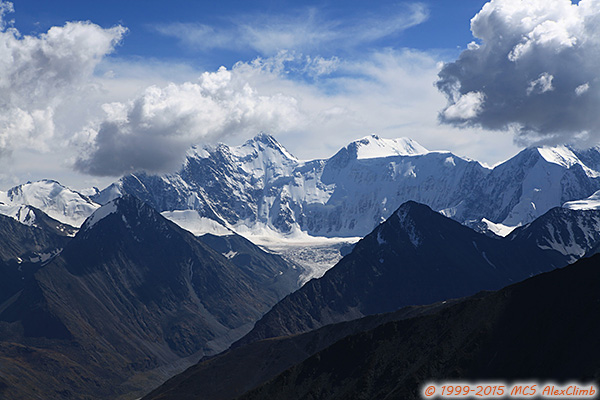
In my previous note (5th May) I mentioned that in 1852 Thomas Atkinson made a serious attempt at climbing Mount Belukha, the highest peak in the Altai chain in southern Siberia, which stands at just over 4,500m and is by no means an easy climb. He and his guide Yepta were forced to turn back due to the poor weather and their lack of suitable equipment.
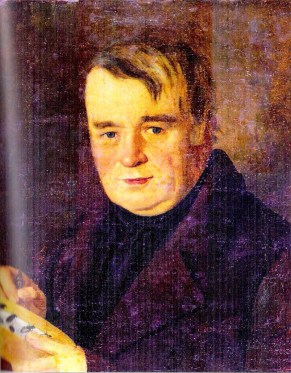
That he took the climb seriously can be established from one of the contemporary documents that survives in the collection of his papers held by his descendant Paul Dahlquist in Hawaii. This is a handwritten translation of a work by Dr Frederic Gebler (1771-1850), a German physician who had moved to Barnaul in the Altai in 1810, where he founded a museum and became a highly-respected correspondent of scientific institutions throughout Europe, particularly for his collection of thousands of insects. He was also inspector of Hospitals in the Altai and travelled extensively in the region, including close the Mount Belukha, where a glacier is now named after him.
Dr Frederic Gebler
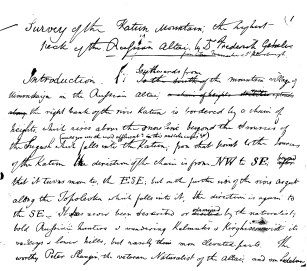
Thomas became a good friend of Dr Gebler following his first visit to the town in 1847. “I spent many happy hours in his company during my first visit to Barnaul,” he says in his book Oriental and Western Siberia and “from him I gathered much information relative to my journey in these regions.” It seems likely that it was Dr Gebler who persuaded Thomas to attempt a climb on the great twin-peaked Belukha, as the handwritten document amongst Thomas’ papers is a translation of Dr Gebler’s 1837 paper on the Katun Mountains and in particular Mount Belukha. It has never been formally translated into English from its original German, but goes by the title Survey of the Katun Mountains; Bielukha, the highest peak of the Russian Altai. Although I cannot be sure, I am almost positive that it was Lucy who did the translation.
An extract from Lucy’s translation of Dr Gebler’s paper on Mt Belukha
Lucy herself comments on Thomas’ two attempts to climb the mountain, in her book Recollections of Tartar Steppes. She first saw the mountain when they travelled through the southern Altai in 1848:
“It was our intention to have gone to the Bielouka; men, horses, and provisions had been prepared at Ouemonia for that purpose, but after a sojourn of a few days in the mountains, on the morning of the 3rd, my husband was obliged reluctantly to turn his horse’s head, but with a determination to return at some future period. I would gladly have accompanied him had he determined to go on, but I was rejoiced when he said we must not proceed farther; we had travelled over versts of morass, our horses sinking up to their saddle-flaps, and at night encamping on the snowy mountains, with a bleak cutting wind penetrating to the very bones.”
Four years later, in 1852, she had not lost her sense of adventure, regretting the fact that she had not accompanied her husband when he returned to the mountain for his second attempt on the summit:
“I have been induced, through the very urgent entreaties of our friends, to allow my husband to go alone this summer to ascend the Bielouka. I consented the more readily, as I had visited the regions round about before; and, besides, Colonel Sokolovsky had intended joining him in this excursion. He was prevented by his departure for Petersburg, which did not take place till the 8th of August, and Mr. Atkinson having remained to see him off, the season was far advanced. Many of our friends thought it too late, as the winter begins in the high regions so early; but he did not seem inclined to defer his journey till another season. He now tells me he regrets much that I did not go, as I have missed some fine scenery; and besides, he says, he missed his companion. He also missed the little arrangements I was able to make for our comfort; I always tried to do this, though scarcely able, at times, to move from fatigue.”
As we know, Thomas’ second attempt on the peak was also unsuccessful, due to his lack of equipment and the bad weather due to the fact he had started out so late in the season. That being said, it is still remarkable that, together with his Kalmuck companion Yepta, he was able to get to the source of the River Katun and the glacier that leads down from the saddle between Belukha’s twin peaks. My guess is that this was about 3-400 metres below the summit. It would be more than 50 years before anyone else got so high and 70 years before the peak was finally conquered.
Thomas’ portrait of Yepta, his climbing companion on Mt Belukha
The rapidity with which Thomas and Lucy Atkinson’s travels were forgotten by the exploring fraternity sometimes astonishes me. By the beginning of the twentieth century, 40 years after Thomas’ death and less than a decade after that of Lucy, no-one (with a few honourable exceptions) seems to have remembered their achievements.
This point was brought home to me recently when reading Siberia: a record of Travel, Climbing and Exploration (1905) by Samuel Turner. Turner was a butter merchant and amateur climber who spent many summers climbing in the Alps, but took advantage of a butter-buying journey to southern Siberia to go climbing in the beautiful and remote Altai Mountains. His intention was to climb Mount Belukha, the highest in the range at 14,784 ft (4,506m).
Samuel Turner, climber and butter merchant
Turner says that he was told in England that there were no mountains in Siberia, but that during a trip to the Royal Geographical Society “I found that all the literature the Society possessed which dealt with the Altai Mountains consisted of a few lines translated from the Russian Geographical Society’s Journal, to the effect that Professor Sapozhnikoff had climbed 13,300 feet of the south side of Belukha and from that elevation had determined the altitude of the mountain to be 14,800 feet, which is the height of the Matterhorn.”
The twin peaks of Mount Belukha
In March 1904 Turner set off on his journey and eventually reached the Belukha massif in mid-April after an arduous journey from Barnaoul involving riverboats, horses and hiking. He soon began his attempt on Belukha itself and congratulated himself on his endeavour:
“The indescribable beauty of the view before me and the consciousness that I was gazing upon a scene that had never yet been desecrated by the camera or described by any human being, was one of a lifetime, and amply repaid me for the difficulties and inconveniences I had experienced on my way. Here all was virgin ground. There were not passes known and labelled; no well-trodden routes to be followed; no Mark Twain had ever made the ascent of these peaks in imagination; no telescope had scaled their heights before my Zeiss binocular; no avalanche had hurled its hapless victims to an untimely death; no Alpine hut vulgarised the slopes or rides or obscured the view of the summit; no Baedeker enumerated the guides or reduced the glories of the ascent to a matter of pounds, shillings and pence.”
Except, of course, he was not the first person to climb in the Altai. Thomas Atkinson beat him to it by more than 50 years. In his book Oriental and Western Siberia, chapter 23 is entitled ‘Ascent of the Bielouka’. Here Thomas describes a visit he made to the Altai in the late spring of 1852, during which he ascended the valley of the River Katounaia – now called the Katun River – and made an attempt to climb the main peak of Belukha. In fact, he had even made an attempt to conquer the peak on his second visit to the region in 1848, when travelling with Lucy.
According to Thomas’ account of the 1852 attempt, he had ascended the mountain together with a Kalmuck hunter called Yepta, making good progress: “Having proceeded about five versts, we reached the bend in the valley, where Bielouka stood before us in all his grandeur. I lost no time in seeking out a good point whence to sketch this monarch of the Altai chain.”
He reached the source of the Katounaia River and the base of the mountain’s twin peaks: “To the west the vast steppes of the Kirghis stretched till lost in hazy distance. To the south were some high peaks and many ridges descending towards the steppes on the east of Nor Zaisan and to the Desert of Gobi. Several lakes were visible in the mountains and on the distant steppes. Innumerable rivers were winding their courses in the deep valleys like a network of silver threads. It was a splendid vista – so many snowy peaks starting up from the purple ridges and green valleys around them.”
However, with no mountaineering equipment at all, no maps or guides and the onset of bad weather, Thomas and Yepta decided to abandon their attempt on the summit, although not before accurately describing the route by which the mountain would eventually be climbed. Fifty years later, Turner failed in his attempt and in fact the peak was not climbed until 1914. You can find a more detailed history of the climbing of Belukha here.
Turner’s book, which is worth reading, is only one example of a book written about Central Asia and Siberia that omits any mention of the journeys carried out by the Atkinsons. In fact, Thomas made at least three journeys to the Altai, on one of which he was accompanied by Lucy. Little by little, we will correct the record.