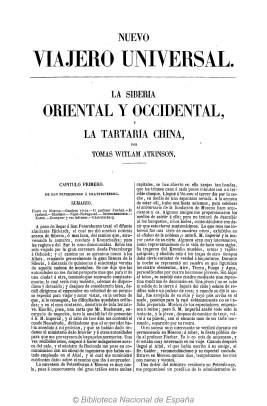
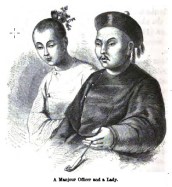
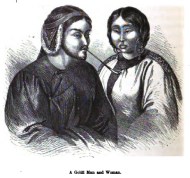
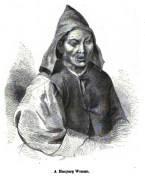
The two pages above come from a Spanish book, Nuevo Viajero Universal, published in Madrid in 1860. The first is the title page to the second volume (of five), which is a compendium of journeys of exploration from the first half of the nineteenth century. The first essay in this volume is a precis of Thomas Witlam Atkinson’s book Oriental and Western Siberia, which had been published two years previously. In total the precis runs to 73 pages, complete with five illustrations.
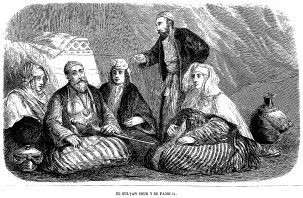
As I mentioned in my recent article about plagiarism, Thomas was more sinned against than a sinner. It is very unlikely that the publishers of this Spanish version of his book paid any royalties to his publisher. The same is true for the German, French and Russian editions that were published soon after Thomas’ own book was issued. As with the others, the publishers used local illustrators to make copies of the illustrations contained in Thomas’ book. As you can see below, they are much inferior to those that appeared in the official version.
The picture on the left is a woodcut from the Spanish book, whilst the picture on the right is a colour lithograph from Thomas’ own book.
However, it is clear from the many pirated versions of Thomas’ book that appeared in the 1860s that there was enormous interest in the journeys conducted by him and Lucy over the course of nearly seven years. His books were the first to bring European readers a sense of the geography and way of life in Siberia and Central Asia.
Steve and Gill Brown, who took part in the trip to Kazakhstan last summer to visit the places associated with their ancestors Thomas and Lucy Atkinson, held a slideshow and talk this week to show their friends in Romsey, near Southampton, what they had been up to. Also in attendance were five Kazakh students from Southampton University, who kindly brought with them traditional Kazakh foods, including the national dish beshparmak and the delicious baursak bread. You can watch a brief video of the event made by one of the Kazakh students here:
While we are on the subject of plagiarism (see the posting below this one), I want to show that Thomas was far more sinned against than a sinner, particularly in relation to his drawings and paintings.
Having spent many hours searching for images of Thomas’ drawings, paintings, etchings and lithographs, I was struck when I began to come across ‘alternate’ versions of some of them. At first I had no idea what was happening. Sometimes they would show his name, sometimes another name altogether. Here, for example, is an etching of Thomas’ picture of an incident at Kopal, entitled ‘A dangerous ride’, where he was almost killed by a runaway sleigh and which appears in Travels in the Regions of the Upper and Lower Amoor:
And here is another version of the same picture, as appeared in a French publication called Le Tour du Monde, published in 1863. In this case the etching has been done by the well-known illustrator and artist Yan d’Argent, using the original as a model. Three articles, totalling almost 50 pages appeared in the publication, which was a precis of Thomas’ book. It is unlikely that any royalties would have been paid.
And here is yet a third version, as appeared in a German book, Reisen in den Steppen und Hochgebirgen Sibiriens, published by Anton Etzel in Leipzig in 1864. It was subsequently translated into Russian, complete with the pictures.
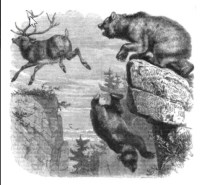
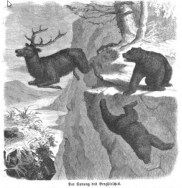
As you can clearly see, Thomas’ hat has levitated in the final etching. Here are a few more examples that show how Thomas’ pictures were pirated – there was no international copyright in the 1860s – by continental and American publishers. This one is called ‘The Maral’s Leap’:
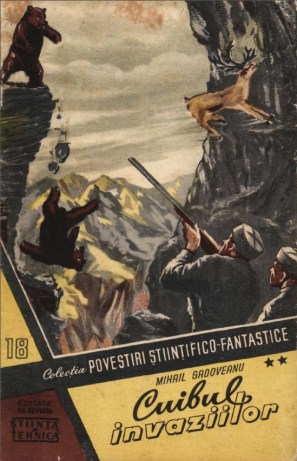
The first is the English version, followed by the French and then the German versions. It is unlikely that any royalties were ever paid for these unlicensed copies of Thomas’ pictures. I have dozens of similar examples. A version of the picture above even appeared on the front cover of a novel published in Romania in 1935:
This book, A Nest of Invasions, by the well-known writer Mihail Sadoveanu (in fact, he was twice elected president of Romania), is regarded as a classic in modern-day Romania. Although it was published under a science-fiction imprint, is based on the travels of Thomas and Lucy Atkinson in Siberia and Central Asia and sought to highlight the beauty of nature and the integrity of traditional tribal life. It was a kind of early ecological novel.
In the 1860s in particular Thomas’ name reached across the world. In France his name was well recognised and his adventures were highly respected. The same was true in America, Germany and Russia. A Spanish version of his book Oriental and Western Siberia was also published at this time, although I have not yet been able to locate a copy (If you find one, please let me know). The more one looks into this the more the charge of plagiarism as levelled against Thomas looks like an excuse not to take him seriously.
It has always been a mystery to me why Thomas and Lucy Atkinson should have been so comprehensively forgotten by history. Most people in Britain have never heard of them and those that have would probably struggle to explain their extraordinary achievements as explorers.
Part of this can be explained by Victorian morality, which would have judged Thomas’ bigamous marriage to Lucy particularly harshly. Part is also due to the fact that, unlike others, Thomas was not a ‘scientific’ explorer ie he did not keep meticulous scientific notebooks, nor record or map his exact routes. There is plenty of evidence to suggest that he did collect geological and archaeological specimens – possibly also plant specimens too – but he certainly lacked the scientific training and map-making skills of some of his contemporaries.
Typical of the criticism levelled against Thomas is this statement from the Dictionary of National Biography, which is often repeated whenever Atkinson’s name is brought up. Referring to his second book, Travels in the Regions of the Upper and Lower Amoor (1860), his entry states:
“The latter work was highly praised by The Athenaeum on its publication, but its authenticity was subsequently questioned. Doubts were raised whether Atkinson had personally travelled on the Amur, and the book was shown (The Athenaeum, 9 Sept 1899) to be at least in part a plagiarism of Richard Maak’s work Journey to the Amur (Puteshestvia na Amur), published in St Petersburg in 1859.”
Let us be clear about this. Despite its title, it is undeniable that Thomas did not travel on the Amur River – although he was able to visit some of its headwaters in the Khinghan Mountains in Mongolia. This was not because he did not want to make the dangerous journey. He tried very hard to get permission, but was repeatedly turned down by the Russian authorities. On 1st October 1850, for example, he wrote from Irkutsk in Eastern Siberia to Lord Bloomfield, the British Ambassador in St Petersburg, asking him to request that Tsar Alexander II should extend the terms of his passport to allow him to travel as far east as the Kamchatka peninsula. “Should I be successful in obtaining His Imperial Majesty’s permission to continue my journey I shall then bring back views of the whole of these mountain regions from Kokan (today’s Kokand-ed) to Kamchatka”, he wrote.
On 19th January 1851, having received no reply, he wrote a second letter to Lord Bloomfield repeating his request that he should intercede with the Tsar for permission to travel: “I am now exceedingly anxious about it, as the season will soon arrive when I must decide what shall be my plans for the summer and take advantage of the winter roads to perform parts of my journey.”
Alas, on the recommendation of the governor of Eastern Siberia, General Nikolai Muravyev-Amursky, his request was turned down. Tensions between Britain and Imperial Russia were increasing and with British forces already in China, it is likely that the Governor thought Atkinson might be spying out the land with a view to a British invasion of the mouth of the Amur and northern Manchuria. In fact, this is precisely what happened – with little success – during the Crimean War, which started in 1854.
Without the permission he sought, it was impossible for Thomas to travel further east. He was not even allowed to visit the famous mines at Nerchinsk to the east of Lake Baikal, but instead decided to strike out into the completely unexplored regions to the north and west of Irkutsk, where he made some wonderful discoveries, including the now-famous Jombolok volcano field.
So why did he name his book Travels in the Regions of the Upper and Lower Amoor? Let’s go back to 1859-60, when he was writing it. Already by this time his health was fading. Lucy says as much in letters she wrote to Thomas’ old friend and mentor, the Reverend Charles Spencer Stanhope. He was, as ever, short of money and desperate to complete and obtain payment for this second book. I believe he originally wanted to publish both his Siberian books as a double-volume set, but that his publishers, not sure if it would be a success, only agreed on the first volume, which appeared in 1858 as Oriental and Western Siberia. After its huge success they were very happy to publish a second book, but wanted to take advantage of the increasing interest in the Amur River and so pushed Thomas to slant it towards concentrating on the Amur.
The problem was that most of his manuscript was not about the Amur at all, but further material on Central Asia, particularly on Thomas and Lucy’s stay in Kapal in present-day eastern Kazakhstan. My guess is that most of this had already been written and was left over from the time the first book was published two years before. There are clues in the cover of the Amur book; if you look, you will see it is elaborately embossed with a scene that took place in Kapal, when Thomas was almost killed by a runaway sleigh. Kapal is several thousand kilometres away from the Amur River.
The elaborately decorated cover of Thomas’ book on the Amur
Inside, we will find that after a few introductory chapters on the deserts of Central Asia, from page 116 to 353 the book is about Eastern Kazakhstan. There follows a chapter about caravan routes in Central Asia (26 pages). Only on page 380 does Atkinson begin to write about the Amur region. The following five chapters, totalling a mere 119 pages, in contrast to the rest of his writing, which is in the first person, are third-person descriptions of the Amur region. These are followed by another 50-odd pages of lists of flora and fauna of the Amur region.
So less than a third of the book is about the Amur. A dozen or so of the illustrations – mostly portraits – in these last few chapters certainly come straight from Travel on the Amur River made by order of the Siberian Department of the Emperor’s Russian Geographical Society in 1855, Richard Maak’s famous work on the Amur, which was published in 1859.
Title page of Richard Maak’s book on the Amur
In fact, these portraits in Thomas’ book, showing different ethnic groups settled along the Amur, are all contained on a single page of Maak’s book, as you can see below. However, I do not think it is reasonable to say this was plagiarism. In the Preface to Thomas’ Amur book, dated July 1860, he makes it clear that he has used material from Russian sources: “I am indebted to several of the Russian officers who were employed in the great expedition into Manjouria for facilities in acquiring information during my travels and I beg them and numerous Asiatic friends, to whom I am under similar obligations, to accept my grateful thanks.” Having himself been refused permission to join the great expedition down to the Amur, it must have been somewhat galling for Thomas to see Maak’s book.
Portraits from Maak’s book of different ethnic groups along the Amur
He goes on: “With regard to the illustrations, it is here necessary to state that to the numerous landscape series, engraved from my own drawings, I have added a few characteristic portraits, copies from a work recently published by the Russian government.” This was clearly a reference to Maak’s book and a look at the illustrations proves this point.
Illustrations from Maak’s book as used by Thomas Atkinson
The fact that Tsar Alexander II sent Thomas an emerald and diamond ring following publication of his Amur book suggests that there was no bad feeling in Russia about Thomas using some of the illustrations and general descriptions contained in Maak’s book.
So at least part of the reason why Thomas and Lucy eventually faded from public consciousness may have been because of ill-founded allegations about plagiarism, combined with Victorian sensibilities about divorce. Jealousy by rivals may well have been another reason. I will come back to this subject in a future posting.
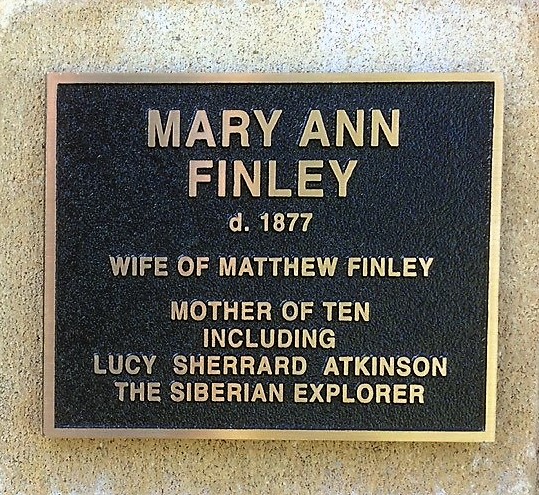
A plaque in memory of Mary Ann Finley, Lucy Atkinson’s mother, has just been installed at the cemetery in Dubbo, New South Wales, Australia, where she was buried in 1877. The plaque was the initiative of Marianne Simpson, who is a descendant of Mary Ann’s third-oldest son, William York Finley (b.1815).
Two years after her husband Matthew’s death in 1847 Mary Ann emigrated to Australia, where her eldest son – also Matthew – was already settled. Together with her children Thomas, George and Mary Ann, she sailed to Australia in December 1849 on the Katherine Stewart Forbes. The ship – a three-masted barque weighing just 457 tonnes – had originally been used to transport convicts to Australia, but when the Finleys sailed they were almost the only passengers, the holds being full of trade goods. They arrived at Port Jackson on 16th May 1850.
Mary Ann’s eldest son, Matthew Smith Finley, was already in Australia working with the Union Bank of Australia. Her son William and daughter Elizabeth married and remained in England. Sons Horatio and Joseph – and maybe also their sister, Maria – travelled separately to Australia. Her eldest daughter Lucy, as we know, travelled to Russia in about 1840 and stayed there until she returned to England with her husband Thomas Atkinson in 1858.
Mary Ann lived out her final years with her daughter Mary Ann Smith’s family on a property near Wellington, NSW. Mary Ann died aged 84 on 1st May 1877, and is buried at Dubbo, NSW.
I hope you enjoy this video of our trip to Kazakhstan this summer. It’s in Russian, but most of the English interviews can be heard in the background and the plot is pretty easy to follow.
I have uncovered another fascinating document in the Manchester Archives about Thomas Atkinson’s activities as an architect in the city.
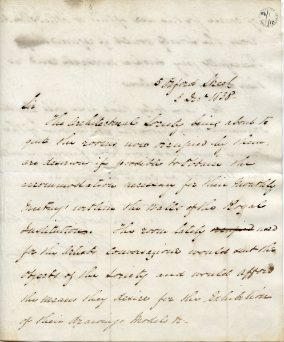
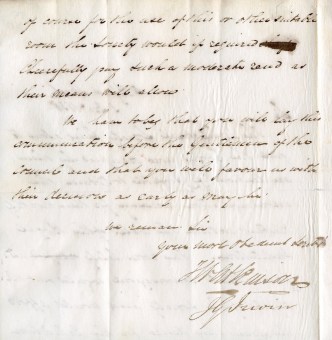
The letter to the Manchester Royal Institution signed by Thomas Atkinson and J G Irwin
(courtesy of Manchester Central Archives)
The document in question is a two-page letter in Thomas’ own handwriting, but signed by him and another prominent Manchester architect called John Gould Irwin. Dated 3rd December 1838 and sent from an address in Oxford Street, Manchester, it is addressed to the secretary of the Royal Manchester Institution and is written on behalf of the Manchester Architectural Society. This latter organisation only had a short life, from about 1837-45, but is noticeable for being the first such professional body of architects in the city. The fact that the letter is signed by Atkinson and Irwin suggests that they were officeholders of the Society.
The letter asks if the Royal Manchester Institution would be willing to let them use a room for their monthly meetings. According to Cornelius P Darcy, in his book The Encouragement of the Fine Arts in Lancashire, 1760-1860 (MUP, 1976): “In order to encourage a greater interest in problems of art and architecture, the Manchester Architectural Society sponsored a series of conversazioni”, evenings at which prominent artist and architects would exhibit their works to municipal leaders to give them an idea of what was currently in fashion.
As Darcy states: “At these conversazioni, painters and architects had an opportunity to discuss with civic leaders problems of art and architecture and to review designs of proposed buildings for the community. In 1838 they examined designs submitted in competition for the Catholic Church, confident that ‘public examination is the most effectual mode of ensuring just decisions in competitions.’ Two years later, when the Society examined some twenty-five designs that were submitted for the new Independent College, ‘The general opinion was, so far at least as the first premium is concerned, the decision had been judicious’.”
The reference to the design for a Catholic Church is interesting because we know that in 1840 Thomas exhibited at the Royal Academy of Arts in London “an interior view of a design for a Catholic church, Manchester”. It was one of several building designs from that period for which Thomas failed to win a commission. I have previously written about two other commissions – for the Athenaeum in Manchester and for a Unitarian Chapel in Upper Brook Street – in which Thomas lost out to the London architect Sir Charles Barry. It is likely that there was a lot of disquiet about the way in which commissions were awarded and this may explain Darcy’s comment about public examination being “the most effectual mode of ensuring just decisions in competitions.” It may have rankled even more with Thomas because in April 1838 he had been declared bankrupt, after one of his building projects was delayed. Even this, however, does not appear to have discouraged him from continuing to play an important role in this pioneering architects’ society.
Thomas Atkinson’s first book, Gothic Ornaments selected from the Different Cathedrals and Churches of England, published in 1828-29, continues to intrigue me. I last wrote about it on 16th July, when I commented on the fact that it was in the forefront of architectural books from the first half of the nineteenth century that sought to popularise the Gothic style. I have now had a bit more time to study the book and to consider Thomas’ relationship with his co-author, Charles Atkinson.
Despite the shared surname, it is unlikely that the two men were related. They must have met soon after Thomas first moved to London in the mid-1820s. Before long they were collaborating on the designs for a number of churches, mostly in the neo-Gothic style. Perhaps it was the detailed stone carving work required for these churches that gave Thomas the idea of publishing a book?
The description of Gothic Ornaments as a ‘book’ is actually something of a misnomer. It wasn’t published as a finished product, but ‘in folio’. This means that individual sheets were issued at regular intervals, either to subscribers or for sale to customers of the publishers. Those buying the sheets would collect the set and then have them bound at their own expense. Thus the Literary Gazette for January 1829 includes an announcement from the publisher, Thomas Griffiths of Wellington Street in the Strand, London:
“The Work will be complete in 25 Parts published at intervals of one month, each containing at least Four Subjects in atlas quarto with an ornamental Wrapper, price 4s. each.” The first plates were in fact published as early as September 1828, each of them containing one or two full-size drawings aimed at “the Architect, Carver and Modeller”.
The Gentleman’s Magazine (Vol 26, p452), reviewed plates Nos. I and II: “These ornaments have been selected from our cathedrals and other churches by the Mssrs. Atkinsons, Architects, by whom they are drawn as large as the original bosses, finials, etc. They are highly useful and from their accuracy in size and detail will be of great assistance to the working mason. The present numbers exhibit two finials and a head from Minster in Kent, a boss from Lincoln, a crocket and foliated capital from Lichfield and an ornament from a cornice at Boston Church.”
Review of Gothic Ornaments in The Gentleman’s Magazine
Later in 1829 the Gentleman’s Magazine carried a further small review: “We have already given our opinions of this useful publication. No 9 and 10 have just been published. They consist of many beautiful specimens of Gothic Ornaments in the Lady Chapel, Ely Cathedral, consisting of crockets, finials, bosses and mouldings, which ornament the arches, pediments, cornices, brackets, etc, of that fine ecclesiastical structure. To the admirers of Gothic Architecture, and to artists especially, these specimens will afford much gratification.”
The Literary Gazette noted that the drawings were “delineated with great distinctness and will no doubt be very useful to the architectural students.”
So it is clear that these drawings were aimed at those who were responsible for decorating the stonework of the neo-Gothic church buildings then being built throughout Britain – much as Thomas himself had done from his earliest days, when he started out as a stone mason working for his father.
However, there are several unresolved questions. The first mystery concerns the joint authorship of the book. If we look closely, we can see that the first nine plates are all signed by ‘Thos. & Chas. Atkinson’. Plates 9-40 are signed by T&C Atkinson. However, plates 41-44 (I have not yet found plates 45-48) are signed by TW Atkinson alone. The first 28 plates were printed by Ingrey & Madeley. The next seven were printed by Jardine & co of Cornhill and from No 35 onwards they are printed by G E Madeley at the same address as the publisher, Thomas Griffiths. We know that Ingrey and Madeley dissolved their partnership on 23 March 1829, so that allows us to say that the first 28 plates were printed before the end of March 1829. We also know that Thomas Atkinson and Charles Atkinson dissolved their partnership on 7th August 1929 “by mutual consent”. This could explain why the last few plates are signed by Atkinson alone.
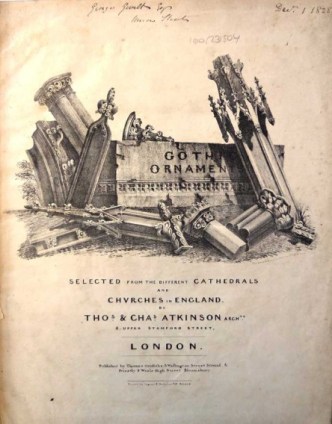
There is one more curious fact that also strengthens the notion that Thomas continued to publish the plates after his partnership with Charles Atkinson was dissolved. In addition to the well-known title page for the plates – the book contains no text – there is a second version of the title page in the British Library that is very different.
The two versions of the title page for Gothic Ornaments. The version on the left appeared before the one on the right.
As you can see, this second version of the title page contains none of the detailed illustrations that appear on the original and only carries Thomas’ name and the statement ‘Published by the Author’. Although I cannot be sure, it seems that this title page was printed following Thomas’s split with Charles in August 1829 and comes from an edition of 48 plates. Although he does not claim to have drawn all the illustrations, my guess is that Thomas was responsible for the bulk of them and that Charles Atkinson possibly helped to fund their publication. When the two men parted company Thomas carried on as best he could, publishing the remaining plates himself.
What happened to Charles Atkinson after his partnership with Thomas came to an end? That will be the subject of a future posting.
(Once again, I am very grateful to Sally Hayles for her diligent research, without which it would have been impossible to write this posting).
A little addendum to my note below about Thomas and his relationship with Vasily Basnin who, by 1850, had become mayor of Irkutsk. Today I checked Lucy’s book, Recollections of Tartar Steppes, for any mention of the Basnin family. Sure enough, several references come up. The first, rather irreverent (but warm) mention is dated March 1852 and although not named, it is clear that she is writing about the Basnin family:
“A most hospitable and amiable family here I have not yet mentioned, and still scarcely a Sunday passes but we dine with them; he is a merchant, and, besides, mayor of the town, we have given him the honourable appellation of ‘lord mayor.’ He is a very clever man, and, being a merchant, has had every opportunity of collecting valuable Chinese ornaments; he has also a splendid library, besides extensive hot-houses. He spends enormous sums of money in collecting plants, and (would you credit it?) he understands nothing about them! The only benefit he derives from his large outlay is to walk through his hot-houses after dinner, and smoke his cigar. Not one of the family has any real love for flowers. His eldest daughter is a clever girl, but with no taste for horticulture; she is, however, an excellent musician, and many a pleasant hour do we spend in hearing her play. The wife is no lover of flowers; indeed I do not know what she is a lover of: she belongs to the old school of Siberian wives, that is, she is literally, an automaton, seldom seen by visitors, and never visiting. I believe the old lady talks to me more than she does to anyone, and her confidence in me is great. This being the first winter her daughter mixes in society, she has begged of me to take charge of her.
Would you like to know how these hot-houses are managed? The mayor has a friend, a counsellor, who undertakes the whole arrangement, and I can assure you he does it well. The one likes to have the shrubs and plants from vanity, and, having a well-stocked purse, is able to gratify it; the other loves them for themselves, and, not having the pecuniary means of gratifying his passion, is able to do so by serving a friend, and thus they are mutually satisfied. But it is quite amusing to see the ‘lord mayor’ asking permission to cut his own flowers, or even to gather a strawberry.”
The second mention is in January 1853 from Barnaul in the Altai region, where Lucy mentions the difficulty of finding appropriate headwear for a ball to which she had been invited: “The last ball I was at I was a little troubled how to arrange for a head-dress: I had never bought one; what on earth should I have done with flowers whilst travelling? In Irkoutsk I managed capitally, as Miss Basnin sent me fresh flowers each time I went out, I was the only one so indulged. Here we cultivated some in our rooms, and I had used the last; what was to be done? I would willingly have gone without, but that could not be. A sudden idea crossed my husband’s mind, so I sent to Miss Annossoff for some ivy leaves, when he made me a beautiful wreath interspersed with red berries made from sealing-wax on the heads of pins, it really looked nice.”
So there you have it. Miss Basnin, probably Vasily’s daughter Lydia, regularly sent fresh flowers to Lucy every time she attended a social occasion in Irkutsk. The mention of flowers confirms it is the same family and at the same time confirms the closeness of the relationship. As she says, “I was the only one so indulged”.
Further confirmation of the close relationship between the Atkinsons and the Basnins can be found in Thomas’ diary for 1851, which contains the following note:
“A list of our effects left in Irkoutsk 23rd May with Mr Basnin, the mayor:
For some time I have been looking for material in the Russian archives that could help to flesh out the biographical details of the Atkinsons. Until today it this had been a very frustrating exercise. Despite the fact that Lucy spent at least 18 years in Russia and Thomas at least a decade, very little has so far turned up that can fill in some of the gaps. However, perhaps my luck is beginning to change.
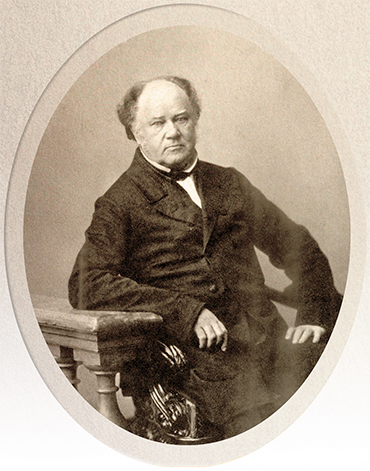
Today I came across a fascinating article by Dr Viktor Kuzevanov, director of the Botanic Garden of the Irkutsk State University. His article Pineapples under the Pine Trees, tells the remarkable story of Vasily Nikolaevich Basnin, scion of a famous merchant family of Irkutsk, who became obsessed with horticulture, so much so that he built a number of wonderful hothouses in Irkutsk in Eastern Siberia in order to grow exotic fruits and plants.
V N Basnin photographed by KA Bergner in 1860 (IZO GIM – Fine Art Dept of State Historical Museum, Moscow)
Working closely with a young finance officer sent out from Moscow called N S Turchaninov, Basnin set about building a Siberian botanical garden that could rival any in the world. Starting in the early 1830s he began planting flowers, shrubs and fruit trees in the gardens and specially built hothouses. Not only did he collect plants from around Lake Baikal and other parts of Eastern Siberia, but he procured seeds from all over the world.
According to Dr Kuzevanov’s article, the gardens eventually covered over half of Basnin’s estate and included a large system of greenhouses comprising three interconnected glass houses and hothouses with a total length of 70 meters and width of 10 meters . The garden itself occupied around 5,000 m2. Local records show that the greenhouses were kept in perfect order: visitors were impressed by the immaculate cleanliness and “artistic” arrangement of plants. The greenhouses themselves contained a special hall for blossoming flowers and in the fruit greenhouse, peaches, pineapples, apricots, pears, apples, cherries, lemons, oranges, grapes, and other fruits were all grown.
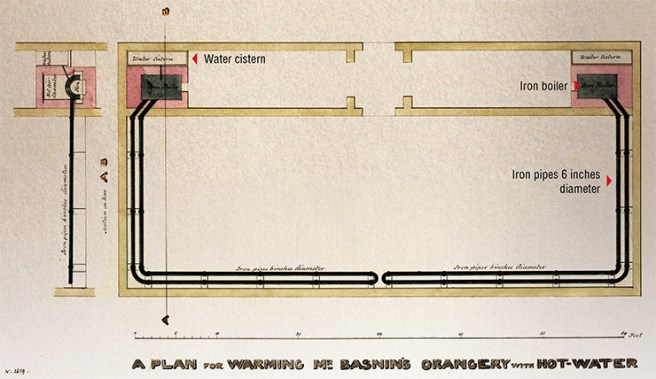
What is fascinating from my standpoint is that Dr Kuzevanoz has found out that Thomas Atkinson designed a heating system for Basnin’s greenhouses. He has even found a drawing of the plan, which I reproduce below.
Thomas Atkinson’s plan for heating Basnin’s hothouses (RGADA, The Russian State Archive of Ancient Arts)
It is not clear if the heating system was ever installed.
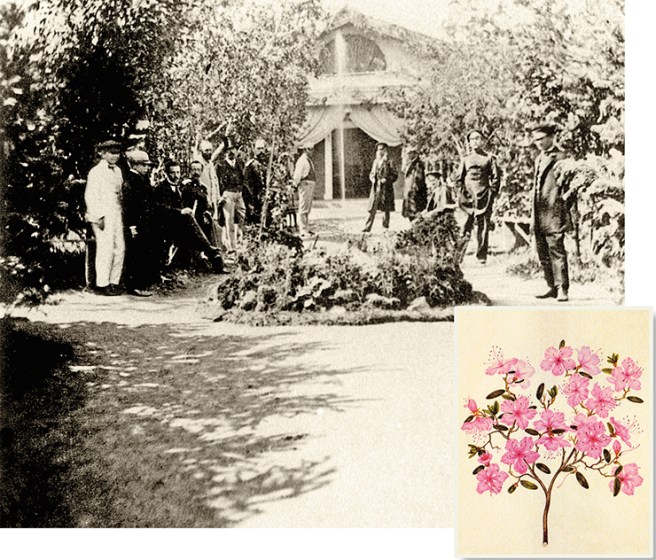
Like Thomas and Lucy, Vasily Basnin was also close to many of the Decembrist exiles, large numbers of whom lived around Irkutsk. He sponsored the brothers A. I. and P. I. Borisov, for example, both of whom collected local plants and drew them for the collection. Sadly the garden only survived until 1879, when a huge fire destroyed most of the old wooden buildings of Irkutsk, although the mansion survived. A new botanical garden was created in the 1930s.
A photo of Basnin’s garden taken in 1869 (from the Zenkovich Archive) together with one of Borisov’s watercolours
This is a wonderful discovery and I hope to be able to add more detail in the coming weeks.